Native Plants

Q. Who is Mr. Smarty Plants?
A: There are those who suspect Wildflower Center volunteers are the culpable and capable culprits. Yet, others think staff members play some, albeit small, role. You can torture us with your plant questions, but we will never reveal the Green Guru's secret identity.
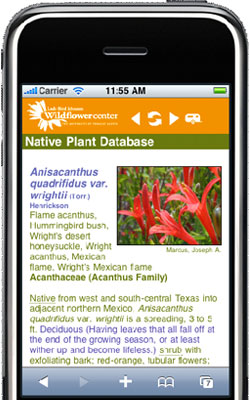
Did you know you can access the Native Plant Information Network with your web-enabled smartphone?

Ask Mr. Smarty Plants
Ask Mr. Smarty Plants is a free service provided by the staff and volunteers at the Lady Bird Johnson Wildflower Center.

rate this answer

Wednesday - September 21, 2011
From: Abilene, TX
Region: Southwest
Topic: Diseases and Disorders, Trees
Title: Live oak trees with rusty spots and holes on tree trunks
Answered by: Nan Hampton
QUESTION:
I have live oak trees that have developed rusty spots, small holes on the tree trunks and sawdust on the trees base. They were planted in Oct 2010. We have had a hot dry summer in Texas this year and I am not sure if this is due to the extreme hot weather. Please advise.ANSWER:
The principal disease associated with Quercus fusiformis (Escarpment live oak) is oak wilt. As you can read on the species page on our Native Plant Database:
"...it is susceptible to live oak wilt and live oak decline when stressed by drought, so care must be taken to protect it from injury both aboveground and below ground to prevent infection."
Certainly, your trees have experienced the stress of extreme drought and high temperatures. I don't know if your trees are infected by oak wilt, but it is certainly possible. You can see on this map from the Texas Oak Wilt webpage that Taylor County has been confirmed as having oak wilt. You can see the characteristic leaf browning pattern associated with Texas oak wilt on the Texas Oak Wilt Information Partnership page. Contact the Taylor County Office of the Texas AgriLife Extension Service to see if you can arrange to have someone look at your trees to determine if you do have oak wilt. You could also consult a professional arborist. You can search for a Certified Arborist in Abilene on the International Society of Arboriculture page. The Texas Oak Wilt Information Partnership page has a wealth of information about diagnosing, treating and preventing oak wilt.

Another disease that can affect oak leaves is Tubakia (formerly known as Actinopelte) but it is usually a disease associated with wet years which certainly doesn't apply to this year. For insect pests, you can read Insect Pests of Central Texas Forests to learn that nitidulid beetles are responsible for spreading the fungus, Ceratocystis fagacearum, that causes oak wilt and that stressed trees are often attacked by wood borer insects and oak bark beetles.
Whatever you trees are suffering from, there is no doubt that they have been seriously stressed by the heat and drought conditions. You might also read "Continuing Severe Drought Conditions Will Seriously Harm Trees" from the Texas Forest Service.
More Diseases and Disorders Questions
How to treat bark damage on oak tree
November 15, 2011 - I have an oak tree approx. 50 ft., live in austin, texas. the tree has dropped bark about 3-4 ft above ground, in a section of 4 inches by 8 inches, and the tree appears dark where the bark was. is ...
view the full question and answer
Reason for decline of Morella cerifera (wax myrtle) in Virginia
March 30, 2007 - We have Wax Myrtle bushes in our back yard. They were about 2 feet tall when planted 2 years ago and now are about 7-8 feet tall. The leaves have turned brown and are dropping essentially denuding the...
view the full question and answer
Failure to thrive of pecan trees in Las Vegas NV
October 11, 2009 - In April this year I purchased two 8-foot tall pecan trees in 3-foot square boxes from a local nursery and planted them here in Southern Nevada. I'm sure I dug a large enough hole to provide plenty ...
view the full question and answer
Problems with non-native tomatoes from Spokane WA
August 18, 2012 - I have 2 tomato plants in 1 whiskey barrel, they are in abundance with tomatoes. My problem is when the tomatoes start to ripen, half green & half light red within 1 day the tomatoes are really soft ...
view the full question and answer
Lantana isn't blooming in Leander, TX.
August 03, 2011 - I bought a small potted New Gold Lantana about 2-1/2 weeks ago. I planted it in full sun and covered it with mulch.
The few original flowers have fallen off. Although, I see a couple of new buds, ...
view the full question and answer
| Support the Wildflower Center by Donating Online or Becoming a Member today. |