Native Plants

Plant Database
Search for native plants by scientific name, common name or family. If you are not sure what you are looking for, try the Combination Search or our Recommended Species lists.
Flaigg, Norman G.
Quercus fusiformis
Quercus fusiformis Small
Escarpment Live Oak, Plateau Live Oak, Hill Country Live Oak, Texas Live Oak, Scrub Live Oak, Plateau Oak, Encino Molino, Tesmoli
Fagaceae (Beech Family)
Synonym(s): Quercus virginiana var. fusiformis
USDA Symbol: qufu
USDA Native Status: L48 (N)
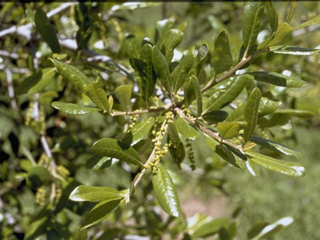
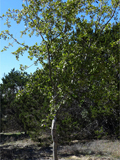
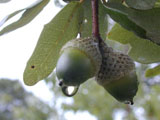
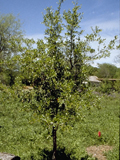
Plateau oak or Escarpment live oak is a thicket-forming shrub or large, spreading tree that is nearly identical in appearance to, and considered much hardier than, Q. virginiana. A short, tapering trunk supports picturesquely gnarled branches and limbs that over time will spread horizontally a great distance from the main trunk. It can reach a height of 20-40 ft. Leaves are semi-evergreen, firm textured, ovate to elliptic, 1 to 3 inches long; usually without lobes except on young plants and rootsprouts, then with pointed lobes. The leaves are generally slightly smaller than those of Q. virginiana. Acorns 3/4 to 1 inch long, rather elongate. Unlike Coastal live oak, acorns are spindle-shaped (fusiform), narrowed at the base.
Ranging from the Glass Mountains and Arbuckle Mountains of southern Oklahoma south through the center of Texas to the mountains of Coahuila, Tamaulipas, and Nuevo Leon in Mexico, Quercus fusiformis is the common live oak used in landscaping and found in the wild in central Texas. It is more drought-tolerant and cold-hardy than Q. virginiana, which it is sometimes considered a variety of. Like Q. virginiana, its magnificent, stately form has endeared it to generations of residents and it remains popular to this day. Also like Q. virginiana, it is susceptible to oak wilt and live oak decline when stressed by drought, so care must be taken to protect it from injury both aboveground and below ground to prevent infection. The largest known Texas live oak grows in Real County, Texas.
Appearing to be evergreen, this species is tardily deciduous, shedding the previous year's leaves in late-February or March as new leaves emerge.
Plant Characteristics
Duration: PerennialHabit: Tree
Leaf Retention: Semi-evergreen
Leaf Arrangement: Alternate
Leaf Complexity: Simple
Leaf Shape: Elliptic , Lanceolate , Ovate
Leaf Venation: Pinnate
Leaf Margin: Entire
Leaf Apex: Acute , Obtuse
Leaf Base: Cordate , Rounded , Truncate
Leaf Texture: Leathery
Breeding System: Flowers Unisexual , Monoecious
Inflorescence: Catkin
Fruit Type: Nut
Size Notes: 20-40 ft tall
Leaf: Upper surface a glossy light to dark green, grayish- green beneath with dense pubescent bloom that rubs off.
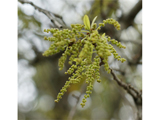
Flower: Flowers 2-3 inches long
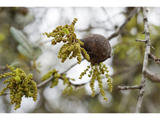
Fruit: Acorns annual; peduncle 1⁄8 - 11⁄8 inches (3 - 29 mm) supporting 1 - 5 nuts, cup has narrow base, light gray scales with reddish-tips may be smooth or pubescent encloses 1⁄4 - 1⁄2 of nut; dark brown, narrow and oblong nut with light brown stripes, 5⁄8 - 1 inch (16 - 25 mm) long.
Bloom Information
Bloom Color: YellowBloom Time: Mar , Apr , May
Distribution
USA: OK , TXNative Distribution: Limited to southern Oklahoma, Texas between the Brazos and Pecos rivers, and the mountains of northeastern Mexico (Coahuila, Nuevo Leon, and Tamaulipas).
Native Habitat: Savannas, rocky hills, & uplands with limestone or calcareous loam soils.
Growing Conditions
Water Use: LowLight Requirement: Sun , Part Shade
Soil Moisture: Dry
Drought Tolerance: High
Cold Tolerant: yes
Heat Tolerant: yes
Soil Description: Rocky, sandy, clay, or loam soils, usually calcareous, including caliche, but also in slightly acidic sands
Conditions Comments: Those from southern Oklahoma are the most cold-hardy, surviving temperatures as low as -20 degrees F.
Benefit
Use Ornamental: Shade tree, AttractiveUse Wildlife: It provides cover and nesting sites for birds and small mammals. Its acorns feed birds and mammals.
Conspicuous Flowers: yes
Interesting Foliage: yes
Attracts: Birds , Butterflies
Larval Host: Hairstreak, Horace's Duskywing
Butterflies and Moths of North America (BAMONA)
|
(Hemileuca peigleri) Larval Host |
Propagation
Propagation Material: SeedsCommercially Avail: yes
Maintenance: Susceptible to oak wilt, so check regularly for injury to trunk and branches and treat injured areas immediately to prevent infection.
Mr. Smarty Plants says
Native trees for cemetery plot in Karnes County, TX
April 08, 2007
I'm looking for a tree for a cemetery plot in Karnes County at Pana Maria. There will be someone to regularly water it. I understand live oak and pecan are native to the area. I assume these would...
view the full question and answer
Invasive, non-native Paulownia
May 03, 2006
Hi. We would like to plant a fast growing tree that will provide shade for our house. What do you think of the Paulownia tree (Empress Tree) as a possibility for the Austin area? If this is not a g...
view the full question and answer
From the National Organizations Directory
According to the species list provided by Affiliate Organizations, this plant is on display at the following locations:Lady Bird Johnson Wildflower Center - Austin, TX
Sibley Nature Center - Midland, TX
Brackenridge Field Laboratory - Austin, TX
Patsy Glenn Refuge, c/o Wimberley Birding Society - Wimberley, TX
NPSOT - Native Plant Society of Texas - Fredericksburg, TX
Nueces River Authority - Uvalde, TX
Texas Parks and Wildlife Department - Austin, TX
NPSOT - Fredericksburg Chapter - Fredericksburg, TX
Texas Master Naturalists - Lost Pines Chapter - Bastrop, TX
NPSOT - Austin Chapter - Austin, TX
National Butterfly Center - Mission, TX
Jacob's Well Natural Area - Wimberley, TX
NPSOT - Williamson County Chapter - Georgetown, TX
Bibliography
Bibref 766 - Dale Groom's Texas Gardening Guide (2002) Groom, D.Bibref 1186 - Field Guide to Moths of Eastern North America (2005) Covell, C.V., Jr.
Bibref 1134 - Field Guide to Native Oak Species of Eastern North America (2003) Stein, John D. and Denise Binion
Bibref 298 - Field Guide to Texas Trees (1999) Simpson, B.J.
Bibref 1185 - Field Guide to Western Butterflies (Peterson Field Guides) (1999) Opler, P.A. and A.B. Wright
Bibref 946 - Gardening with Prairie Plants: How to Create Beautiful Native Landscapes (2002) Wasowski, Sally
Bibref 481 - How to Grow Native Plants of Texas and the Southwest: Revised and Updated Edition (2001) Nokes, J.
Bibref 355 - Landscaping with Native Plants of Texas and the Southwest (1991) Miller, G. O.
Bibref 354 - Native & Naturalized Woody Plants of Austin & the Hill Country (1981) Lynch, D.
Bibref 318 - Native Texas Plants: Landscaping Region by Region (2002) Wasowski, S. & A. Wasowski
Bibref 281 - Shinners & Mahler's Illustrated Flora of North Central Texas (1999) Diggs, G. M.; B. L. Lipscomb; B. O'Kennon; W. F...
Bibref 291 - Texas Wildscapes: Gardening for Wildlife (1999) Damude, N. & K.C. Bender
Bibref 297 - Trees of Central Texas (1984) Vines, Robert A.
Search More Titles in Bibliography
From the Archive
Wildflower Newsletter 1988 VOL. 5, NO.4 - Controlling Oak Wilt, Jubilee Celebration Expands Endowment, Director\'s Report...Wildflower Newsletter 1993 VOL. 10, NO.6 - Saving Trees and Plants at New Center Site a Big Job, Director's Report, Wildflo...
Additional resources
USDA: Find Quercus fusiformis in USDA PlantsFNA: Find Quercus fusiformis in the Flora of North America (if available)
Google: Search Google for Quercus fusiformis
Metadata
Record Modified: 2022-08-01Research By: TWC Staff, GDG