Native Plants

Q. Who is Mr. Smarty Plants?
A: There are those who suspect Wildflower Center volunteers are the culpable and capable culprits. Yet, others think staff members play some, albeit small, role. You can torture us with your plant questions, but we will never reveal the Green Guru's secret identity.

Did you know you can access the Native Plant Information Network with your web-enabled smartphone?

Ask Mr. Smarty Plants
Ask Mr. Smarty Plants is a free service provided by the staff and volunteers at the Lady Bird Johnson Wildflower Center.

rate this answer

Monday - July 18, 2011
From: Manchester, MD
Region: Mid-Atlantic
Topic: Erosion Control, Grasses or Grass-like, Herbs/Forbs, Shrubs
Title: Plants for a property near a conservation area in MD
Answered by: Anne Bossart
QUESTION:
Can you tell me what native plants and the type of landscaping that would be good to plant in front of a forest conservation area that is on a steep hill behind our future house? It is located in Manchester, MD.ANSWER:
We are really delighted to see new homeowners concerned about the impact their landscape will have on an adjacent natural area. The best thing you can do is take cues from nature. Spend the season exploring in the conservation area with field guides identifying plants. Look at how nature arranges the plants.
You can learn more about what plants are native to your area by visiting out Native Plant Database and doing a Combination Search for Maryland. You can create lists of plants that are linked to detailed information pages. You can also check the Recommended Species for Maryland for a list of plants that are known to be readily available in the nursery trade and suitable for a home garden setting.
Check out the website of the Maryland Native Plant Society and consider joining a local chapter. The people you meet will be a great resource as you embark on the project. Their website has a wealth of information including a list of Native Plant Nurseries. We also have nurseries affiliated with the Wildflower Center that you can find on our Suppliers page.
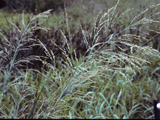
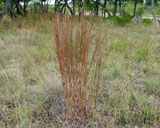
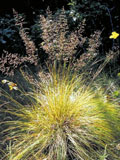
When you get to the stage of planning and planting on the slope you will want to consider using shrubs and perennials that spread by stolons and native ornamental grasses whose fibrous root systems are particularly adept at stabilizing a slope.
The organization that maintains your conservation area probably has plant lists and plenty of advice as well. Before you plant, you would be well advised to check with them that you are choosing plants that will not spread into their area and displace the delicate plant communities they are trying to protect.
Here are a few plants we think might be suitable:
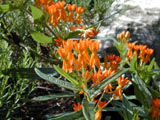
Asclepias tuberosa (Butterflyweed)
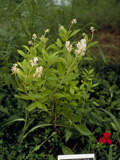
Ceanothus americanus (New jersey tea)
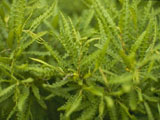
Comptonia peregrina (Sweet fern)
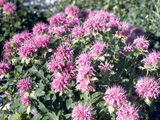
Monarda fistulosa (Wild bergamot)
Panicum virgatum (Switchgrass)
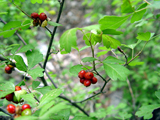
Rhus aromatica (Fragrant sumac)
From the Image Gallery
More Herbs/Forbs Questions
Alternative to swamp sunflower for Austin
June 15, 2011 - Dear Mr. Smarty Plants,
I love this forum and have learned so much from it!
Do you know of an alternative to Helianthus angustifolius L. (Swamp sunflower) that requires less water and would be m...
view the full question and answer
Butterfly plants from Austin TX
December 17, 2012 - I have a butterfly garden in the front part of the house facing the south side. However it is also mostly under a few Oak trees that cast shadow over half of the front yard starting early afternoon. ...
view the full question and answer
Habitats of pitcher plants
October 16, 2005 - Where do pitcher plants live?
view the full question and answer
Early spring wildflowers of Pennsylvania
September 30, 2011 - What native wildflower is the first to bloom in Weedville, Pa? (Jay township, Elk county)
I am working on a research paper for my Environmental Problems class, and this would be very helpful. Thank y...
view the full question and answer
Planting under Pine Trees in Pocatello ID
April 08, 2014 - Hi I was wondering if you could give me some ideas of what I could plant under and near some pine trees for my area. The trees are huge and so it is also constant shade where I want to plant. Thanks f...
view the full question and answer
| Support the Wildflower Center by Donating Online or Becoming a Member today. |