Native Plants

Plant Database
Search for native plants by scientific name, common name or family. If you are not sure what you are looking for, try the Combination Search or our Recommended Species lists.
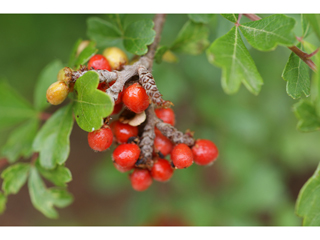
Mathews, Ray
Rhus aromatica
Rhus aromatica Aiton
Fragrant Sumac, Aromatic Sumac, Lemon Sumac, Polecat Bush
Anacardiaceae (Sumac Family)
Synonym(s):
USDA Symbol: RHAR4
USDA Native Status: L48 (N), CAN (N)
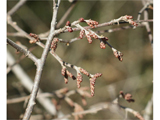
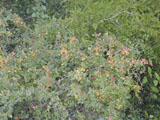
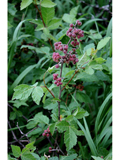
Fragrant sumac is an irregular, spreading, deciduous shrub, 6-12 ft. tall, with velvety twigs and lower branches turned up at the tips. Glossy, somewhat blue-green, coarsely toothed, trifoliate leaves turn orange, red, purple and yellow in the fall. Yellowish catkin-like flowers precede dark-red berries which persist into March. A sprawling, small to medium-size shrub with aromatic foliage.


Plant Characteristics
Duration: PerennialHabit: Shrub
Leaf Retention: Deciduous
Leaf Arrangement: Alternate
Leaf Complexity: Trifoliate
Fruit Type: Drupe
Size Notes: Height 6-12 feet and 4-6 feet wide.
Autumn Foliage: yes
Fruit: Red
Bloom Information
Bloom Color: YellowBloom Time: Apr , May , Jun
Distribution
USA: AL , AR , CT , DC , FL , GA , IA , IL , IN , KS , KY , LA , MA , MD , MI , MN , MO , MS , NC , NE , NH , NJ , NY , OH , OK , PA , SC , SD , TN , TX , VA , VT , WI , WVCanada: MB , ON , QC
Native Distribution: W. Que. to n. MI & IL, s. to GA, LA & KS, west to California and southern Oregon, south to Guerrero in west-central Mexico
Native Habitat: Dry, rocky prairies, old fields & open woods
Growing Conditions
Water Use: LowLight Requirement: Sun , Part Shade , Shade
Soil Moisture: Dry , Moist
Soil pH: Circumneutral (pH 6.8-7.2)
Cold Tolerant: yes
Soil Description: Dry, rocky soils. Sandy, Sandy Loam, Medium Loam, Clay Loam Clay, Rocky, Caliche type, Limestone-based
Conditions Comments: In spring, fragrant sumac flowers appear before the foliage. This shrub turns fall colors of red, yellow and orange. The flower is a nectar source for adult butterflies. Fragrant sumac colonizes to form thickets and looks best when planted en mass or in drift-like plantings as it occurs in nature. It is fast growing, generally pest and disease-free, and drought-tolerant. Colonies are often single-sexed, formed from a single, suckering parent. Only female plants produce flowers and berries.
Benefit
Use Ornamental: Several cultivated varieties of this shrub are available. Aromatic, Attractive, Fall conspicuousUse Wildlife: The berries are winter food. Its berries provide food for small animals and birds such as Townsend's Solitaires.
Use Food: Its berries provide food for small animals and birds such as Townsend's Solitaires.
Conspicuous Flowers: yes
Interesting Foliage: yes
Fragrant Foliage: yes
Attracts: Birds , Butterflies
Larval Host: Red-banded hairstreak butterfly
Deer Resistant: High
Value to Beneficial Insects
Special Value to Native BeesSpecial Value to Honey Bees
Provides Nesting Materials/Structure for Native Bees
Supports Conservation Biological Control
This information was provided by the Pollinator Program at The Xerces Society for Invertebrate Conservation.
Butterflies and Moths of North America (BAMONA)
|
Banded Hairstreak (Satyrium calanus) 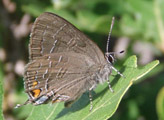 Larval Host |
Red-banded Hairstreak (Calycopis cecrops) 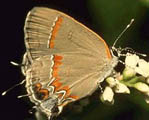 Larval Host |
Propagation
Propagation Material: SeedsDescription: Scarified and stratified seed planted 1/3-3/4 in. deep; semi-hardwood cuttings taken in summer through fall; easily transplanted from suckers.
Seed Treatment: Acid scarification for one hour followed by stratification at 41 degrees for 30-60 days.
Commercially Avail: yes
Find Seed or Plants
Find seed sources for this species at the Native Seed Network.
View propagation protocol from Native Plants Network.
Mr. Smarty Plants says
Hedge in central Texas
June 17, 2009
Help, my oleanders are dying. I am in need of hedge suggestions- ideal would be quick growing, maybe 8-12 feet at their tallest. I live in Central Texas.
view the full question and answer
Variety of native tall plants for a screen in shady area near Ft. Worth
June 12, 2007
Hello, we live west of Ft Worth. We are looking for tall plants to form a visual screen along a chain link fence we share with a neighbor. We have post oaks there and it is very shady and the ground ...
view the full question and answer
Sapindus drummondii or Rhus aromatica for Austria
May 07, 2006
Hy!
I'm from Austria/Europe, and interested in some North American native plants specially. It would be great if you can help me with my two questions:
Sapindus drummondii
I read from different...
view the full question and answer
National Wetland Indicator Status
| Region: | AGCP | AK | AW | CB | EMP | GP | HI | MW | NCNE | WMVE |
| Status: | UPL | FACU | UPL | UPL | UPL | UPL | UPL |
From the National Organizations Directory
According to the species list provided by Affiliate Organizations, this plant is on display at the following locations:Fredericksburg Nature Center - Fredericksburg, TX
Lady Bird Johnson Wildflower Center - Austin, TX
Native Plant Center at Westchester Community College, The - Valhalla, NY
Pineywoods Native Plant Center - Nacogdoches, TX
Texas Discovery Gardens - Dallas, TX
Delaware Nature Society - Hockessin, DE
Brackenridge Field Laboratory - Austin, TX
NPSOT - Native Plant Society of Texas - Fredericksburg, TX
Texas Parks and Wildlife Department - Austin, TX
NPSOT - Fredericksburg Chapter - Fredericksburg, TX
Texas Master Naturalists - Lost Pines Chapter - Bastrop, TX
NPSOT - Austin Chapter - Austin, TX
Native Seed Network - Corvallis, OR
NPSOT - Williamson County Chapter - Georgetown, TX
Mt. Cuba Center - Hockessin, DE
Wildflower Center Seed Bank
LBJWC-85 Collected 2007-05-03 in Travis County by Lady Bird Johnson Wildflower CenterBibliography
Bibref 1186 - Field Guide to Moths of Eastern North America (2005) Covell, C.V., Jr.Bibref 1185 - Field Guide to Western Butterflies (Peterson Field Guides) (1999) Opler, P.A. and A.B. Wright
Bibref 946 - Gardening with Prairie Plants: How to Create Beautiful Native Landscapes (2002) Wasowski, Sally
Bibref 355 - Landscaping with Native Plants of Texas and the Southwest (1991) Miller, G. O.
Bibref 354 - Native & Naturalized Woody Plants of Austin & the Hill Country (1981) Lynch, D.
Bibref 841 - Native Alternatives to Invasive Plants (2006) Burrell, C. C.
Bibref 318 - Native Texas Plants: Landscaping Region by Region (2002) Wasowski, S. & A. Wasowski
Bibref 291 - Texas Wildscapes: Gardening for Wildlife (1999) Damude, N. & K.C. Bender
Bibref 1294 - The Midwestern Native Garden: Native Alternatives to Nonnative Flowers and Plants An Illustrated Guide (2011) Adelman, Charlotte and Schwartz, Bernard L.
Bibref 297 - Trees of Central Texas (1984) Vines, Robert A.
Search More Titles in Bibliography
Web Reference
Webref 23 - Southwest Environmental Information Network (2009) SEINet - Arizona ChapterFrom the Archive
Wildflower Newsletter 1985 VOL. 2, NO.3 - Greenhouse Assists Research, Wild color on the Hills, Director's Report, Clearin...Wildflower Newsletter 1993 VOL. 10, NO.6 - Saving Trees and Plants at New Center Site a Big Job, Director's Report, Wildflo...
Additional resources
USDA: Find Rhus aromatica in USDA PlantsFNA: Find Rhus aromatica in the Flora of North America (if available)
Google: Search Google for Rhus aromatica
Metadata
Record Modified: 2023-05-25Research By: TWC Staff