Native Plants

Q. Who is Mr. Smarty Plants?
A: There are those who suspect Wildflower Center volunteers are the culpable and capable culprits. Yet, others think staff members play some, albeit small, role. You can torture us with your plant questions, but we will never reveal the Green Guru's secret identity.

Did you know you can access the Native Plant Information Network with your web-enabled smartphone?

Ask Mr. Smarty Plants
Ask Mr. Smarty Plants is a free service provided by the staff and volunteers at the Lady Bird Johnson Wildflower Center.

rate this answer

Saturday - September 04, 2010
From: Driftwood, TX
Region: Southwest
Topic: Compost and Mulch, Diseases and Disorders, Transplants, Shrubs
Title: Wax myrtle problems from Driftwood TX
Answered by: Barbara Medford
QUESTION:
We planted 27 wax myrtles on the perimeter of our property last year and were diligent about watering them throughout the drought. They are in very rocky soil (we had to use a jackhammer to dig the hole). Except for some antlering by local whitetail bucks, most of them thrived and bushed out somewhat. Others remained tall and skimpy but otherwise healthy. Now about 9 of them are turning brown all over. With the great rainfall we had this past winter and spring, we didn't feel the need to water them. But since the rain ceased about one month ago, I've watered them once. We took cuttings to the specialist at The Natural Gardener to see if he could tell what is wrong. He wasn't absolutely sure, but said it could be a kind of lethal fungus. His information was not helpful on determining if it was wilt or fungus. He said there was no indication of canker. In any case, we bought some seaweed concentrate and watered all the wax myrtles again. Do you have any suggestions about what we can do to help these shrubs thrive?ANSWER:
We are not sure "thrive" is the right word; we would go more for "survive." You listed several different growing conditions that we would definitely tag as causes for the decline of your Morella cerifera (wax myrtle). We'll try to deal with them one at a time, but we have a feeling that all of them are contributing factors.
The first, and most obvious to us, was the necessity to use a jackhammer to makes holes for your new plants. Our Native Plant Database page on this plant stipulates:
"Soil Description: Slightly acidic, moist, deep sands, loams, clays."
Even if you refilled that hole with soil amendments like compost or topsoil, you still have to ask what happens when those expanding roots (usually farther out than the width of the plant) hit that rock. Plants don't come equipped with jackhammers, and being unable to extend further out for nutrients and moisture from the soil probably zapped some of them.
Next is the question of watering. Granted, we had good Spring rains, but then it dried up, and when Central Texas dries up, it really dries up. The early season moisture encouraged plants, always optimistic, to put on more leaves for more vigorous growth. Then, when the water stopped, the plant could have gone into semi-dormancy, not trying to get the now-restricted supply of water to upper and outer branches and leaves. Again, from our Database:
"Conditions Comments: Requires constant moisture to get established, but both drought- and flood-tolerant once established. Water Use: High"
So, some of your plants could be suffering from transplant shock, the symptoms of which can show up as much as 3 to 5 years after the initial planting. Again, you said you planted them "last year." If this was in the summer, or nearly any time except late Fall or Winter, that could certainly contribute to transplant shock. We're afraid a few months in the ground does not constitute "established." One watering since the drought came back, with blistering heat, probably would be called murder if you were in Plant Court.
You did not say if the plants uniformly had sun or shade, perhaps from large native trees. If there are trees around, you can be sure they are competing with the new shrubs for every drop of moisture or nutrients in that shared soil. We would regard shade and competition as a possible cause for the bushes that are tall and skimpy; they are reaching for sun. Back to the Database:
"Light Requirement: Sun , Part Shade"
We consider "sun" to be 6 hours or more of sun daily, "part shade" 2 to 6 hours of sun.
On to the dangers of planting that many of the same species together. This is probably not a full-blown monoculture, but it presents the possibility of one plant having a disease (possibly even brought with it from the nursery) and spreading to all the others over time. Furthermore, if you plant a diversity of plants, and one species dies, you are not left with the prospect of totally replanting.
As for the diagnosis of lethal wilt, we are not plant pathologists and couldn't judge on that account. However, we did find this article from the University of Florida Extension Myrica cerifera, which details several forms of fungus that can attack wax myrtles, with pictures. We usually think of fungus or wilt as being associated with too much moisture, rather than too little, and most wilts have a specific insect carrier. However, again, this is out of our line of expertise, so we are not sure if the seaweed concentrate correctly addressed that problem.
And, finally, a question that we always ask is "Is this plant in the right place?" While wax myrtle does grow natively in Texas, and we often recommend it for hedges, here is our database description of its preferred habitat:
"Native from New Jersey west to eastern Oklahoma and east Texas, south through Mexico to Central America as well as through much of the Caribbean, this popular evergreen ornamental is used for screens, hedges, landscaping, wetland gardens, habitat restoration, and as a source of honey."
It is found natively mostly in East Texas, where the deep, sandy acidic soil it likes are available.
Our conclusion is that you planted a really good plant, native to Texas, in a place most of the plants don't seem to like. The moral of this is that it is necessary to thoroughly investigate a plant before you purchase and plant it. We hope with more watering, most of your plants will survive, and offer our sympathy if they don't.
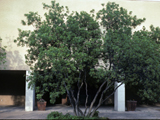
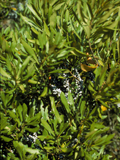
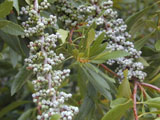
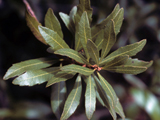
From our Native Plant Image Gallery:
More Diseases and Disorders Questions
Problems with crossvine from Semmes AL
January 06, 2013 - I have a 3 year old cross vine (tangerine beauty) and the leaves have started turning black and falling off the plant. I have two plants growing on the same pergola (opposite ends) and the second plan...
view the full question and answer
Survivability of plants after freeze
December 08, 2003 - I have many beautiful plants that froze. Some were Lantana, Hummingbird Bush, Candlestick Trees, Esperanza, Some flowers, and Marigolds. I love all of my plants and flowers and I want them to grow bac...
view the full question and answer
Yellowing foliage on a lemon cypress from St. Charles MO
May 22, 2011 - I recently received a lemon cypress tree as a gift. After about a month we transplanted it outside and the foliage turned from a light green to a yellow color. Is this normal? The tree doesn't app...
view the full question and answer
Problems getting desert western US plant Stanleya pinnata to bloom in England
March 13, 2006 - I am having trouble getting my Princes plume (Stanleya pinnata) to produce a flower and then go to seed. Do you have any advice on triggering flowering in this plant?
view the full question and answer
Esperanza freezing back in Highlands, TX
April 16, 2011 - I have an 3 yr. old Esperanza that froze the last two yrs.
but grew back each spring. This spring after getting about 2 ft. the leaves at the bottom began turning brown at the edges and now seems to...
view the full question and answer
| Support the Wildflower Center by Donating Online or Becoming a Member today. |