Native Plants

Q. Who is Mr. Smarty Plants?
A: There are those who suspect Wildflower Center volunteers are the culpable and capable culprits. Yet, others think staff members play some, albeit small, role. You can torture us with your plant questions, but we will never reveal the Green Guru's secret identity.

Did you know you can access the Native Plant Information Network with your web-enabled smartphone?

Ask Mr. Smarty Plants
Ask Mr. Smarty Plants is a free service provided by the staff and volunteers at the Lady Bird Johnson Wildflower Center.

rate this answer

Wednesday - May 27, 2009
From: Tyler, TX
Region: Southwest
Topic: Vines
Title: Which Aristolochia species are toxic to pipevine swallowtail larvae
Answered by: Nan Hampton
QUESTION:
In a May 30, 2008 question regarding the toxicity of certain Aristolochia species to pipevine swallowtail larvae, I had heard the same from at a talk from the curator of the Cockrell Butterfly Center in Houston (also a similar toxicity of non-native Passiflora species to Fritillary). Having been given a pipevine plant, but not knowing the species, I tried to find out answer to the same question. It seems the A. elegans species is reported to be toxic. Wondering if you have any updated information?ANSWER:
Mr. Smarty Plants contacted Dr. Nancy Greig, the Curator of Entomology and the Director of Cockrell Butterfly Center at the Houston Museum of Natural Science about your question. Here is what she said:"Certainly caterpillars of at least the native Battus philenor (Pipevine swallowtail) seem to prefer and/or survive better on some species rather than others. We are hard put to find native Aristolochias around here, but people grow several tropical species including vines such as A. elegans, A. grandiflora, and more recently a sort of shade-tolerant ground-cover species, A. fimbriata, has hit the nursery trade. The latter species is a great attractor of both pipevine swallowtails and polydamas swallowtails, which are as of the past few years equally common here. Battus polydamas, Polydamas swallowtail is more of a tropical species that seems to have moved northwards to include Houston in its range. Several people have told me that while B. polydamas caterpillars seem to be able to survive on some of the tropical viney Aristolochias, B. philenor caterpillars sicken and die on them. However, both butterflies do equally well on A. fimbriata. I cannot speak to the palatability of native Aristolochias to either species, as they are not commonly grown here.
And, as far as fritillaries and Passifloras go, there are some species of Passiflora (e.g., P. vitifolia) that fritillary caterpillars will not eat/do not survive on. In the case of P. vitifolia I always assumed it is because the leaves are quite tough as compared with the species the caterpillars do eat. Dr. Larry Gilbert (Professor, Biological Sciences, University of Texas at Austin) could tell you that most Heliconius species eat a limited suite of the available Passifloras in a given habitat. Certainly we cannot assume that the caterpillars of a given species of butterfly can eat every species in a given genus of plant. Sometimes the specialization is more finely tuned than that."
Dr. Greig also said that she had spoken to Joshua, who is the enthusiastic and knowledgeable owner of Joshua's Native Plants and Antiques in Houston Heights. He says that the Aristolochia species that is toxic to Battus philenor (the native pipevine swallowtail) is A. gigantea (Brazilian Dutchman's pipe), the species with the huge, purple-velevety flower. However, Battus polydamas does fine on it. According to him, other Aristolochia species including A. triloba, A. elegans, A. fimbriata, and A. tomentosa are palatable and safe for both Battus species. He says that B. philenor females will occasionally lay eggs on A. gigantea, but the larvae sicken and die.
The native Aristolochia species that can be found in the general vicinity of Tyler and Smith County, Texas are:
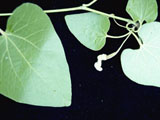
Aristolochia reticulata (Texas dutchman's pipe)
Aristolochia serpentaria (Virginia snakeroot)
Aristolochia tomentosa (woolly dutchman's pipe)
More Vines Questions
Transplanting trumpet creeper in Prairie City, IA
August 22, 2011 - I have a Trumpet Creeper that I would like to transplant. How do you do that?
view the full question and answer
Propagation of blackberry from Williamsport PA
January 18, 2014 - I have been told that if you cut a branch off of a black berry bush and stick it in water for a few days, and then put it in the ground it will grow into another bush. Please tell me if this is true a...
view the full question and answer
Stumps of fallen oaks in Hurricane Irene from Newton PA
September 03, 2011 - Two large red oaks fell in the woods in our yard in Newtown PA due to Hurricane Irene. The trees have been removed, but the stumps remain. Please can you recommend some fast-growing, attractive, nativ...
view the full question and answer
Vine in New Braunfels for Baytown, TX
July 25, 2009 - I have seen a vine in New Braunfels that looks nothing like the trumpet vine or trumpet creeper; however, the flower is almost identical. The flower is more pink though, and the leaves look more like...
view the full question and answer
Lonicera sempervirens not harmful to dogs from Naperville IL
December 16, 2012 - Is the trumpet honeysuckle (lonicera sempervirens) harmful to dogs if eaten? I have been told in the past that the common trumpet vine is harmful, but this appears to be different. Thank you!!
view the full question and answer
| Support the Wildflower Center by Donating Online or Becoming a Member today. |