Native Plants

Q. Who is Mr. Smarty Plants?
A: There are those who suspect Wildflower Center volunteers are the culpable and capable culprits. Yet, others think staff members play some, albeit small, role. You can torture us with your plant questions, but we will never reveal the Green Guru's secret identity.

Did you know you can access the Native Plant Information Network with your web-enabled smartphone?

Ask Mr. Smarty Plants
Ask Mr. Smarty Plants is a free service provided by the staff and volunteers at the Lady Bird Johnson Wildflower Center.

rate this answer

Tuesday - April 28, 2009
From: Indianapolis, IN
Region: Midwest
Topic: Seed and Plant Sources
Title: Source for invasive, non-native Lythrum in Indiana
Answered by: Barbara Medford
QUESTION:
Please help me find where I can purchase Lithrum in Indiana. This is my favorite plant from long ago. I know it has been banned for the last few years. Presently you need a permit to sell Lithrum. I cannot find a nursery who sells the plant.ANSWER:
There is one member of the Lythrum genus, Lythrum alatum (winged lythrum), that is native to Indiana. However, you may also be thinking of Lythrum salicaria, which is a non-native invasive plant. You have to realize there is probably a very good reason why this plant is forbidden to be sold in several states in North America. For some of those reasons, read this website from the Plant Conservation Alliance Alien Plant Work Group, Purple loosestrife or Lythrum salicaria. Another article on this plant is from The Master Gardeners of Adams County, PA and Frederick, MD, Lythrum, a Noxious Weed, by Mary Ann Ryan, Adams Co. Master Gardener. At the Lady Bird Johnson Wildflower Center, we are committed to the use and propagation of plants native not only to North America but to the area in which the plant is being grown, so we would never recommend planting an invasive non-native, and no sources for it would appear on our Native Plant Suppliers lists.
Both of these articles point out that even lythrum plants advertised as "sterile" are not. The plant spreads both by prolific seeding and root extensions from which fresh suckers grow. It can easily interbreed with and take over from the native lythrum, and soon crowd out native plants and clog waterways, disturbing or destroying native habitats. Since you can never be sure what you are purchasing, we advise you not to try it at all. There are many other beautiful plants native to Indiana that belong there and will not try to take over. For instance, we went to our Recommended Species section, used Narrow Your Search to "herb" (herbaceous blooming plant) for Habit, "perennial" for Duration, and "wet or moist soil" for Soil Moisture, all characteristics of the Lythrum. You can use the same technique to search for others that you would like.
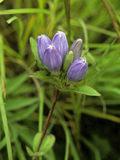
Gentiana andrewsii (closed bottle gentian) - 1 to 2 ft. tall, blooms white, blue, purple August til frost
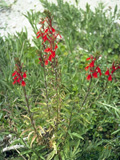
Lobelia cardinalis (cardinalflower) - 1 to 6 ft., blooms red May til October
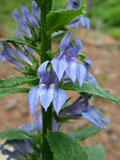
Lobelia siphilitica (great blue lobelia) - 2 to 3 ft., blooms blue July to October
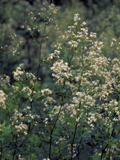
Thalictrum dasycarpum (purple meadow-rue) - 3 to 6 ft., blooms white, yellow, green, purple March to July
More Seed and Plant Sources Questions
Sources for Calyptocarpus vialis and Dalea greggii.
June 05, 2009 - What are sources for 4" horseherb and gregg dalea? I've tried nurseries listed with NPSOT.
Also, would using the above and maybe wooly stemodia and/or frogfruit together become a problem?
view the full question and answer
Source of Calycanthus floridus in Lincolnton NC
May 14, 2010 - I have been trying to find a Calycanthus Floridus, I want to plant them around the house, but have had no luck. I live in Lincolnton, NC do you know of any place I can find them?
view the full question and answer
Source for native plants for Austin, TX
March 20, 2004 - Where can I purchase native plants for my area?
view the full question and answer
Flowering Deer Resistant Ground Cover for Dry Rocky Soil: Alabama
March 26, 2012 - My question has been partially answered in the FAQ but I live in Birmingham where the soil is clay and rocky so it's a little different. I want to plant on a rocky slope (small rocks like the size of...
view the full question and answer
Where can I find poppies that bloom all summer in Centennial CO?
May 28, 2010 - Where can I find poppies that bloom all summer? Are they called California poppies?
view the full question and answer
| Support the Wildflower Center by Donating Online or Becoming a Member today. |