Native Plants

Plant Database
Search for native plants by scientific name, common name or family. If you are not sure what you are looking for, try the Combination Search or our Recommended Species lists.
Bransford, W.D. and Dolphia
Gentiana andrewsii
Gentiana andrewsii Griseb.
Closed Bottle Gentian, Closed Gentian, Bottle Gentian
Gentianaceae (Gentian Family)
Synonym(s):
USDA Symbol: gean
USDA Native Status: L48 (N), CAN (N)
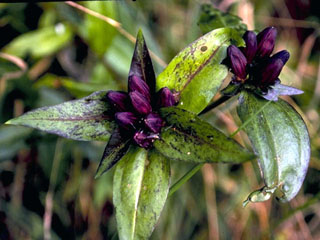
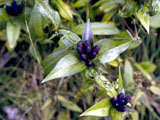
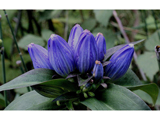
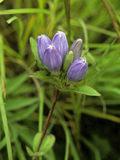
Closed Bottle Gentian is a 1-4 ft. plant with narrow, purplish leaves whorled or opposite below clusters of purple flowers which stay closed. The dark blue/purple, bottle-like, cylindrical flowers, nearly closed at tips, are in tight clusters atop the stem and sometimes in axils of upper leaves. Robust plants may have two whorls of flowers. When in full bloom, the flower looks like a bud about to open.
This is one of our most common perennial gentians and the easiest to grow in a moist wildflower garden. Other bottle gentians include a very similar species, Blind Gentian (G. clausa), in which the bands are not longer than the petals. Narrow-leaved Gentian (G. linearis), which occurs chiefly in the north and in the mountains as far south as West Virginia, has very narrow leaves and open flowers. The flowers of Soapwort Gentian (G. saponaria) are light blue and slightly open at the tip; this midwestern species has soapy juice. Stiff Gentian (Gentianella quinquefolia), an annual, has light blue or lilac, open flowers with bristle-pointed, fringeless lobes and a 4-sided stem; it occurs from southwestern Maine south to Florida and from southern Ontario to Missouri, Louisiana, and southern Tennessee.
The Gentians are named after King Gentius of ancient Illyria, who is said to have discovered the medicinal value of these plants.
Only large bees strong enough to force the corolla open crawl inside to sip nectar and deposit pollen.
Plant Characteristics
Duration: PerennialHabit: Herb
Fruit Type: Capsule
Size Notes: 1 to 4 feet tall.
Leaf: Green
Flower: Flowers 1.5 inches long.
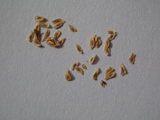
Fruit: Tan.
Bloom Information
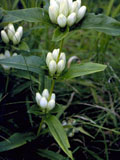
Bloom Color: White , Blue , PurpleBloom Time: Jul , Aug , Sep , Oct
Bloom Notes: Can bloom until frost. The petals never open so flowers look like buds.
Distribution
USA: CO , CT , DE , IA , IL , IN , KY , MA , MD , MI , MN , MO , ND , NE , NH , NJ , NY , OH , PA , RI , SD , VA , VT , WI , WVCanada: MB , ON , QC , SK
Native Distribution: W. Que. to Man., s. to NJ, OH, KY, n. AR & n.c. CO
Native Habitat: Moist, shaded sites; meadows; damp prairies; shores
Growing Conditions
Water Use: Medium , HighLight Requirement: Part Shade , Shade
Soil Moisture: Moist , Wet
Soil pH: Acidic (pH<6.8) , Circumneutral (pH 6.8-7.2)
CaCO3 Tolerance: Low
Soil Description: Humus-rich, slightly acidic, sandy loam. Tolerant of lime.
Conditions Comments: Plant in soil that is not too acidic and maintain moisture throughout the growing season, without letting soil get soggy.
Benefit
Use Ornamental: Unusual flowers add a subtle touch of colorUse Wildlife: Bees and bumblebees attracted
Conspicuous Flowers: yes
Value to Beneficial Insects
Special Value to Bumble BeesThis information was provided by the Pollinator Program at The Xerces Society for Invertebrate Conservation.
Propagation
Propagation Material: Root Division , SeedsDescription: Propagate by seed or divisions of the root crown. Divide root crowns in fall or early spring and plant 1 ft. apart. Germination of seed requires stratification and exposure to light. Scatter seeds on growing medium – do not scratch in – and cover. Said to be difficult to establish.
Seed Collection: Collect in Oct. and Nov.
Seed Treatment: Stratify 3 months at 40 degrees.
Commercially Avail: yes
Maintenance: Young plants may need protection from herbivores. Plant tends to lean at maturity, so plant among sturdier plants for support.
Find Seed or Plants
Find seed sources for this species at the Native Seed Network.
View propagation protocol from Native Plants Network.
Mr. Smarty Plants says
Native wildflowers for Northern Indiana
May 08, 2007
I had the wonderful opportunity to visit the Lady Bird Johnson Wildflower Center
on Saturday April 21. What a beautiful place. I thoroughly enjoyed my visit. I was
wondering how I could find out w...
view the full question and answer
National Wetland Indicator Status
| Region: | AGCP | AK | AW | CB | EMP | GP | HI | MW | NCNE | WMVE |
| Status: | FACW | FACW | FAC | FACW | FACW | FAC |
From the National Organizations Directory
According to the species list provided by Affiliate Organizations, this plant is on display at the following locations:Native Seed Network - Corvallis, OR
Mt. Cuba Center - Hockessin, DE
Bibliography
Bibref 1620 - Gardening with Native Plants of the South (Reprint Edition) (2009) Wasowski, S. with A. WasowskiBibref 946 - Gardening with Prairie Plants: How to Create Beautiful Native Landscapes (2002) Wasowski, Sally
Bibref 1294 - The Midwestern Native Garden: Native Alternatives to Nonnative Flowers and Plants An Illustrated Guide (2011) Adelman, Charlotte and Schwartz, Bernard L.
Search More Titles in Bibliography
Web Reference
Webref 23 - Southwest Environmental Information Network (2009) SEINet - Arizona ChapterAdditional resources
USDA: Find Gentiana andrewsii in USDA PlantsFNA: Find Gentiana andrewsii in the Flora of North America (if available)
Google: Search Google for Gentiana andrewsii
Metadata
Record Modified: 2023-04-04Research By: TWC Staff