Native Plants

Q. Who is Mr. Smarty Plants?
A: There are those who suspect Wildflower Center volunteers are the culpable and capable culprits. Yet, others think staff members play some, albeit small, role. You can torture us with your plant questions, but we will never reveal the Green Guru's secret identity.

Did you know you can access the Native Plant Information Network with your web-enabled smartphone?

Ask Mr. Smarty Plants
Ask Mr. Smarty Plants is a free service provided by the staff and volunteers at the Lady Bird Johnson Wildflower Center.

rate this answer

Wednesday - August 07, 2013
From: Warren, OH
Region: Midwest
Topic: Pests, Propagation, Problem Plants, Herbs/Forbs
Title: Invasive native blackeyed susans from Warren OH
Answered by: Barbara Medford
QUESTION:
In our demo garden we master gardeners in NE Ohio have been unable to get rid of black-eyed susans which have, like the other person, prevented or "killed" the other perennial plants. They are spreading everywhere!!!!! In my section of the demo garden I had removed some this past spring and have regrown even tho I removed "all" (???) of the roots. I have clipped off the flowering stalks and now have to dig out what is left. This means the soil will have to be replaced also. Now, do I have the chance that anything else will die if I use roundup or sevin????? or put in other perennials????? We are without a MG coordinator at this time and we are at our wits end with this problem. Thank you for your consideration in this matter.ANSWER:
There are two plants in our Native Plant Databas with the common name "Blackeyed Susan."
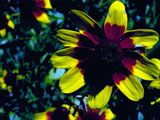
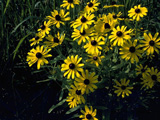
Rudbeckia hirta var. angustifolia (Blackeyed susan) According to this USDA Plant Profile Map, this plant grows only in southeastern states and Texas, so we conclude that what you are dealing with is Rudbeckia hirta var. pulcherrima (Blackeyed susan), which according to this USDA Plant Profile Map, grows just about everywhere, so we can assume that is the plant you are finding invasive. Mostly the Lady Bird Johnson Wildflower Center, home of Mr. Smarty Plants, is committed to the growth, propagation and protection of plants native not only to North America but to the area in which those plants have evolved. We are totally in favor of preventing the spread of non-native invasives, but obviously sometimes natives can be invasive, too, as you have discovered.
We did learn that the plant has rhizomatous roots, as you probably know. This makes eradication extremely difficult, as you also know. This plant is classified in our database as a biennial which can perennialize if it is happy. You must have a lot of happy plants. The biggest problem with rhizomatous roots is that if you don't eradicate every possible small underground stem, it will rise to grow again. This plant, of course, also propagates itself by seeding, so you have a double whammy. There is a possibility that what you have is a hybrid or species of the rudbeckia genus that is not in our database, but we are assuming that the same principle applies. When you ask about using a broad-spectrum herbicide, we tend to shudder because most gardeners want to apply it in a spray. Doing so means that, yes, you are going to damage other plants, but the poisons will not get down to the root of your problem (excuse the pun) because the spray is airborne.
We are frequently approached for a way to get rid of an invasive plant that seems to just keep coming back. Here is what we suggest: buy a small bottle of an undiluted broad-spectrum herbicide and some small disposable sponge paint brushes. Cut a plant down to the ground, and make sure no seedheads are left on the plant before you put it in the compost pile. Quickly, within five minutes, paint the cut root still in the ground with the herbicide. You must do it quickly because the root will be trying to heal itself over to protect the roots. This requires persistence and determination; learn to recognize the plant as soon as it pops its head up and treat immediately. Of course, you already know not to let any of the plants seed themselves out. You can still enjoy the blooms but they must be trimmed promptly, and Rudbeckia hirta var. pulcherrima (Blackeyed susan) blooms for several months.
Would you consider designating a "Blackeyed Susan Garden" and make lemonade out of your lemons?
From the Image Gallery

More Problem Plants Questions
Problems with Mexican feathergrass
October 24, 2015 - I live in Austin. I've recently seen negative comments re: Mexican feathergrass. Is it native to this area? Is it becoming a problem? I have had it in my yard for years and never considered it a ...
view the full question and answer
How to Deal With Goutweed?
June 12, 2015 - Hi, I'm wondering what plants (groundcover) would best compete against goutweed. It's coming up all around some existing potentilla shrubs and some nice bulbs and prairie perennials. I would hate to...
view the full question and answer
Elimination of Whitemouth dayflower in Dothan AL
March 18, 2009 - I am infested with Widow's Tears in my yard. I would like to get rid of them. Can you tell me how?
view the full question and answer
Shoots sprouting around base of liveoak tree
April 18, 2008 - I have a Live Oak that was planted in my yard about 15 years ago. In the last several years, small shoots have been sprouting up around the tree base, are getting more dense and spreading into the gr...
view the full question and answer
Eliminating evasive Celastrus orbiculatus (Oriental bittersweet)
July 21, 2013 - I have Oriental Bittersweet growing pervasively in my shrub garden, strangling my shrubs and growing into my beautiful Victorian porch. I can't keep up with it! What can I do?
view the full question and answer
| Support the Wildflower Center by Donating Online or Becoming a Member today. |