Native Plants

Q. Who is Mr. Smarty Plants?
A: There are those who suspect Wildflower Center volunteers are the culpable and capable culprits. Yet, others think staff members play some, albeit small, role. You can torture us with your plant questions, but we will never reveal the Green Guru's secret identity.

Did you know you can access the Native Plant Information Network with your web-enabled smartphone?

Ask Mr. Smarty Plants
Ask Mr. Smarty Plants is a free service provided by the staff and volunteers at the Lady Bird Johnson Wildflower Center.

rate this answer

Monday - July 29, 2013
From: Lubbock, TX
Region: Southwest
Topic: Planting, Grasses or Grass-like, Trees
Title: Native Desert Willow and bunchgrass for Lubbock TX
Answered by: Barbara Medford
QUESTION:
We live in Lubbock and have decided to try to make our front yard as native as possible. It has been a very difficult process finding native species locally (even the local Aggie nursery sells a lot of non-native species). The main question is that you do not have desert willow on the list of species that do well in the high plains of West Texas. It is relatively easy to find locally but is there a reason we should not grow it in Lubbock? Your advice has also steered us away from putting in pampas grass so we are looking for another 'bunch' style grass to plant. Will switchgrass, northern sea oats or little bluestem be appropriate for this area?ANSWER:
Insofar as finding Texas natives in nurseries, even the very excellent Texas A&M Horticulture Department is not as committed to natives as we are. You can go to our National Suppliers Directory, put your town and state or just your zipcode in the "Enter Search Location" box and press GO. This will result in a list of native plant nurseries, seed suppliers and consultants in your general area. All have contact information so you can check for availability before you begin shopping.
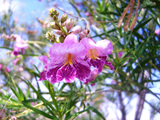
According to this USDA Plant Profile Map, Chilopsis linearis (Desert willow) is not reported as growing naturally in Lubbock County; it is shown as growing in nearby Lynn and Garza Counties. Since our Recommended Species for the Texas High Plains takes its information from the USDA website, that explains why why the tree is not on the list. Just because it has not been reported as growing there doesn't mean it won't grow there, it just hasn't been reported doing so to the USDA. If you follow the plant link above to our webpage on the Desert Willow you will find these growing conditions:
"Growing Conditions
Water Use: Low
Light Requirement: Sun
Soil Moisture: Dry , Moist
CaCO3 Tolerance: Medium
Drought Tolerance: High
Cold Tolerant: yes
Heat Tolerant: yes
Soil Description: Well-drained limestone soils preferred, but also does well in sands, loams, clays, caliches, granitic, and rocky soils. Minimal organic content the norm.
Conditions Comments: Allow to dry out between waterings, as this will encourage more extensive waves of blooms. Avoid excessive water and fertilizer, as that can lead to overly rapid growth, fewer blooms, and a weaker plant. Prolonged saturation can result in rot. Wont grow as fast or get as large in clay soil but wont suffer there either. Can be drought-deciduous in some regions. Can survive temperatures as low as 10 degrees F."
It looks to us like it should do just fine there. Let us suggest that you not attempt to plant it until December to January, and certainly not to buy it until then. Check with the local nurseries that are selling it now to make sure they will be selling it then, and carefully examine the root ball to ensure that it is not root bound, which could mean it has probably been out of the ground and standing in the nursery pot far too long. We would emphasize the warning about prolonged saturation of the soil. This plant is, by name, basically a desert plant; digging out a hole big enough for the roots and adding some good quality compost to the soil before refilling the hole around the roots will help ensure that the tiny rootlets can access nutrients in the soil and that the drainage will be good.
Now, on to your question about bunch grasses. This list we are going to take from our Native Plant Database for more selection, scrolling down the page to Combination Search. On the list of qualifications on the right-hand side of that page, we will select on Texas and "grasses/grass-like" for Habit. You can run the search yourself, adding specifications like Light Requirements, Soil Moisture and Height. We will check to make sure each grass we suggest is native to your area; again, more information on each plant will be available from our webpage. First, we will report on the three grasses you asked about:
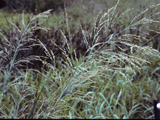
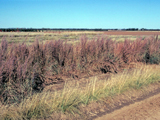
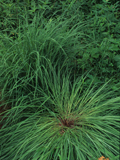
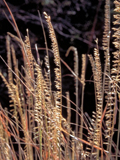
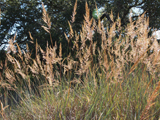
Panicum virgatum (Switchgrass) - map, native to Lubbock County
Schizachyrium scoparium (Little bluestem) - map, native to Lubbock County
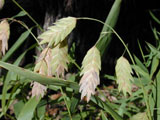
Chasmanthium latifolium (Inland sea oats) - map, native more to East and Central Texas, requires quite a bit of shade
Finally, back to our Recommended Species for the Texas High Plains, to look for other bunch grasses:
Andropogon gerardii (Big bluestem) - map, native to Lubbock County
Bouteloua curtipendula (Sideoats grama) - map, native to Lubbock County
Sorghastrum nutans (Indiangrass) - map, native to Lubbock County
From the Image Gallery
More Grasses or Grass-like Questions
Plants for delineating property line
July 18, 2010 - I have a neighbor who does not mow his grass or take care of a strip that runs between my property and his. I would like to plant some inexpensive, low maintenance, shrubs, that would do well in full...
view the full question and answer
Plants for 60 degree slope in Mobile, AL
February 09, 2010 - Dear Mr. Smarty Plants,I live on an eroding 60 foot bluff in USDA Zone 8A, along Mobile Bay (AL). To address erosion problems we are using a gabion-style product called "Green Terramesh," which is ...
view the full question and answer
Phytoremediation using Paspalum vaginatum
February 06, 2015 - Do you know of any on-going research using Paspalum vaginatum as the prime plant (monoculture) for use in phytoremediation.
Utilizing this plant in Vegetated Swales, Spreader Swales, Grassy Swales,...
view the full question and answer
Controlling KR Bluestem
February 11, 2016 - How can I control KR Bluestem in my 55 acre coastal bermuda hayfield? The field has a Farm Road along one side planted in KR, and now the hayfield is about 25 - 30% KR. Summer burn is fairly dangerous...
view the full question and answer
Native grasses as low-water option for ranch yard
March 19, 2007 - We have a weekend ranch in LLano Texas and are looking for a grass to plant in the front yard. (approx 3/4 acre) The house is very small and cute but not a real big fancy house. We do have a fence aro...
view the full question and answer
| Support the Wildflower Center by Donating Online or Becoming a Member today. |