Native Plants

Q. Who is Mr. Smarty Plants?
A: There are those who suspect Wildflower Center volunteers are the culpable and capable culprits. Yet, others think staff members play some, albeit small, role. You can torture us with your plant questions, but we will never reveal the Green Guru's secret identity.

Did you know you can access the Native Plant Information Network with your web-enabled smartphone?

Ask Mr. Smarty Plants
Ask Mr. Smarty Plants is a free service provided by the staff and volunteers at the Lady Bird Johnson Wildflower Center.

rate this answer

Friday - July 26, 2013
From: Heber City, UT
Region: Rocky Mountain
Topic: Propagation, Shrubs
Title: Revegetation with Rosa Woodsii in Heber UT
Answered by: Barbara Medford
QUESTION:
I am using Woods Roses for a revegetation project (to stop trail short cutting) in a public picnic area. Growing them from seed was too slow so I am experimenting with transplanting and it is working great! My question is: I would like to allow my transplants enough time to grow tall enough to survive moving to a picnic area, but space in our greenhouse is limited. Can I leave potted plants outside in a northern Utah winter without killing them?ANSWER:
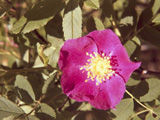
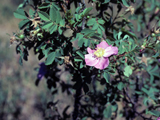
This USDA Plant Profile Map for Rosa woodsii (Woods' rose) shows that it does indeed grow natively in Wasatch County Utah. If you follow the plant link to our website on this plant you will see, under "Benefits" the phrase "Warning: Plant has thorns or prickles." In view of your purpose in planting this native rose, it would seem that IS a benefit. What a good idea. We will do some research and see if this rose can be propagated under the conditions you describe.
The best article on the survival characteristics of this rose was The Wild Garden from Hansen's Northwest Native Plant Database. It sang the praises of this rose in the wild, saying it did well at high elevations, grew well in Alaska and British Columbia, thrived in USDA Plant Hardiness Zones of 4 to 6, and quickly formed thickets impenetrable by all but small wildlife, like birds and little mammals.
We went to the USDA Plant Hardiness Zone Map on Utah and found Heber City on it. (You have to click on the state of Utah on the map to see the individual area names.) This is a color-coded map but it looks like you are in Zone 5b, which should allow small plants to survive outside. We would make one caveat, however, a plant in a pot is not as well protected from freezing as a plant with its roots in the ground. We would suggest that you place your baby plants in a sheltered sunny spot if possible, and either heap earth or mulch up around the pots or dig a trench and sink the pots in that, with dirt around. These plants apparently propagate themselves more generously by suckering than by seeding, which means that new growth coming up in their natural habitat is still growing from roots in the warm ground.
From the Image Gallery

More Propagation Questions
Transplanting suckers on Cenizo in Austin
June 21, 2010 - Our large silverado sage has produced some volunteers, which are now about 1 ft - 1-1/2 ft tall. Is it possible to transplant them or has the taproot grown too deep for transplanting? Also, will the ...
view the full question and answer
Seed planting of Crossvine from Orlando FL
September 12, 2011 - Seed planting of Bignonia capreolata - Tangerine Beauty. I have seed pods. Do I plant how deep and should I put in a plastic bag with a wet papertowel in the refrigerator and let it sprout? ...
view the full question and answer
Should I remove the flowering stalk from my Dasylirion leioiphyllum?
March 23, 2009 - We transplanted a plant that is new to us but going through your photos on your website, it appears that we have a Dasylirion Leiophy. My question is this.. Are we supposed to cut the 6' stem that f...
view the full question and answer
When are seeds of Indian paintbrush mature from Bend OR
July 14, 2010 - How do I know when to collect seeds of Indian paintbrush - when are they mature?
view the full question and answer
How to graft muscadines?
June 07, 2013 - I have tried for the last two years, grafting my perfect muscadines to the native non-bearing vines. I have tried every method available to no avail. I usually get two or three leaves, then wilt and...
view the full question and answer
| Support the Wildflower Center by Donating Online or Becoming a Member today. |