Native Plants

Q. Who is Mr. Smarty Plants?
A: There are those who suspect Wildflower Center volunteers are the culpable and capable culprits. Yet, others think staff members play some, albeit small, role. You can torture us with your plant questions, but we will never reveal the Green Guru's secret identity.

Did you know you can access the Native Plant Information Network with your web-enabled smartphone?

Ask Mr. Smarty Plants
Ask Mr. Smarty Plants is a free service provided by the staff and volunteers at the Lady Bird Johnson Wildflower Center.

rate this answer

Monday - April 29, 2013
From: Burkittsville, MD
Region: Mid-Atlantic
Topic: Plant Lists, Privacy Screening, Vines
Title: Vines to Cover Brush Pile in Maryland
Answered by: Anne Van Nest
QUESTION:
We have a large brush pile on our property that we'd intended to burn, but it is big enough now that it would require the help of the fire department! I'm thinking I'd like to cover it with native vines instead. What do you suggest? I'm in central MD with clay soil (except that the soil around this ancient and previously burned-over pile must be insanely rich), and it's in full sun. I won't be able to water.ANSWER:
The first place to go to find a list of potential plants is our Native Plant Database. Use the Combination Search feature instead of Recommended Species. This will provide a bigger selection with much more choice to narrow down. The volunteers and staff at the Wildflower Center who maintain the database have partners in different regions to help with these recommended species lists based on what is easy to access in local nurseries.
Under Combination Search, select the following categories: Maryland, Habit – vine, Duration – perennial, Light requirement – sun.
Some of the more drought and sun tolerant possibilities that could be used as brush pile screening plants include:
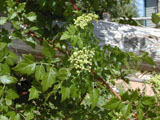
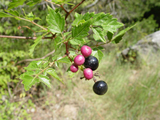
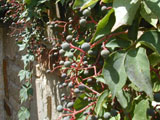
Ampelopsis arborea (peppervine) fast growing but short lived. Growing to 35 ft. Clusters of pea-sized bluish-purple inedible berries.
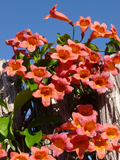
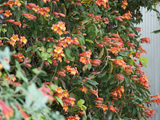
Bignonia capreolata (crossvine) woody vine to 50 ft. Showy orange-red, trumpet-shaped blooms in spring.
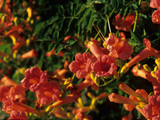
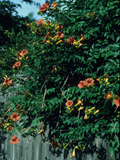
Campsis radicans (trumpet creeper) aggressive woody vine to 35 ft. Showy orange-red, trumpet-shaped blooms at the end of the branches throughout the summer.
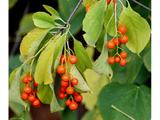
Celastrus scandens (American bittersweet) woody vine to 30 ft. In the fall showy orange capsules split to reveal crimson arils.
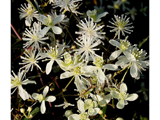
Clematis virginiana (Devil’s darning needles) fine-textured vine to 15 ft. A profusion of small white flowers in summer followed by a plume-like feathery achene.
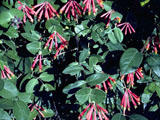
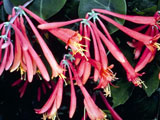
Lonicera sempervirens (coral honeysuckle) semi-evergreen twining vine to 20 ft. Clusters of red tubular blooms in early summer followed by bright red berries.
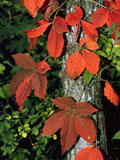
Parthenocissus quinquefolia (Virginia creeper) deciduous vine to 40 ft. Brilliant mauve, red and purple fall color.
The effect of the wood ash on your new native vine plants depends on the type of wood that was burned. Cornell University has a good article online that explains the effects of wood ash on garden soils which is based on the composition of wood ash, the completeness of the wood combustion and how much leaching has taken place after the burn. The wood ashes just after burning have a nutrient composition of 1-2% phosphate (P2O5) and 4-10% potash (K20). As the ash is exposed to the weather the lime in the wood ash is converted from an oxide form to hydroxide and carbonate forms. Wood ashes can have lime ratings of 20-50% (as calcium carbonate, CaCO3). Hardwoods such as maple, elm, oak and beech contain 1/3 more calcium than the ash of softwoods. Calcium carbonate will raise the pH of acid soils.
From the Image Gallery
More Vines Questions
Orange-red caterpillar with black spikes on passionflower vine
September 19, 2009 - What kind of orange-red caterpillar with black spikes is all over my passion vine?
view the full question and answer
Will wisteria grow in LaQuinta CA?
June 13, 2010 - I have moved to the desert, near Palm Springs, CA from Omaha NE where I was an avid gardener. I would like to know if wisteria will grow in this environment, with temps up to 120 several weeks each su...
view the full question and answer
Huckleberries and blueberries from Vancouver WA
April 14, 2013 - Can you plant a blueberry next to a huckleberry?
view the full question and answer
Native vine for a privacy fence in Austin, TX.
June 16, 2015 - I have a vacant lot in Greenshores that has two 6' iron fences. Neighbor planted some sort of vine that grows up and along fence for privacy, white flowers when in bloom, I assume its Jasmine? On ne...
view the full question and answer
Propagation of Crossvine from San Antonio
September 03, 2011 - I have a new Crossvine (Bignonia capreolata) that has a single seedpod so far. What is the best way to plant it for the best chances for success? It is still green and a very hot August. Do I plant ...
view the full question and answer
| Support the Wildflower Center by Donating Online or Becoming a Member today. |