Native Plants
Q. Who is Mr. Smarty Plants?
A: There are those who suspect Wildflower Center volunteers are the culpable and capable culprits. Yet, others think staff members play some, albeit small, role. You can torture us with your plant questions, but we will never reveal the Green Guru's secret identity.
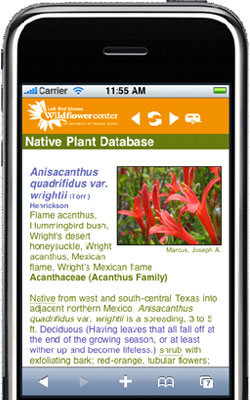
Did you know you can access the Native Plant Information Network with your web-enabled smartphone?
Ask Mr. Smarty Plants
Ask Mr. Smarty Plants is a free service provided by the staff and volunteers at the Lady Bird Johnson Wildflower Center.

rate this answer

Tuesday - October 02, 2012
From: Palm Desert, CA
Region: California
Topic: Trees
Title: Growing Magnolia trees in Palm Desert, CA.
Answered by: Jimmy Mills
QUESTION:
Will magnolia trees grow in the Palm Desert/Indio, CA area?ANSWER:
There are nine species of Magnolias in our Native Plant database and one of the more popular ones, Magnolia grandiflora (Southern magnolia) is described as one of the most beautiful native trees. It grows in rich porus acidic soils in lowland and coastal woods in the southeastern United States. Southeastern Texas is about as far west as it grows.
My guess is that a tree that prefers moist temperate and sub tropical regions would not be happy in a place called Palm Desert.
To consider alternative plants, lets go to our Native Plant Database. Scroll down to Recommended Species Lists, and click on View Recommended Species Page. Click on Southern California on the map and you will get a list of 208 commercially available native plant species suitable for planned landscapes in California. SInce we are interested in trees, lets go to the Narrow Your Search Box on the right of the page and make the following selections: select California under State, Tree under General Appearance, perennial under Lifespan, and check Sun under light requirement.”Click the Narrow Your Search” button and your list shrinks to 28. Clicking on the scientific name of each plant will bring up its NPIN page which contains a description of the plant, its growth characteristics and requirements, and in most cases images. As you check out each plant, you can note its size and and other features.
Here are just a few possibilities;
Cornus nuttallii (Pacific dogwood) (more information)
Quercus kelloggii (California black oak) (more information)
Quercus engelmannii (Engelmann oak) (more information)
Quercus agrifolia (California live oak) (more information)
Washingtonia filifera (California fan palm) (more information)
More Trees Questions
Drought affecting native trees from The Woodlands
August 18, 2011 - I've been trying to grow native trees in my yard for the past 3 years and I'm starting to question whether the amount of time required to spend watering them during the long hot season in Texas is r...
view the full question and answer
What is the pH of Bald Cypress needles?
February 24, 2010 - What is the pH of Bald Cypress needles?
view the full question and answer
Failure to bud out of Shumard oaks in Floresville TX
April 16, 2010 - Question: I have a Shumard red oak (9-10ft tall) that I planted last October as its leaves were turning a brilliant red color. However, it's the only tree that did not bud this spring. I scraped t...
view the full question and answer
Will a Texas Mountain Laurel thrive in a 4'x4'x4' brick planter. pl
September 14, 2015 - Would a Texas Mountain Laurel thrive in a 4'x4'x4'x4' brick planter with a drain at the bottom? It will get full sun all day. If not, would a Green Cloud Sage or a Waxleaf Myrtle work? Thanks!
view the full question and answer
Tiny holes oozing sap from Austin
August 22, 2012 - My ash tree becomes loaded with butterflies on the trunk. At closer inspection, I see they are drinking sap which is coming from small holes in the trunk. Are the butterflies creating the holes? I ...
view the full question and answer
| Support the Wildflower Center by Donating Online or Becoming a Member today. |