Native Plants

Q. Who is Mr. Smarty Plants?
A: There are those who suspect Wildflower Center volunteers are the culpable and capable culprits. Yet, others think staff members play some, albeit small, role. You can torture us with your plant questions, but we will never reveal the Green Guru's secret identity.

Did you know you can access the Native Plant Information Network with your web-enabled smartphone?

Ask Mr. Smarty Plants
Ask Mr. Smarty Plants is a free service provided by the staff and volunteers at the Lady Bird Johnson Wildflower Center.

rate this answer

Friday - August 31, 2012
From: San Antonio, TX
Region: Southwest
Topic: Non-Natives, Cacti and Succulents, Shrubs, Trees
Title: Replacements for photinia from San Antonio
Answered by: Barbara Medford
QUESTION:
i just read your response to someone regarding Red Tip shrubs. You just saved me thousands of dollars ! I was getting ready to order over 250 of these to line my 2.5 acre fence line. What shrub would you recommend that grows at a decent rate, provides pricacy and aesthetically pretty.ANSWER:
We don't know if this is the previous answer you are referring to, because we answer lots of questions on Red Tip Photinia. It is from New York, so the substitutions we recommended would not apply to your situation, but we will find some that do. We are always gratified when someone reads our answers and is prevented from making a mistake. Most of our questions are from people who made a mistake and then want us to help them fix it. Alas, we are better at preventing than fixing.
Your request for a replacement is a tall order. That's why so many non-natives that are not good plants for the area where they are being planted are out there, because they look so good on paper, and it's only after you have spent all that money that they are not so good. However, we are going to look for some native to the Bexar County area that will be much more likely to survive and prosper in your climate, soils and rainfall. You can follow each plant link to our webpage on that plant. We are going to make several suggestions, trees, shrubs and succulents. Although obviously your plants are for a hedge of all the same plants, you might consider a mixed hedge, with different textures, blooming times and heights. This takes a little more consideration and time, but we find it much more satisfactory than a monoculture. Because we have addressed that before for Central Texas, we would like to link you to some of those previous answers.
Austin - replacing non-native boxwood maze
Austin - replacing non-native Italian Cypress hedge
Since these answers contain several plants appropriate for your needs and are also in Central Texas, you should consider some of them. We will demonstrate how to use our Native Plant Database. Since you will be looking at several different parts of your property, including shady and sunny sites (we assume), we will not specify in our sample search the characteristics of soil moisture or light requirement. When you make your own custom search, you can tailor your specifications by those or even so far as bloom color and time, mature height, etc. Just remember, the more numerous the custom specifications, the fewer (or none) plants will fit them and be listed. We suggest you make a map of your property-no surveyors tools required-just sketch in areas with already existing plants and structures, and then watch for several days noting the total amount of sunlight each area gets. As you will note when you are making your search, we quantify "sun" as 6 hours of more of sun a day, "part shade" 2 to 6 hours of sun, and "shade" as 2 hours or less. You will have to read the webpage each link takes you to in order to know the growing conditions. We will make two searches, one for trees and one for shrubs.
Plants for a hedge in Central Texas:
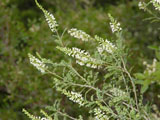
Eysenhardtia texana (Texas kidneywood)
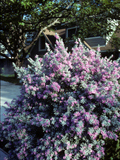
Leucophyllum frutescens (Cenizo)
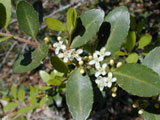
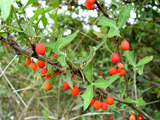
Mahonia trifoliolata (Agarita)
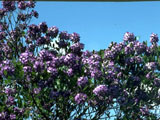
Sophora secundiflora (Texas mountain laurel)
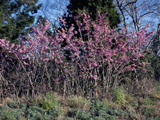
Cercis canadensis var. texensis (Texas redbud)
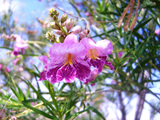
Chilopsis linearis (Desert willow)
Prunus mexicana (Mexican plum)
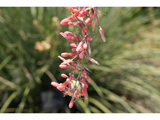
Hesperaloe parviflora (Red yucca)
From the Image Gallery

More Shrubs Questions
Evergreen sumacs for privacy along fence
August 02, 2014 - I would like to plant enough Evergreen Sumacs along our fence for privacy for the length of our backyard which is 60 ft. Fifteen feet on the left and right ends are shaded with the right side being d...
view the full question and answer
What is the name of the Texas Wildflower that smells like grape koolaid?
March 28, 2014 - Can you tell me the name of the Texas wildflower that smells like grape koolaid? I live in north west Texas and every spring, the low growing purple flowers line spots along the roadside. It's a joy ...
view the full question and answer
Plants looking similar to Camellia sinensis in Venezuela
June 30, 2008 - Is there another plant that looks similar to the tea plant? I need to do a photoshoot of a tea plantation, but can´t really get to one, so I was wondering if there were other plants that at least look...
view the full question and answer
Nutrient imbalance in Tecoma stans
October 18, 2007 - I have two Tecoma stans on the north-east side of my yard. They have grown very tall (5') but have not bloomed all summer. Last summer they bloomed profusely. Any idea what the problem might be?
view the full question and answer
Transplanting Esperanza in Abilene TX
November 03, 2012 - I have 3 beautiful Gold Star Esperanzas that are too large and need to be transplanted. How can I do this and what time of year. They are five years old and always return in the spring.
view the full question and answer
| Support the Wildflower Center by Donating Online or Becoming a Member today. |