Native Plants
Q. Who is Mr. Smarty Plants?
A: There are those who suspect Wildflower Center volunteers are the culpable and capable culprits. Yet, others think staff members play some, albeit small, role. You can torture us with your plant questions, but we will never reveal the Green Guru's secret identity.
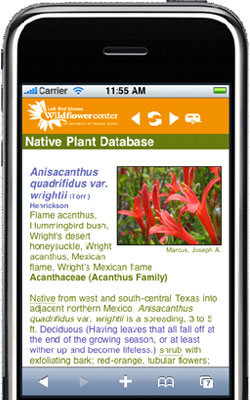
Did you know you can access the Native Plant Information Network with your web-enabled smartphone?
Ask Mr. Smarty Plants
Ask Mr. Smarty Plants is a free service provided by the staff and volunteers at the Lady Bird Johnson Wildflower Center.

rate this answer

Friday - June 29, 2012
From: Frisco, TX
Region: Southwest
Topic: Trees
Title: Tree species for a small yard
Answered by: Guy Thompson
QUESTION:
I have a small front yard area. Maybe 10' x 15'. It is also elevated. There is a retaining wall about 4 feet high. The builders planted a live oak! I think it is a nightmare waiting to happen as it matures. I would like a smaller tree, to fit in that size yard, that will not tear the wall down 10 years down the road. I have looked at crepe myrtles, and choke cherries. Am I going in the right direction? Are there any others I should consider? Additionally the parkway area between the sidewalk and street. Maybe 5 feet wide. They planted live oaks there as well. I love trees, but it just seems like bad choices for small areas. I am in zone 8a. Help!ANSWER:
You are wise to be concerned about tree size and possible damage to retaining walls. Crepe myrtle (non-native) and Prunus virginiana (Chokecherry) are good bets. To view a larger number of possible replacement trees check the Texas Tree Selector web site. Native trees are recommended because of their ability to withstand the Texas climate. This site does not give information on root encroachment, but some useful data on that point will be found at a site dealing with street trees. As a general rule, trees will extend at least small roots out to about the outer drip line of the foliage. Additional information on any of the native trees, including images, can be found by typing the common or botanical name into the Lady Bird Johnson Wildflower Center Native Plant Database.
This is certainly not an ideal season for planting trees. You would be advised to wait for cooler weather in the fall or winter. By checking the list of plant suppliers in your neighborhood on the Lady Bird Johnson Wildflower Center web site you should find a source of suitable trees.
More Trees Questions
Tree planting in OH
June 12, 2011 - When transplanting a tree (a maple in Spring in my case now), I understand that one should leave a surrounding doughnut like ridge around the root base to hold in the water from rains and irrigation. ...
view the full question and answer
Trees for privacy shield in Dublin, Virginia
April 16, 2009 - What are the best trees to plant for privacy in a small yard?
view the full question and answer
Pruning technique for Anacacho Orchid from Austin
May 18, 2011 - I have an Anacacho Orchid tree that is about 8 ft tall and still young. It is doing quite well. I have never pruned it, but lately I have been considering it as some of the top branches are starting t...
view the full question and answer
Growth rate of Thuja occidentalis
January 31, 2011 - What is the growth rate of thuja occidentalis? I have found web sites and books claiming slow to fast.
view the full question and answer
Large ash tree with round white spot on bark
July 21, 2008 - I have a large ash tree that seems to be fairly healthy. However, it has a large round white spot (about 18" diameter) on the bark, about 3' up from the base. Within the solid white circle the bark ...
view the full question and answer
| Support the Wildflower Center by Donating Online or Becoming a Member today. |