Native Plants

Q. Who is Mr. Smarty Plants?
A: There are those who suspect Wildflower Center volunteers are the culpable and capable culprits. Yet, others think staff members play some, albeit small, role. You can torture us with your plant questions, but we will never reveal the Green Guru's secret identity.

Did you know you can access the Native Plant Information Network with your web-enabled smartphone?

Ask Mr. Smarty Plants
Ask Mr. Smarty Plants is a free service provided by the staff and volunteers at the Lady Bird Johnson Wildflower Center.

rate this answer

Sunday - May 20, 2012
From: Corpus Christi, TX
Region: Southwest
Topic: Invasive Plants, Non-Natives, Pollinators, Seed and Plant Sources, Butterfly Gardens, Planting, Propagation, Seeds and Seeding, Soils, Wildflowers
Title: Adding Wildflowers to Corpus Christi
Answered by: Leslie Uppinghouse
QUESTION:
I have a dry sandy yard, full sun in Corpus Christi with lot's of stickers mostly, want to transform to wildflowers. When should I plant, how should I prepare soil, should I dig out stickers? Which wildflowers do you recommend? Thank you.ANSWER:
East Texas is an interesting habitat, there are so many wildflowers that only grow on or near the Texas Coast. Almost everything native that would grow in your area, would be fine with the dry sandy soil. What you need to do is look up which plants grow in your specific conditions and area. To do this, head to the Recommended Species area of our web site and do a specific search for your area, which if you notice, is separated in Texas, by region. Click on the eastern portion of the map and sub-search dry soil, sun, and if you are looking for wildflowers, annual for lifespan. This combination search should pull up the annuals that are commercially available in your area. If you widen your search criteria to add perennials to the mix you would have more plant species to choose from.
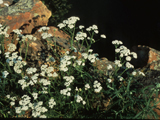
Here are some good options pulled up from those combined searches: Achillea millefolium (Common yarrow) is a tough flowering plant that loves the heat of the sun and dry sandy soil. It is a cheery flowering perennial that adds a nice height to any garden of wildflowers. It can stand as high as 3 Ft tall. One of the nicest features for yarrow, is its very long bloom time. It will typically bloom from spring through the fall year after year. It also can spread on its own but would not be considered an aggressive spreader. Typically you would be lucky to have the number of plants you have in the ground double each year. This is also an easy perennial to divide when mounds of them become to dense. Yarrow also makes a good cut flower.
Castilleja indivisa (Entireleaf indian paintbrush) Is a showy annual with bright red paintbrush-like spikes at the tips of each leaf. It will grow nicely in full sun with sandy soil. Paintbrush should be grown by seed, it does not transplant well. Make sure that you let the seeds mature fully and drop before you mow at the end of the season, to allow for optimal reseeding. A good source for ordering this plant and many others mentioned here would be the Native American Seed company.
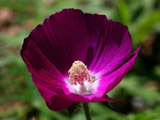
Callirhoe involucrata (Winecup) Is also a great annual wildflower to plant in the sandy soil of east Texas. These are cheery pink purple cup shaped flowers that attract butterflies and other pollinators, including the Gray Hairstreak butterfly. Winecup is a great wildflower to plant in areas that have other species mixed in. It does well in grassy areas which is sometimes harder to do with short annuals. They bloom in early spring through June. Winecup is another wildflower that would best be grown from seed.
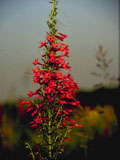
One of the toughest wildflowers of the bunch is Ipomopsis rubra (Standing cypress). This wildflower is a biennial so it is best to seed it two years in a row if you would like to have flowers annually. Standing cypress is a neat little plant. It has a very green ferny base with a 2-4 Ft bloom stalk from that base which has dozens of tiny cherry red tubular flowers. Standing cypress is a huge attraction to humming birds.
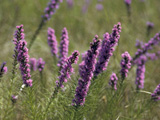
Liatris elegans (Blazing star) is another flower that can add some nice vertical to any garden. Liatris has a tall pink to purple series of flowers that run up a stalk that can reach heights up to 4 Ft. It is thought of as a wildflower and does grow wild, in a wide distribution throughout coastal states from South Carolina to Texas. It is a perennial and grows from a tuber deep underground. Liatris loves to have it's roots dig down into the deep sandy soil.
There are many more to choose from. Within your search make sure to read up on the plants that interest you and double check that they will grow in the sandy soil you have. If you are purchasing seeds make sure to plant them at the recommended time. Many wildflowers are sown in the fall.
About the stickers: If you can identify what the plants are, and they are native then they really should not be a problem except for perhaps an annoyance. If they are invasive then yes, dig them out and be careful to throw them away rather than compost the material.
In terms of how to prep the soil, you are in luck. Sandy soil is about the easiest soil to dig in. The trick with planting wildflowers and especially ones from seed it to not over-prep the soil. Read the directions from each seed packet. They will tell you when to plant and how to plant. Most wildflower seeds are tiny and the grains of sand hold these seeds in place when you sow them. So in theory you won't have to do much in terms of prep. Really you just need to figure out whether or not you stickers are worth removing. Enjoy planting!
From the Image Gallery
More Propagation Questions
Propagation of myrtle in Wapperger Falls, NY
September 01, 2009 - How do you propagate myrtle?
view the full question and answer
Removal of leaves before transplanting
April 05, 2008 - Before transplanting a plant, is it a good idea to remove leaves?
view the full question and answer
What do wildflower seeds look like from Westlake Village CA
February 23, 2014 - I collect seeds from my wild flower garden but can't always tell what part of the dried flower is the actual seed that will reproduce. Is there a resource that shows the seed part of flowers? Than...
view the full question and answer
Can Crataegus viridian be grown in Houston, TX?
June 21, 2015 - I am looking to plant Crataegus viridis (species or cultivar "Winter King") at a location in full sun in Houston. Many places I've found online say that it is hearty through Zone 9, but others have...
view the full question and answer
Transplanting wild sumac
September 23, 2010 - About a month ago I dug up five sumac from my backyard in Aylmer Quebec. I potted them. They now look dead. I wanted to transplant them at my cottage in Barrie Ontario. Can I still transplant them...
view the full question and answer
| Support the Wildflower Center by Donating Online or Becoming a Member today. |