Native Plants

Q. Who is Mr. Smarty Plants?
A: There are those who suspect Wildflower Center volunteers are the culpable and capable culprits. Yet, others think staff members play some, albeit small, role. You can torture us with your plant questions, but we will never reveal the Green Guru's secret identity.

Did you know you can access the Native Plant Information Network with your web-enabled smartphone?

Ask Mr. Smarty Plants
Ask Mr. Smarty Plants is a free service provided by the staff and volunteers at the Lady Bird Johnson Wildflower Center.

rate this answer

Tuesday - April 10, 2012
From: Salado, TX
Region: Southwest
Topic: Plant Identification
Title: Identification of blue flower
Answered by: Nan Hampton
QUESTION:
I have two similar (but obviously different) wild flowers growing on my property. I have pictures of each. What email address can I use to send them to you to identify? I thought one was blue-eyed grass, until the other bloomed. Now it seems fairly obvious that first is not b.e.g. and the other is unknown. (I've looked in several field guides with no success.) Thanks for your help.ANSWER:
Mr. Smarty Plants would love to be able to accept photographs for identification. Unfortunately, we don't have enough staff or volunteers to do this anymore. We were overwhelmed with photos and requests for identification. Please visit our Plant Identification page for links to several plant identification forums that will, however, accept photos for identification.
Using your description and assuming that the flowers were blue (even if they weren't blue-eyed grass), I will offer some possibilities for your two flowers:
Herbertia lahue (Prairie nymph)
Nemastylis geminiflora (Prairie celestials)
Androstephium caeruleum (Androstephium)
Amsonia ciliata (Fringed bluestar)
Nemophila phacelioides (Baby blue-eyes)
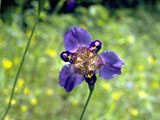
Alophia drummondii (Propeller flower)
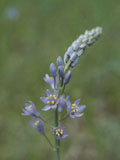
Camassia scilloides (Atlantic camas)
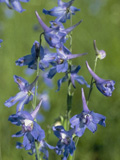
Delphinium carolinianum (Carolina larkspur)
Giliastrum incisum (Split-leaf gilia)
Nuttallanthus texanus (Texas toad-flax)
Phacelia patuliflora (Blue phacelia)
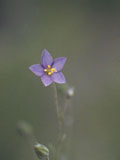
Triodanis coloradoensis (Colorado venus' looking-glass)
Triodanis perfoliata (Clasping venus' looking-glass)
Tinantia anomala (False dayflower)
To see more possibilities, you can search in our Native Plant Database for blue flowers that bloom in Texas in the spring by doing a COMBINATION SEARCH choosing "Texas" from Select State or Province; "Herb" under Habit (general appearance); "March", "April", and "May" under Bloom Time; and "Blue" under Bloom Color. Since Texas is a large place with many differenct eco-regions, all the blue flowers that will result from that search won't necessarily be ones that occur in Central Texas. If you see one that you think might be one of the flowers you saw, you can check the distribution map on the USDA Plants Database by scrolling down the species page in our Native Plant Database to the ADDITONAL RESOURCES section near the bottom of the page. Click on the USDA link and then click on Texas on the distribution map to see which counties in Texas have reported the plant. The plants listed above were found in or within two counties of Bell County.
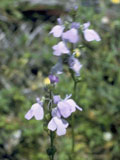
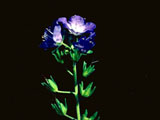
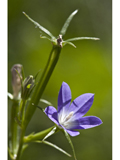
From the Image Gallery
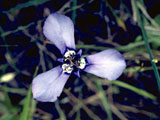

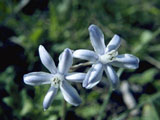
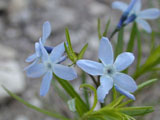
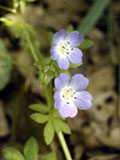
More Plant Identification Questions
Looking for the identification of spice or cinnamon bush
May 30, 2011 - My grandmother had a flowering bush that had little yellow flowers on it and smelled like cinnamon to me. She called it a spice bush. Could you help me name that bush?
view the full question and answer
Photo identification from Sun Tan Valley AZ
June 29, 2013 - I just tried sending y'all some photos of a plant I'd like to identify. The email address failed. Please let me know how I can get these 3 photos sent.
view the full question and answer
Identification of plants emerging from "wildflower mix" of seeds
January 02, 2007 - I planted a "wildflower mix" a couple months ago, and now I have a bunch of plants growing that I'm not sure what they are. Some of them are starting to make buds, and I've been looking on the in...
view the full question and answer
Looking for rattlesnake flower
April 22, 2008 - I taught school for many years. The students and I identified wildflowers. I had one I call Rattlesnake Flower. It was small and had a little blue flower. On the leaves were little seed cases that...
view the full question and answer
More information about Trillium in New Jersey
June 23, 2011 - Hi, Nan. FYI.
The Trillium seeds in question came from the State of Alabama. If you have an interest in seeing photos of this Trillium and two others in my garden, which are different and which I be...
view the full question and answer
| Support the Wildflower Center by Donating Online or Becoming a Member today. |