Native Plants

Q. Who is Mr. Smarty Plants?
A: There are those who suspect Wildflower Center volunteers are the culpable and capable culprits. Yet, others think staff members play some, albeit small, role. You can torture us with your plant questions, but we will never reveal the Green Guru's secret identity.

Did you know you can access the Native Plant Information Network with your web-enabled smartphone?

Ask Mr. Smarty Plants
Ask Mr. Smarty Plants is a free service provided by the staff and volunteers at the Lady Bird Johnson Wildflower Center.

rate this answer

Sunday - July 10, 2011
From: Nokomis, FL
Region: Southeast
Topic: Erosion Control, Septic Systems, Grasses or Grass-like, Herbs/Forbs
Title: Can Carolina wild petunia be planted over septic tank in Nokomis FL
Answered by: Barbara Medford
QUESTION:
Could you tell me the root depth of the Ruellia caroliniensis/ Carolina wild petunia? Trying to determine if I can plant it over septic tank.ANSWER:
From a previous Mr. Smarty Plants answer on plants over a septic field:
"So far as we are able to determine, there is no list or database on root lengths of any plants, including natives. The root length of any plant is variable, depending on the plant size, genetics and age as well as environmental conditions. Keep in mind that when your system was designed, it was a well-known fact that something would grow over it-if not planted by you, then weedy volunteers. If those volunteers are not eliminated, some of them are bound to be woody plants, and that's what you're trying to avoid."
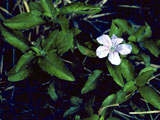
We see no reason why your Ruellia caroliniensis (Carolina wild petunia) would not be fine in the area of the septic field. The plant roots will help to carry moisture up to the surface, and should not interfere with the lines. This plant is a perennial, and annuals are even better because their roots start over every year, but we don't think the Carolina wild petunia would become a nuisance. Follow the plant link above to find out what light and moisture requirements the plant has, bloom time and color, etc. What you do want to avoid is any woody plant, such as trees and shrubs, over or near a septic line because they will definitely cause problems. Another option is native grasses, not necessarily the kind you mow for a lawn, but taller ornamental grasses. Their fibrous roots will help to hold the soil in plant to prevent erosion and should cause no disruption in the septic lines.
From the Image Gallery



More Herbs/Forbs Questions
Problems with Gregg's mistflower from Fredericksburg, TX
May 19, 2013 - Dear Mr. Smarty Plants: Something is wilting the tops of my Gregg's mistflower, Conoclinium greggii. I cannot see bugs on the plant, so I am wondering if it's a disease. The problem is widespread to...
view the full question and answer
Growing Chile Pequin Indoors
December 09, 2015 - About a year ago I visited your page and as a result I planted 8 seeds in spring 2015 from a large Chile Pequin plant that came up wild in my Cedar Park home near Austin. The last harvest was late su...
view the full question and answer
Overwintering Cardinal Flower in Thornwood NY
October 01, 2009 - I have 6 Cardinal Flower plants in planters. They have mulch on top to keep them moist. Can they stay in the planters all winter? Do I cut the stalks before winter comes or leave as is?
view the full question and answer
Invasiveness of Oenothera speciosa?
October 02, 2015 - Hello! I received a large package of Oenothera speciosa seeds and would like to plant them this month. I've read elsewhere that they can choke out out other plants and am wondering to what degree thi...
view the full question and answer
Montana native plants to create a garden with edible plants
January 14, 2013 - Hi Smarty Plants
We are looking to create a native herb, vegetable, root, fruit, flower and ground cover garden for the area of Hot Springs, Sanders County, Montana. Our zone is 4 and soil is mostly ...
view the full question and answer
| Support the Wildflower Center by Donating Online or Becoming a Member today. |