Native Plants

Q. Who is Mr. Smarty Plants?
A: There are those who suspect Wildflower Center volunteers are the culpable and capable culprits. Yet, others think staff members play some, albeit small, role. You can torture us with your plant questions, but we will never reveal the Green Guru's secret identity.

Did you know you can access the Native Plant Information Network with your web-enabled smartphone?

Ask Mr. Smarty Plants
Ask Mr. Smarty Plants is a free service provided by the staff and volunteers at the Lady Bird Johnson Wildflower Center.

rate this answer

Saturday - February 05, 2011
From: Lehi, UT
Region: Rocky Mountain
Topic: Edible Plants
Title: Jersalem artichoke as a medicinal herb
Answered by: Brigid & Larry Larson
QUESTION:
I am having trouble with high cholesterol and coming up on being borderline diabetic and I am overweight. I know that Jerusalum Artichoke helps lower blood sugar. Am into herbs and J.A. is hard to locate, what other plants can help me in these areas? Thank you, Margaret Shumate CarlsonANSWER:
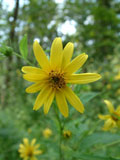
Mr. Smarty Plants wants his readers to know that he is not qualified to give medical advice, which includes making suggestions on herbs and medicinal plants for various ailments. He can only tell you what is best to grow in your part of the United States. On that note, Helianthus tuberosus (Jerusalem artichoke) is native to most of the United States, with the exception of the desert southwest. In Utah, it is actually considered a native of Utah County! This is a plant we can recommend because it is a beautiful native that can be grown locally by you. For information on propagating this plant - I would contact your County extension service, the native plant society of Utah, the university, and the American Botanical Council (Austin). The Wikipedia article on the Jerusalem artichoke indicates that it is a source of fructose and ethanol fuel. I was amused by the quote from the English planter John Goodyer from Gerard's Herbal, which was rather scathing towards Jerusalem artichoke as a food!
You should always consult your physician before embarking on a herbal course. I checked a few sources for herbal information. Ones that appeared reputable were the American Botanical Council, Suite 101, and an article by Jonathan Klemens. Still, looking at the herbs that were mentioned, only a few were native to the US and none to Utah, which makes them inappropriate to recommend to you.
From the Image Gallery
More Edible Plants Questions
How Do Persimmons Breed - Starkville, MS
August 14, 2012 - Thank you for your earlier response about the genders of native persimmon trees. We have two, a much larger one that has borne fruit for years and years and a smaller one that I'd just assumed was m...
view the full question and answer
Garden crop to plant in July in Austin
July 16, 2010 - I've just been given access to a plot at Sunshine Gardens and must plant something within 30 days. What would be a good planting crop for the middle of July that would be successful for harvesting i...
view the full question and answer
Edible fruits and plants in Pennsylvania
May 15, 2008 - Can you give me a list of edible berries and plants that someone might find if they were hiking through the forest of Pennsylvania?
view the full question and answer
Non Toxic Fruit Plants
April 03, 2015 - I am trying to plant on my backyard. My dog spends about 8 hours a day outdoors and I am afraid she will be poisoned. I am overwhelmed by the information of toxic trees\plants for dogs. However, I ju...
view the full question and answer
Digging sassafras roots in Oklahoma
March 11, 2009 - When should I dig sassafras roots in eastern Oklahoma?
view the full question and answer
| Support the Wildflower Center by Donating Online or Becoming a Member today. |