Native Plants
Q. Who is Mr. Smarty Plants?
A: There are those who suspect Wildflower Center volunteers are the culpable and capable culprits. Yet, others think staff members play some, albeit small, role. You can torture us with your plant questions, but we will never reveal the Green Guru's secret identity.
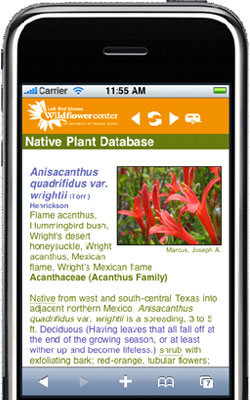
Did you know you can access the Native Plant Information Network with your web-enabled smartphone?
Ask Mr. Smarty Plants
Ask Mr. Smarty Plants is a free service provided by the staff and volunteers at the Lady Bird Johnson Wildflower Center.
rate this answer

Monday - May 03, 2010
From: St. Augustine, FL
Region: Southeast
Topic: Shrubs
Title: Dwarf foundation plants for St. Augustine FL
Answered by: Barbara Medford
QUESTION:
Need to put in fast, low growing (3' max) foundation plants that would be frost hardy and work well in the St. Augustine area of Northeast Florida.ANSWER:
With very few exceptions, there are no shrubs that will grow in Florida that will not get taller than 3 ft. very quickly. Your sub-tropical climate and normally frequent rains are an inspiration to most shrubs to head for 6 to 8 feet. So, you may find dwarf varieties of some plants native to your area. These cultivars (cultivated variety) or selections are being developed by growers all the time. Since the Lady Bird Johnson Wildflower Center is dedicated to the use, protection and propagation of plants native not only to North America but to the area in which they are being grown, we will first look in our Recommended Species List, selecting Florida on the map and then "shrub" for General Appearance. Since you did not say if you needed plants that tolerate shade or full sun, we will have to leave that specification off. One excellent foundation plant is Ilex vomitoria (yaupon); you will definitely need a dwarf version of that. Follow the plant links to each page on that plant to find out its normal size, whether or not it is evergreen, and what moisture and sunlight requirements it has.
Short Shrubs for St. Augustine, FL:
Callicarpa americana (American beautyberry)
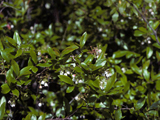
Gaylussacia dumosa (dwarf huckleberry)
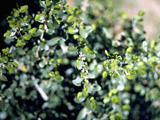
Ilex vomitoria (yaupon) - you will definitely need a dwarf of this. Here is a list of references.:
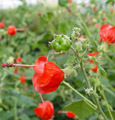
Malvaviscus arboreus (wax mallow)
Vaccinium myrsinites (shiny blueberry) - more information from Floridata
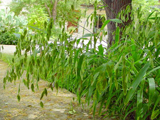
Chasmanthium latifolium (Inland sea oats) - This is actually a grass, 2-4 ft. tall, with graceful seed heads that bend over. It makes a nice short hedge and is a shade plant.
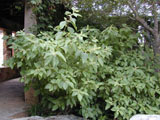
From our Native Plant Image Gallery:

More Shrubs Questions
Care of Northern honeysuckle bush
April 26, 2009 - I have a honeysuckle bush, I have had it for about year to two years. I would like to know if I should cut the brown parts off. There are some vines that do not look good, but some of the branches ha...
view the full question and answer
Blooming of native swamp azalea in New York
July 04, 2006 - I have a native swamp azalea, very healthy, but it has never bloomed. Do you know why or how I could get it to bloom?
view the full question and answer
Evergreen shrubs for foundation plants
June 02, 2010 - Can you recommend any evergreen shrubs that would work as foundation plants in front of windows, so preferably below 4' tall? I would love a native plant, and of course anything for the birds and be...
view the full question and answer
Identifcation of strange orange growth on shrubs
May 04, 2009 - I have found a strange orange ball shape with softer spikes about 1-2 in. growing from it on my shrubs, they grow around the branch. I believe they are Yews. I have never seen them before but now ther...
view the full question and answer
Availability of Michigan Holly berries in Northern Michigan
November 17, 2012 - I live in Northern Michigan, and am new in the wreath making business. Last year I found Michigan Holly berries and used them for my wreaths. They have the most beautiful berries I have ever seen, a...
view the full question and answer
| Support the Wildflower Center by Donating Online or Becoming a Member today. |