Native Plants

Q. Who is Mr. Smarty Plants?
A: There are those who suspect Wildflower Center volunteers are the culpable and capable culprits. Yet, others think staff members play some, albeit small, role. You can torture us with your plant questions, but we will never reveal the Green Guru's secret identity.

Did you know you can access the Native Plant Information Network with your web-enabled smartphone?

Ask Mr. Smarty Plants
Ask Mr. Smarty Plants is a free service provided by the staff and volunteers at the Lady Bird Johnson Wildflower Center.

rate this answer

Thursday - April 29, 2010
From: Whitehouse Station, NJ
Region: Northeast
Topic: Problem Plants, Grasses or Grass-like
Title: Aggressive native Inland Sea Oats in Whitehouse Station NJ
Answered by: Barbara Medford
QUESTION:
Can you direct me to a source of help managing a very aggressive grass, Chasmanthium latifolia, Woodland Oats or Indian Sea Oats. It is behaving like a very noxious plant and I am concerned as I am having trouble controlling it.ANSWER:
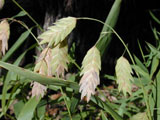
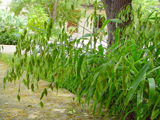
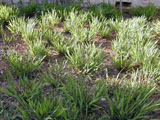
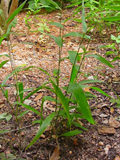
We are surprised to find someone wanting to get rid of Chasmanthium latifolium (Inland sea oats). In Texas, many gardeners love it, because it is one of the few grasses that really do well in shade, it looks good most seasons, and will virtually make a hedge with it's graceful stems and "oats" hanging over. However, everyone has their preferences and we will see what we can do to help you.
From Wayside Garden, we found this article Three Seasons of Showy Color for the Shade; they don't consider it invasive but several of the responders in Dave's Garden do. This Floridata site, Chasmanthium latifolium, conceded that it could be invasive if you had it in moist soil and sun, so that's at least a clue.
We found no one saying "This is a pest, and this is how to get rid of it," so we will have to do it. First, don't let it seed; in fact, keep it cut down very low. This can eventually starve it out, but it's a little slow. The roots are apparently fairly easy to transplant, so we're assuming they are also easy to dig out. If you have it growing in a garden situation, that is going to make it harder, because you may have to keep the soil moist for the garden plants, and don't want to disturb the other plant roots to dig up the grass roots. It can spread both by seeds and roots, you'll have to address it on both fronts. Since it is a grass, a member of the Poaceae family, you can purchase a weed killer for monocots, only; that is, grasses. When a plant has a good root system like this one does, it's difficult to get the herbicide to the roots. You might try cutting it down as much as you can, which eliminates seed, and then painting the stalks left in the ground with the herbicide and a small disposable paint brush. Be careful, though, your lawn is probably a grass, too, so we don't recommend spraying. Dig out as many of the roots as you can, and dispose of them where they won't regrow. You'll have to keep watching for it and grubbing it out as it comes up in the Spring.
From our Native Plant Image Gallery:
More Grasses or Grass-like Questions
Tree without extensive root system in Ozark, AL
April 10, 2009 - I would like to plant a tree (in full sun next to a brick house wall) that doesn't have an extensive root system. I have concerns about the roots and the water/septic lines, as well as the concrete h...
view the full question and answer
Use of Turffalo in Possum Kingdom TX
June 27, 2013 - Hello, we will be building a retirement home in the hillside area of Possum Kingdom Lake which currently has cactus, cedar, and some live oaks. Our intention is to keep most of the 8 acres natural wi...
view the full question and answer
Using bamboo as a filter for odoras from a wastewater treatmen plant in College Station, TX
November 16, 2014 - My wastewater treatment plant is considering planting bamboo to create a filter for odors between it and the neighborhood. Are there any native plant alternatives that would function as well (if not b...
view the full question and answer
Looking for a tall ornamental grass native to Massachusetts.
July 23, 2009 - I am looking for a tall (4-8 ft) ornamental grass, native to Massachusetts/ New England. It needs to be tolerant of moist to wet soil, and preferably colorful. Thanks for your help.
view the full question and answer
Grasses for area under pecan tree in Tennessee
March 26, 2009 - I have two big pecan trees in my yard and would like to know what kind of grasses would thrive in the shade and also survive for my area of the country.
view the full question and answer
| Support the Wildflower Center by Donating Online or Becoming a Member today. |