Native Plants
Q. Who is Mr. Smarty Plants?
A: There are those who suspect Wildflower Center volunteers are the culpable and capable culprits. Yet, others think staff members play some, albeit small, role. You can torture us with your plant questions, but we will never reveal the Green Guru's secret identity.
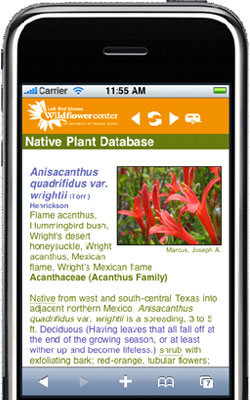
Did you know you can access the Native Plant Information Network with your web-enabled smartphone?
Ask Mr. Smarty Plants
Ask Mr. Smarty Plants is a free service provided by the staff and volunteers at the Lady Bird Johnson Wildflower Center.

rate this answer

Sunday - April 18, 2010
From: San Antonio, TX
Region: Southwest
Topic: Shade Tolerant
Title: Shrub or small tree for dappled shade in San Antonio
Answered by: Nan Hampton
QUESTION:
I'm looking for an attractive bush or small tree that will grow in dry, dappled shade. I'd prefer one that does not form fruit-I don't want the neighborhood skunks visiting my yard.(My dog has been sprayed twice already).ANSWER:
All flowering plants are going to have fruits of some sort unless it is a plant that produces male and female flowers on separate plants and you choose a male plant. Skunks, by the way, are omnivorous—eating insects, worms, small rodents and lizards as well as some berries and fruits. We can't guarantee that you won't get skunks in your yard, but here are some possibilities native to the San Antonio area that won't produce fruits particularly attractive to skunks:
The male trees won't produce fruits. The fruits on the female trees will be far enough from the ground that the skunks can't reach them. They are generally eaten by birds before they would fall to the ground.
Leucophyllum frutescens (Texas barometer bush)
The fruits are small and not particularly attractive to skunks. It prefers full sun but will grow in partial shade.
Sophora secundiflora (Texas mountain-laurel)
The beans (fruits) of the mountain laurel are poisonous and not eaten by skunks or any other animals as far as I know.
Erythrina herbacea (coralbean) The beans of this plant are also toxic and would not be attractive to skunks.
Cornus drummondii (roughleaf dogwood) Fruits more likely will be eaten by birds before they fall to the ground.
You can go to the Recommended Species page and select South Texas from the map or pulldown menu and use the NARROW YOUR SEARCH option in the side bar to select 'Shrub' or 'Tree' from the GENERAL APPEARANCE category and 'Partial Shade' from the LIGHT REQUIREMENT category to find more recommendations.


More Shade Tolerant Questions
Low maintenance, shade tolerant groundcover for Pacific Northwest
August 09, 2012 - What's a good low maintenance, shade tolerant ground cover for the Pacific Northwest? It needs to have good erosion control, too.
view the full question and answer
Groundcover for foot traffic in dry shade from Prineville OR
May 12, 2013 - I live in central Oregon. I have an area under a large elm tree that slopes on all sides and has lots of foot traffic and no sun. (my kids have a swing in the tree and play around it a lot.) It's a v...
view the full question and answer
Plants for shade in Pennsylvania
September 13, 2008 - i would like to plant a small area in my rear yard, that is full shade in the summer (when the trees are full with leaves) and part shade in early spring. i live on a state park - there are plenty of...
view the full question and answer
Low water use tree to shade pond in Burnet TX
May 10, 2011 - I'm in need of some shade at a 1/2 acre pond, but I don't want a tree to consume so much water that it will lower the water level. During droughts the little pond needs all the water it can get. Som...
view the full question and answer
Sedges and ornamentals for shade in Bastrop County
June 20, 2007 - I bought a home in Elgin, TX that was owned by an elderly woman. Most of
the lawn is shaded by elm or pecan trees. In the sunny areas, i got native
wildflowers to grow like lantana and coneflower,...
view the full question and answer
| Support the Wildflower Center by Donating Online or Becoming a Member today. |