Native Plants

Q. Who is Mr. Smarty Plants?
A: There are those who suspect Wildflower Center volunteers are the culpable and capable culprits. Yet, others think staff members play some, albeit small, role. You can torture us with your plant questions, but we will never reveal the Green Guru's secret identity.

Did you know you can access the Native Plant Information Network with your web-enabled smartphone?

Ask Mr. Smarty Plants
Ask Mr. Smarty Plants is a free service provided by the staff and volunteers at the Lady Bird Johnson Wildflower Center.

rate this answer

Monday - February 08, 2010
From: Woburn, MA
Region: Mid-Atlantic
Topic: Wildflowers
Title: Is common milkweed considered endangered from Woburn MA
Answered by: Barbara Medford
QUESTION:
Is common milkweed, a food source for monarchs, considered federally protected, endangered, rare or threatened? Does any state protect common milkweed? It would be nice; if not, if state parks and national parks could protect it for the butterflies. Also, technically, is it considered a weed? Thank you.ANSWER:
Last question first: A weed is a plant that is not where you want it to be. We can probably all agree on some plants, like poison ivy, being a weed. No one wants it anywhere. If milkweed is in a pasture and the farmer doesn't want his stock grazing on it, he sees it as a weed. But you, obviously concerned about the well-being of the Monarch, do not.
When we searched our Native Plant Database on "milkweed;" there were 46 hits, of which 6 of them were plants having "milkweed" in their common names, but were not members of the genus Asclepias, family Asclepiadaceae. One, Asclepias syriaca (common milkweed), was the only one with "common" in its name. However, we are assuming you are referring to the genus Asclepias as a group, all of which do, indeed, support the Monarch butterfly, and allow that butterfly to pass some of the toxins from the milkweed on to its offspring as protection against predators. There are no doubt some milkweeds that are perhaps not as widespread, and might be considered rare, but by and large, the Monarchs would seem not to be in imminent danger of extinction because of their food source.
However, let's talk a little bit more about what makes a plant considered endangered, rare, threatened, etc.We went to a USDA website for Threatened and Endangered Plants and got a listing of the members of the genus Asclepias that are protected in various states; two are on the Federal threatened list.
From a U.S Fish and Wildlife Service website Endangered Species Program. we extracted this quotation:
'An “endangered” species is one that is in danger of extinction throughout all or a significant portion of its range. A “threatened” species is one that is likely to become endangered in the foreseeable future.'
The site goes on to tell you far more than you probably ever want to know about getting a plant or animal declared endangered, with many links to other sites for more information. Since you are from Massachusetts, we did a search on our Native Plant Database on the Asclepias genus. From this, we found 10 species of milkweed native to your state and extending west, north and south.
Asclepias native to Massachusetts and their natural range:
Asclepias amplexicaulis (clasping milkweed) - as far west as Kansas and Texas
Asclepias exaltata (poke milkweed) - as far west as Minnesota
Asclepias incarnata (swamp milkweed) - all but West Coast states and Mississippi, plus Manitoba, Ontario and Quebec
Asclepias incarnata ssp. incarnata (swamp milkweed) - all but West Coast states and Arizona, plus Manitoba, Ontario and Quebec
Asclepias purpurascens (purple milkweed) - 31 states and Ontario
Asclepias quadrifolia (fourleaf milkweed) - approx. 27 states and Ontario
Asclepias syriaca (common milkweed) - 40 states and large portion of Canada
Asclepias tuberosa (butterfly milkweed) 43 states and Eastern and Central Canada
Asclepias verticillata (whorled milkweed) - all states as far west as Montana and Arizona, midsection of Canada
If you assess all this information, we believe you'll agree that there is little chance the Asclepias will need to be declared endangered.
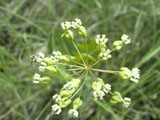
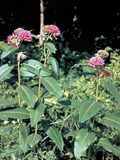
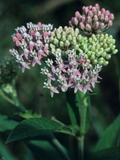
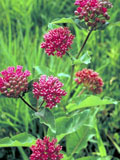
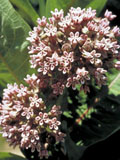
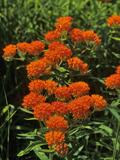
From our Native Plant Image Gallery:


More Wildflowers Questions
Creating a wildflower meadow
May 18, 2013 - I have an area 1-6 acres worth that is currently grass that I would like to overseed with wildflower seed. The local native plant nursery says that would be a waste. I don't really want to kill gra...
view the full question and answer
Plants for a Shaded Slope in Philadelphia
April 17, 2015 - I have a small slope along the North side of my house in a suburb of Philadelphia. A small maple tree grows there but most of it gets no sun at all (a large segment is under the tree). I had the soil ...
view the full question and answer
Can bluebonnets be made into jelly from Ennis TX
May 07, 2013 - Are Texas bluebonnet flowers okay for human consumption? I have seen recipes for wild violet jelly,so was wondering about making bluebonnet jelly from the bluebonnet blossoms if they are not poisonous...
view the full question and answer
Wildflower blooming in Austin in mid-March from Laceys Spring AL
February 27, 2013 - Hi I will be at and around the center the weekend of March 9 & 10 to exhibit in the Art and Artisan's Festival and plan to stay a few extra days to "wildflower" either before or after. What is you...
view the full question and answer
Wildflower succession from Austin
April 02, 2011 - I am interested in learning about a wildflower "cycle" (not sure of a better term). I recently saw the Wildflower special on PBS that talked briefly about an area that had wildflowers that naturally...
view the full question and answer
| Support the Wildflower Center by Donating Online or Becoming a Member today. |