Native Plants

Q. Who is Mr. Smarty Plants?
A: There are those who suspect Wildflower Center volunteers are the culpable and capable culprits. Yet, others think staff members play some, albeit small, role. You can torture us with your plant questions, but we will never reveal the Green Guru's secret identity.

Did you know you can access the Native Plant Information Network with your web-enabled smartphone?

Ask Mr. Smarty Plants
Ask Mr. Smarty Plants is a free service provided by the staff and volunteers at the Lady Bird Johnson Wildflower Center.

rate this answer

Monday - August 03, 2009
From: Royal Palm Beach, FL
Region: Southeast
Topic: Edible Plants
Title: Use of Ilex sp. by Seminole Indians to make black drink.
Answered by: Dean Garrett and Nan Hampton
QUESTION:
Ilex myrtifolia: can the leaves be used as tea? Seminole indians made a black drink reputed to be made of holly leaves.ANSWER:
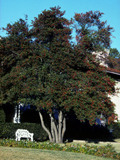
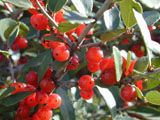
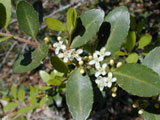
The holly used to make this black "tea" is Ilex vomitoria (yaupon), and not Ilex myrtifolia (myrtle dahoon). There is, in fact, a book considered the standard reference book for Native American use of this drink—"Black Drink" by Charles Hudson, an anthropologist specializing in cultures of the Southeast. A small company out of St. Augustine, Florida, (Brown's St. Augustine Tea Company) has sold it in recent years and may still do so. Ilex vomitoria is related to Ilex paraguariensis, the South American holly used to make the national drink of Argentina, maté or yerba maté. Like the maté, the black drink made from the leaves of Ilex vomitoria (yaupon) is loaded with caffeine. Before the mass marketing of coffee and standard teas, this black drink made from yaupon was very popular in the southeastern US, usually known as Cassina or Cassina Tea, after one of the names for Ilex vomitoria. One of us (Dean) has tried some that was ordered from St. Augustine Tea Company and also made some from wild yaupon stands west of Austin, Texas. It tastes like maté and definitely packs a lot of caffeine like maté. It does not make you vomit, despite the species name. European explorers witnessed Southeastern Native Americans vomiting after drinking tons of the piping hot liquid in ceremonies, but it was either voluntarily induced or because of other ingredients added.The Native American Ethnobotany database from the University of Michigan-Dearborn lists a number of uses for Ilex sp., but doesn't list Ilex myrtifolia (myrtle dahoon) specifically. Ilex sp. leaves are said to have been used by the Comanche Indians to make a beverage. Enter "Ilex" in the Search String to see all the uses given by the database. If you would like to see the uses of Ilex sp. by the Seminoles, enter "Ilex AND Seminole" in the search string. Or, if you just want to see all entries for Seminole Indians, enter "Seminole" in the search string. Ilex vomitoria (yaupon) does grow in Florida and you can see the other different Ilex sp. that also grow in Florida in the maps on the Ilex sp. page of the USDA Plants Database.
More Edible Plants Questions
Failure of highbush blueberry plant to produce in New Hampshire
July 25, 2008 - One of my highbush blueberry plants completely stopped producing. What can I do to revive it?
view the full question and answer
Plants for farm animals from East Greenwich RI
May 03, 2014 - What type of perennial flowers and shrubs are safe to plant around farm animals (dogs, horses, chickens, turkeys) in New England climate?
view the full question and answer
Red berry that changes the taste of other foods
January 15, 2013 - Hi, your site is fantastic.
I heard from a friend that he tried a red berry in Florida which when eaten change the taste of other foods eaten afterwards. He ate a lemon after trying that berry and th...
view the full question and answer
A garlic plant with only one clove in Ft. Worth, TX?
August 08, 2011 - Is there a garlic that does not have cloves? I have been using what appears to be garlic from my garden and it is garlicy, hot and delicious. I have spent many hours online but cannot find this garlic...
view the full question and answer
Edible plants beginning with I, T, X and Z in Colorado
March 26, 2009 - My friend would like to know a fruit or vegetable that he would plant in his garden and come back yearly. The plants would have to start with the letters I,T,X, & Z. It has to be edible, of course.
view the full question and answer
| Support the Wildflower Center by Donating Online or Becoming a Member today. |