Native Plants

Q. Who is Mr. Smarty Plants?
A: There are those who suspect Wildflower Center volunteers are the culpable and capable culprits. Yet, others think staff members play some, albeit small, role. You can torture us with your plant questions, but we will never reveal the Green Guru's secret identity.

Did you know you can access the Native Plant Information Network with your web-enabled smartphone?

Ask Mr. Smarty Plants
Ask Mr. Smarty Plants is a free service provided by the staff and volunteers at the Lady Bird Johnson Wildflower Center.

rate this answer

Sunday - June 07, 2009
From: Oakton, VA
Region: Mid-Atlantic
Topic: Groundcovers
Title: Plants to put between stepping stones in Virginia
Answered by: Nan Hampton
QUESTION:
We are a public school in Northern Virginia and are looking for native plants that could be planted between heavily used stepping stones and could withstand some foot traffic (mostly in a sunny spot, but would love to know good plants for different light conditions for other areas of the school as well, from very sunny to deep shade).ANSWER:
Mr. Smarty Plants suggests that you go to our Recommended Species page and select Virginia from the map or pull-down menu. This will give you a list of more than 120 native plants that are commercially available for landscaping in Virginia. You can use the NARROW YOUR SEARCH OPTION to limit the list to a particular type of plant; for instance, under General Appearance you might select 'Herb' or 'Shrub' and then select the appropriate choice under Light Requirement and/or Soil Moisture. This would give you many choices for the different light conditions in the other areas of your school. For the areas between stepping stones, here are a few recommendations. If you can keep traffic to a minimum until the plants are well-established, they will have a better chance of withstanding regular traffic.
Phyla nodiflora (turkey tangle frogfruit)
Dichondra carolinensis (Carolina ponysfoot)
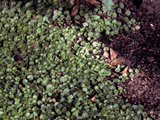
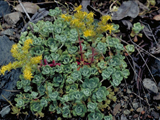
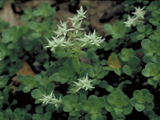
Sedum glaucophyllum (cliff stonecrop)
Sedum ternatum (woodland stonecrop)
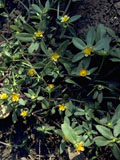
Portulaca oleracea (little hogweed)
Portulaca halimoides (silkcotton purslane)
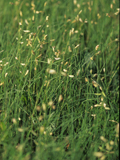
Bouteloua dactyloides (buffalograss) grows very well in the sun and requires little watering once established. Since it grows only as high as 12 inches, it would perhaps need mowing only once or twice a season.


More Groundcovers Questions
Habiturf lawn in Carson City, NV
October 15, 2013 - I planted habiturf just south of Reno NV May 5. First two months no or little germination because nite temps too cold. Now doing ok except battling purslane and redstem filaree.. SO, I notice bare/spa...
view the full question and answer
Groundcover for Lighthouse Point FL
April 13, 2012 - Dear Mr. Smarty Plants:
I am looking for mowable ground cover for part of my back yard. Due to a Mahogany tree, a hammock, surrounding foliage and a fence, there is alot of shade in the area, alon...
view the full question and answer
Ground cover for under a maple tree in DE
December 22, 2010 - In my front yard in Newark, Delaware, I have a HUGE maple tree that shades the whole yard and most of its roots are visible and make the yard very "bumpy." Consequently, grass does not grow well the...
view the full question and answer
Groundcovers over roots in Roeland Park KS
June 18, 2013 - Large Hackberry tree (aprox 50+years) roots are popping up above ground making mowing under/around it impossible. Is there a plant, ground cover, something I can plant, or cover the roots with that w...
view the full question and answer
Straggler daisy as a ground cover in Florida
April 21, 2015 - I live in Hillsborough county,FL. My yard has two large oak trees and is very shady. I am looking for a shade resistant ground cover that will do well for a yard used by children to play.
I was told...
view the full question and answer
| Support the Wildflower Center by Donating Online or Becoming a Member today. |