Native Plants

Q. Who is Mr. Smarty Plants?
A: There are those who suspect Wildflower Center volunteers are the culpable and capable culprits. Yet, others think staff members play some, albeit small, role. You can torture us with your plant questions, but we will never reveal the Green Guru's secret identity.

Did you know you can access the Native Plant Information Network with your web-enabled smartphone?

Ask Mr. Smarty Plants
Ask Mr. Smarty Plants is a free service provided by the staff and volunteers at the Lady Bird Johnson Wildflower Center.

rate this answer

Sunday - March 15, 2009
From: Cleburne, TX
Region: Southwest
Topic: Privacy Screening
Title: Screening plant for pool in Cleburne, Texas
Answered by: Nan Hampton
QUESTION:
I recently put in a very large pool. I need to plant something for fast growing, taller than an 6 ft fence for privacy. The property isn't so appealing behind my pool. When standing on my deck, I have a 6 ft privacy fence, but my deck is built up so, people going to the diving board can look over at the next doors UGLY BURNED DOWN HALF STANDING BARN. Is there anything I can plant that will completely block this view? I was thinking baboo? The area needed to be blocked is about 50 yards in length. I will be planting this in front of a redwood fence 50 ft in length. If you can think of anything that I can plant, please let me know...ANSWER:
Our focus and expertise are in plants native to North America. The only bamboo native to North America is Arundinaria gigantea (canebreak bamboo) and there are two subspecies Arundinaria gigantea ssp. gigantea and Arundinaria gigantea ssp. tecta. The A. gigantea ssp. tecta is the shorter of the two, growing only to about 8 feet tall; whereas, the A. gigantea ssp. gigantea can grow up to 30 feet tall. This giant cane or canebrake bamboo does require lots of water so that might be a factor in your decision to plant it. Also, bamboos can be invasive since they spread quickly by rhizomes (underground stems). You certainly would want to consider installing a barrier to keep it from spreading out of control.Assuming you want an evergreen plant for screening year round, here are three other possibilities:
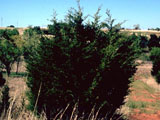
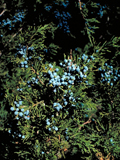
Juniperus virginiana (eastern redcedar) can grow into a tall tree (>40 feet), but it can be an effective dense screen if you plant them close together and keep them pruned. They also have berries that attract birds.
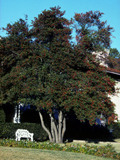
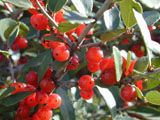
Ilex vomitoria (yaupon) grows 15-25 feet high and female plants produce red berries that attract birds.
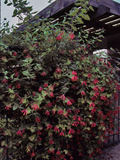
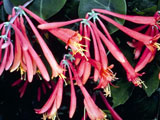
Lonicera sempervirens (trumpet honeysuckle) is an evergreen vine, but if you wanted to extend your fence upwards by a couple of feet with a trellis, trumpet honeysuckle growing on it would make a good screen. It attracts hummingbirds and butterflies.
More Privacy Screening Questions
Shrubs that non-toxic to horses but that they won't eat
October 29, 2011 - I am looking for a low maintenance, low water, green shrub that horses won't eat and will not be toxic to them. I want to hide my neighbors corral and keep down dust on my side. The horses have "l...
view the full question and answer
Is purple bindweed good for a screen growing on a fence?
September 12, 2012 - We cleared a bunch of dead trees and tree limbs (mostly cedars and some oaks) on our semi-rural property in Driftwood and now we're left with an undesirable view onto the neighboring property. We're...
view the full question and answer
Pruning cherry laurel in January in Austin
January 07, 2011 - Do trust I checked Q&A first. Can Cherry Laurel shrubs be pruned earlier than late winter in Austin? I foolishly planted 12 native Cherry Laurel standards on our suburban property line 5 years ago. I ...
view the full question and answer
Need suggestions for plants for a privacy screen in Long Beach, NY.
August 10, 2011 - I have recently added 1500sq.ft. to my backyard. My backyard faces a busy road. I would like to place native trees and bushes along the fence for added privacy, shade and to protect my house from the...
view the full question and answer
Plants to hide utility boxes
July 16, 2008 - What are suggestions for plants to plant around utilities boxes (3 of them clustered together) to effectively camouflage them but be attractive. We will outline a larger area in brick, plant evergree...
view the full question and answer
| Support the Wildflower Center by Donating Online or Becoming a Member today. |