Native Plants

Q. Who is Mr. Smarty Plants?
A: There are those who suspect Wildflower Center volunteers are the culpable and capable culprits. Yet, others think staff members play some, albeit small, role. You can torture us with your plant questions, but we will never reveal the Green Guru's secret identity.

Did you know you can access the Native Plant Information Network with your web-enabled smartphone?

Ask Mr. Smarty Plants
Ask Mr. Smarty Plants is a free service provided by the staff and volunteers at the Lady Bird Johnson Wildflower Center.

rate this answer

Thursday - January 29, 2009
From: Charlotte, NC
Region: Southeast
Topic: Erosion Control
Title: Native plants for erosion control in North Carolina
Answered by: Barbara Medford
QUESTION:
I have an area on the north side of my house that is a hill with about a 6:1 slope. It also has a set of steps used to get from the front of the yard to the rear yard. It is very shaded. I am having a problem with erosion around my steps and stepping stones. I plan to cover the area around the steps/stepping stones with small river stone. My local nursery suggested Phlox. I would like a recommendation on some types of plants that would provide color and ground cover in this situation, that will be low maintenance if possible ? Can you please provide some insight ?ANSWER:
Probably the biggest deterrent to erosion is a grass or sedge. They have fibrous roots that grab and hold the soil, and keep it from slithering away. We realize you specified adding some color to your area, and some of the grasses do have color and can be very attractive. We will select some blooming groundcovers and some grasses that we feel would address your problem. To do this, we will go to our Recommended Species site, click on North Carolina on the map, and then NARROW YOUR SEARCH, selecting "Herb" (herbaceous flowering plants) under Habit, and "Shade" under light requirements. We will repeat the process selecting "Grass or Grass-like" under Habit. From those, we will be able to pick plants native, not only to North America but to North Carolina, that will thrive in the conditions you specified. You can follow the links to each plant page and learn how big it gets, whether it's perennial or annual, what color the blooms are, etc. These plants are all commercially available; if you have difficulty locating the ones you like, go to our Native Plant Suppliers section, type in your town and state in the "Enter Search Location" box and it will give you a list of native plant nurseries, seed companies and landscape and environmental specialists in your general area.
HERBS (herbaceous flowering plants)
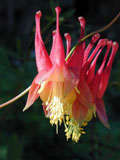
Aquilegia canadensis (red columbine)
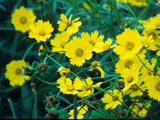
Coreopsis lanceolata (lanceleaf tickseed)
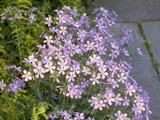
Phlox divaricata (wild blue phlox)
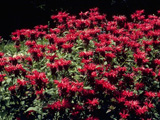
Monarda didyma (scarlet beebalm)
GRASSES OR GRASS-LIKE PLANTS
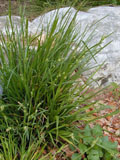
Carex blanda (eastern woodland sedge)
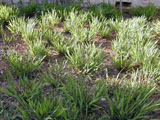
Chasmanthium latifolium (Inland sea oats)
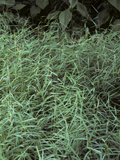
Muhlenbergia schreberi (nimblewill)
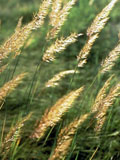
Sorghastrum nutans (Indiangrass)
More Erosion Control Questions
Plants to stem bank erosion in Ponder, Texas
May 07, 2010 - We have a pond with a bridge over the middle in full sun with a steep bank on one side. The bank is difficult to maintain and we need some natural looking low maintenance plants or ground cover to pl...
view the full question and answer
Plants for slope in central Alabama
July 26, 2011 - Our home is atop a 20-25' eastern facing sandy loam slope in central Alabama. It was previously covered w/ kudzu. After 3 yrs. of eradication of the kudzu we are ready to plant with native grasses/pl...
view the full question and answer
Groundcover for Bonsall, CA
October 17, 2012 - I live in Bonsall, CA. (San Diego) I have 3 acres, flat and sloped that are graded dirt. (DG and sheep poop from previous owner). It is getting close to mud season and I'd like to plant winter cover...
view the full question and answer
Raised beds over lateral lines in Solgohachia AR
January 02, 2010 - I would like to build raised flower beds over my lateral lines. They would be planted with strawberries and perennials. Will this cause any problems with the absorption into the ground or not lettin...
view the full question and answer
Plants to control hillside erosion in Virginia.
November 21, 2007 - Good Morning, Mr Smarty Plants, I need your advice and guidance.
I live in a condo complex in Virginia and we have a hill/slope that is eroding. It also has two very nice tall trees that partially sh...
view the full question and answer
| Support the Wildflower Center by Donating Online or Becoming a Member today. |