Native Plants

Q. Who is Mr. Smarty Plants?
A: There are those who suspect Wildflower Center volunteers are the culpable and capable culprits. Yet, others think staff members play some, albeit small, role. You can torture us with your plant questions, but we will never reveal the Green Guru's secret identity.

Did you know you can access the Native Plant Information Network with your web-enabled smartphone?

Ask Mr. Smarty Plants
Ask Mr. Smarty Plants is a free service provided by the staff and volunteers at the Lady Bird Johnson Wildflower Center.

rate this answer

Tuesday - June 24, 2008
From: Sand Creek, WI
Region: Midwest
Topic: Erosion Control
Title: Erosion on sandy bank in Wisconsin
Answered by: Barbara Medford
QUESTION:
I live in Sand Creek Wisconsin. As the name states SAND. I have a problem with rain eroding the sand hill sides. Looking for some type of plant or plants that will help with the erosion problem.ANSWER:
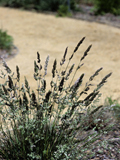
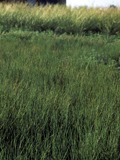
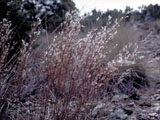
We have been getting a lot of questions on erosion lately. Our answer is always pretty much the same; that is, that grasses have the best potential for holding the soil on a slope. The only thing we change is that we try to recommend grasses or grass-like plants that are appropriate to the area concerned, as well as to the soils, if we know what they are. So, in your case, we went to Recommended Species, selected Wisconsin from the map, narrowed our search to grasses or grass-like plants. Then, of that number, we went into the webpage on each plant and looked for the soil it would grow in, and selected the ones that tolerated (or even preferred) sandy soil. You can do the same and make different choices, based on shade or sun exposure, etc. Once the grasses are established, you might want to turn the area into something a little more attractive by adding wildflowers appropriate to your area. See our How-To Article on Meadow Gardening for suggestions. This is not a fast process, but can be very rewarding. To find both the seeds or plants to fill your meadow garden, go to our Suppliers section, type in your town and state in the Enter Search Location box, and you will get a list of native plant nurseries, seed suppliers and landscape consultants for your general area. Any reputable dealer will be able to advise you on the time of year to plant seed, whether to use seed or small plants to begin, and appropriate care for them until they are established. Most of the plant webpages have propagation information in them; i.e., seeds, cuttings, etc.
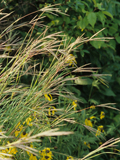
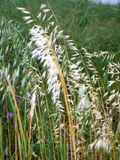
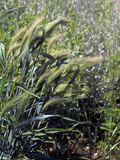
Here are our suggested grasses for erosion control in Wisconsin:
Andropogon gerardii (big bluestem)
Bouteloua curtipendula (sideoats grama)
Elymus canadensis (Canada wildrye)
Koeleria macrantha (prairie Junegrass)
Pascopyrum smithii (western wheatgrass)
Schizachyrium scoparium (little bluestem)
Sorghastrum nutans (Indiangrass)

More Erosion Control Questions
Solution for erosion on steep slope in California
April 14, 2011 - Dear Mr.Smarty Plants,
I have a serious hillside problem in Santa Cruz County resulting from the recent deluge of rain. Steep to sheer now with no plants left on it after the hill slide washed to th...
view the full question and answer
Controlling erosion in Leburn KY
July 21, 2009 - I would really appreciate advice on controlling a serious erosion problem in eastern Kentucky. The slope is north facing, shady and moist with rich soil. Would prefer to use native Kentucky plants. ...
view the full question and answer
Stream Bank Erosion Control for Bryan/College Station
August 16, 2012 - I live in the Bryan/College Station area and need a ground cover to abate erosion on the bank of an intermittent stream. The bank is shaded. Do you have any suggestions?
view the full question and answer
Native plants and grasses for river bank from Rosanky TX
February 19, 2014 - Our property owners association would like to know what native plants/grasses to plant on the Blanco River bank in our river park to help prevent erosion. Some banks are steep and some areas are a gra...
view the full question and answer
Plants for steep slope in Virginia
October 24, 2008 - Please help! Looking for landscaping ideas for a very large Steep hill. Features: slope is approximately 45-60 degrees, clay soil mixed with fill dirt, lots of deer, partial sun, seeking minimal maint...
view the full question and answer
| Support the Wildflower Center by Donating Online or Becoming a Member today. |