Native Plants

Q. Who is Mr. Smarty Plants?
A: There are those who suspect Wildflower Center volunteers are the culpable and capable culprits. Yet, others think staff members play some, albeit small, role. You can torture us with your plant questions, but we will never reveal the Green Guru's secret identity.

Did you know you can access the Native Plant Information Network with your web-enabled smartphone?

Ask Mr. Smarty Plants
Ask Mr. Smarty Plants is a free service provided by the staff and volunteers at the Lady Bird Johnson Wildflower Center.

rate this answer

Friday - May 30, 2008
From: Houston, TX
Region: Southwest
Topic: Vines
Title: A Pipevine poisonous to Pipevine Swallowtails
Answered by: Barbara Medford
QUESTION:
I have heard that a specific Pipevine is poisonous to the larva of Pipevine Swallowtails. Is this true? If so, what is the poisonous species of Pipevine, and what other types can I plant that will not be poisonous? Thank you!ANSWER:
All of the pipevine plants native to North America (which is what we deal with at the Lady Bird Johnson Wildflower Center) are members of the genus Aristolochia. Many experts consider all parts of plants of that genus to be toxic. In an article by the Napa Valley Master Gardeners, we picked up this information on the toxicity of the plant to the pipevine swallowtail.
"All parts of the pipevine plant, including the seed pods, are toxic to humans. In contrast, caterpillars can ingest the toxins, but then they become unappetizing to birds. Yellow jackets also have no problem cleaning out the pods as soon as they open."
So, apparently, the toxicity in the plant is for the protection of the caterpillars for this beautiful butterfly. We could find no reference of any kind about any member of this genus being poisonous for the larvae. We did note that the plant is not considered a nectar source for the butterfly; perhaps because the nectar would be toxic for the adult.
Here are the species of Aristolochia that are native to Texas:
Aristolochia coryi (Cory's dutchman's pipe)
Aristolochia erecta (swanflower)
Aristolochia pentandra (Marsh's dutchman's pipe)
Aristolochia reticulata (Texas dutchman's pipe)
Aristolochia serpentaria (Virginia snakeroot)
Aristolochia tomentosa (woolly dutchman's pipe)
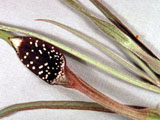
And here is a page of pictures of various species of Aristolochia.
More Vines Questions
Possibility of growing Smilax pumila (Wild Sarsaparilla Vine in Virginia
June 13, 2006 - Hello, I am inquiring about a plant my grandmother keeps telling me about. It's called sarasee (sp?). It's supposed to have some medicinal properties like helping with a cold and things of that nat...
view the full question and answer
Are seeds of trumpet vine poisonous from Creston BC
September 12, 2013 - Are the seeds in the trumpet vines pods poisonous to humans or can I use them as dried beans? I have one plant that covers most of my house's south wall. It is a very established plant.
view the full question and answer
Germination of Purple Clematis from Junction TX
October 31, 2013 - I have some Purple Leather Vine seeds I want to share and want help learning to germinate. Can anyone there help me find interested recipients?
view the full question and answer
Identification of cucumber-like plant with red fruit
July 01, 2012 - Hi; My name is Peter, live in Lewisville. When I walked through a park trail last year, I noticed a very strange vine described as the following:
It is vine with leaves and stems (size and shape) lo...
view the full question and answer
Evergreen Vine for San Antonio Trellis
November 23, 2011 - I have a new trellis at the end of my patio on which I want to grow an evergreen vine. The area is fairly shady. I had settled on Carolina Jasmine, but read that it is very toxic which is worrisome ...
view the full question and answer
| Support the Wildflower Center by Donating Online or Becoming a Member today. |