Native Plants

Q. Who is Mr. Smarty Plants?
A: There are those who suspect Wildflower Center volunteers are the culpable and capable culprits. Yet, others think staff members play some, albeit small, role. You can torture us with your plant questions, but we will never reveal the Green Guru's secret identity.

Did you know you can access the Native Plant Information Network with your web-enabled smartphone?

Ask Mr. Smarty Plants
Ask Mr. Smarty Plants is a free service provided by the staff and volunteers at the Lady Bird Johnson Wildflower Center.

rate this answer

Sunday - July 01, 2012
From: Lewisville, TX
Region: Southwest
Topic: Plant Identification, Vines
Title: Identification of cucumber-like plant with red fruit
Answered by: Nan Hampton
QUESTION:
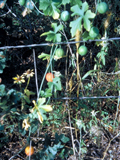
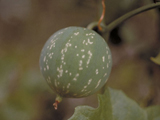
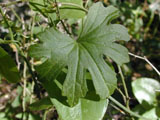
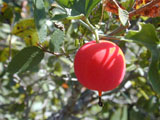
Hi; My name is Peter, live in Lewisville. When I walked through a park trail last year, I noticed a very strange vine described as the following: It is vine with leaves and stems (size and shape) look almost "exact" as creeping cucumber, it climbs on the trees, the young fruit looks just likes a baby waterlemon with beautiful green/light green or yellow strips, if you just see the young fruit, you will definitely say it is a baby water melon; the ripe fruit is beautiful shinny red color with size about 1 to 1.5 inch perfect round ball shape. I picked a ripe fruit, cut it, the inside is not juicy, pretty hollow with about 10 black round ball-like seeds. Can you identify this beautiful plant and give me some detailed information or web sites if possible? Thanks. PeterANSWER:
Your plant description sounds like Ibervillea lindheimeri (Lindheimer's globeberry). It is a member of the Family Cucurbitaceae (Cucumber Family). Here are more photos and information from the School of Biological Sciences, University of Texas and from Texas Agrilife Reasearch and Extension Center in Uvalde, Texas.
It isn't poisonous, but it also isn't edible. You can see a discussion about this aspect of it from the answer to a previous question. You can also see more information about the edibility of the plant, in particular its roots, on the Texas Beyond History page.
For more information about globeberry, scroll to the bottom of the species page on our Native Plant Database (cited above) to the section labeled Additional Resources and click on the species name under USDA link and under the Google link.
From the Image Gallery
More Plant Identification Questions
Plant identification
July 22, 2010 - Dear Mr. Smarty Plants, (love the name), I have found a plant in my yard. Underground it looks like a green onion, above ground it has a broad leaf, a thin 8-12 inch stalk and the top 2" of the stalk...
view the full question and answer
Identification of plant that looks like a spider plant
February 25, 2008 - Okay Mr. Smarty Pants, I have an identification for you. I have no pictures, but I've been staring at this plant for weeks trying to figure out what it is. I got it as a cutting from a friend who got...
view the full question and answer
Taxonomic question about Viola missouriensis and Viola affinis.
March 28, 2011 - I have tentatively identified a violet as either Viola affinis or V. missouriensis. However, the pages for those species are dated 2007 and 2009, respectively, in the NPIN, while it read...
view the full question and answer
Identification of shrub in South Carolina
December 12, 2011 - First, I'm in Iraq but trying to write a book and have a question on a plant that grows in South Carolina. All I can do is describe it. The bush is normally green but turns red, has large leaves, kin...
view the full question and answer
Identity of yellow thistle-like plant
June 01, 2011 - Dear Mr.Smarty Plants,
I see this flower along the road but I can't seem to find it on your website. It looks like a yellow thistle and it is a panicle and a head. It is about a foot tall. Do you kn...
view the full question and answer
| Support the Wildflower Center by Donating Online or Becoming a Member today. |