Native Plants
Q. Who is Mr. Smarty Plants?
A: There are those who suspect Wildflower Center volunteers are the culpable and capable culprits. Yet, others think staff members play some, albeit small, role. You can torture us with your plant questions, but we will never reveal the Green Guru's secret identity.
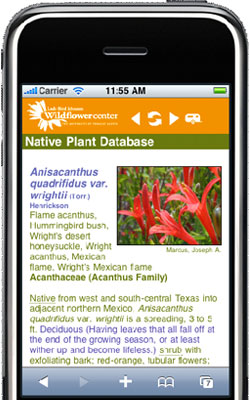
Did you know you can access the Native Plant Information Network with your web-enabled smartphone?

Ask Mr. Smarty Plants
Ask Mr. Smarty Plants is a free service provided by the staff and volunteers at the Lady Bird Johnson Wildflower Center.
rate this answer

Wednesday - May 14, 2008
From: Kyle, TX
Region: Southwest
Topic: General Botany, Diseases and Disorders
Title: Yellowing of palm tree leaves
Answered by: Barbara Medford
QUESTION:
I want to know about palm trees. The leaves are turning yellow.ANSWER:
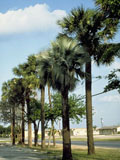
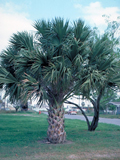
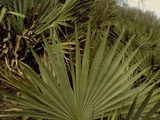
There are more than 2,500 plants in the palm family worldwide, but only about a dozen are native to the United States. We went looking in the Native Plant Database for palm trees that would be native to Texas and, therefore, could reasonably be expected to grow in Hays County. Of course, you may have a non-native palm, but they are probably closely enough related that what would cause leaf yellowing in one would cause it in others. The two Texas native palms we found are Sabal mexicana (Rio Grande palmetto), also called Sabal Texana, and Sabal minor (dwarf palmetto). We also found a website from TreeHelp.com, PalmTree Care. On that same site, there is a section on diseases of the palm tree, of which one is called Lethal Yellowing. We very much hope that is not the problem your tree is suffering, because it seems pretty serious. Read that section and the description of the symptoms, and you can make the decision whether that is the diagnosis.
Hopefully, your palm tree has just a normal occurrence of yellowing leaves, which can be caused by a number of different problems in most plants. We recently had another question on this, and you might want to read this previous Mr. Smarty Plants answer. Since we don't know exactly what palm you are growing, how recently it was planted, or in what environmental conditions it is growing, we could hardly hazard a guess. We hope you have enough information now that you can make an on-the-spot judgment on whether this is something that needs to be treated or can be ignored. And we hope you don't have to abandon your tree! If the problem appears to be wide spread and you know of others having the same indicators in their palm trees, contact the Hays County Extension Office for more localized help.
From the Image Gallery
More General Botany Questions
Will a Venus flytrap bite?
December 01, 2008 - Will a venus flytrap bite a person?
Taylor
view the full question and answer
Fragrant Texas wildflowers from Waco TX
July 28, 2013 - Hi,
I'm interested in looking at any Texas Wildflowers which have attractive aromas which I can distill essential oil from. Any ideas?
Thanks
view the full question and answer
Are Chickasaw plums evergreen?
August 13, 2014 - Are Chickasaw Plums evergreens? I've been very interested in planting a few but some websites say they are evergreens while others say the opposite. Furthermore, would I have to plant a male and fema...
view the full question and answer
Plants addicted to caffeine
February 28, 2009 - Im doing a science project on if plants can get addicted to caffeine, but coffee in general and i was wondering what materials you need to figure that out.
view the full question and answer
Forestiera pubescens blooming in July
August 07, 2012 - I have a lot of what appears to be Forestiera pubescens. They are covered with the dark blue/black berries and flowers. Apparently they are blooming again in the middle of July. I live about 35 mile...
view the full question and answer
| Support the Wildflower Center by Donating Online or Becoming a Member today. |