Native Plants

Q. Who is Mr. Smarty Plants?
A: There are those who suspect Wildflower Center volunteers are the culpable and capable culprits. Yet, others think staff members play some, albeit small, role. You can torture us with your plant questions, but we will never reveal the Green Guru's secret identity.
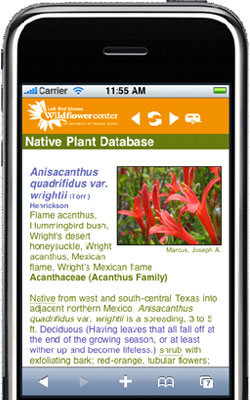
Did you know you can access the Native Plant Information Network with your web-enabled smartphone?
Ask Mr. Smarty Plants
Ask Mr. Smarty Plants is a free service provided by the staff and volunteers at the Lady Bird Johnson Wildflower Center.

rate this answer

Monday - February 25, 2008
From: Bennington, NE
Region: Midwest
Topic: General Botany
Title: How do plants living in various climates differ?
Answered by: Nan Hampton
QUESTION:
Do plants that live in different climates have different tecture or are they just totally different?ANSWER:
Mr. Smarty Plants isn't exactly sure what you mean by different texture, but certainly plants come in different sizes and shapes and with many different forms of foliage and flowers. In middle latitudes where there is at least a moderate amount of rainfall and temperatures are not too severe, plants can range from very tiny specimens, such as Oxalis violacea (violet woodsorrel), to very large plants like Ulmus americana (American elm), both of which can be found in Douglas County, Nebraska where you live. There are different large and small plants in somewhat different, but moderate, climates. For instance, in Placer and Tulare Counties in California, the giant sequoia, Sequoiadendron giganteum (giant sequoia), grows along with tiny Phlox diffusa (spreading phlox). In both these climates and many other slightly different moderate climates, plants grow together in many different sizes and forms.In severe climates plants are restricted in form and size. In places that are very cold, such as the Arctic tundra, Antarctic tundra or alpine tundra (high mountain elevations), plants are generally low and very compact (ex. Silene acaulis (moss campion)). This protects them from the weight of snow during their long winter and, after the snow has melted in their brief summer, it protects them from cold winds. Additionally, low, clumped plants have a warmer microclimate from the sun heating the ground near them. These tundra regions have no trees or other large plants because the growth period is too short to support extensive growth. Grasses and sedges are a large component of the plants that grow there. You can read more about the tundra and the plants that grow there. Click here to learn about the two species of flowering plants that grow in Antarctica. Some plants in the alpine tundra have another adaptation to protect themselves from the high levels of ultraviolet (UV) light in the thinner atmosphere of higher elevations. UV is harmful to chlorophyll and delicate cellular structures that the plant needs to photosynthesize. There are two protection strategies: 1) the plants are covered with dense white hairs that filter the sunlight, (ex. Phacelia sericea (silky phacelia)) or 2) they have a dark red pigment called anthocyanin which absorbs the UV rays before they can harm the cellular components (ex. Saxifraga flagellaris (spider plant)).
The other notable extreme climate is the hot desert. It is the temperature combined with the scarcity of water that causes the problem. The forms adopted by plants in the desert are geared to conserving water. In the desert most of the rain comes in the wintertime and during the heat of summer with no rain plants have to conserve all the water that they can. Most desert plants put on new growth only in the spring. This is also when they carry out photosynthesis and the food they make is stored in their roots. Some perennials (ex. Fouquieria splendens (ocotillo) have very small leaves to minimize water loss that they lose in the summertime and become dormant to conserve water. Other perennials are very have thickened leaves and grow small and close to the ground (ex. Chaetopappa ericoides (rose heath). Still other perennials, such as the Carnegiea gigantea (saguaro), have no true leaves. Their stems, where photosynthesis occurs, are covered with a waxy cuticle to retain water and are pleated so that the ridges shade part of the stem. They store a great deal of water in their stems and these pleats allow the stems to expand when water is available to store. Annuals also tend to be small and flower quickly after a rain (ex. Abronia villosa (desert sand verbena). They exist mostly as seeds waiting for the next combination of rain and temperature to allow them to complete their quick life cycle and make seeds for the next generation. Plants have small openings called stomata on the undersides of their leaves (and sometimes on their stems like the saguaro) to allow for gas exchange—plants need carbon dioxide (CO2) for photosynthesis and they release oxygen (O2) as a by-product. When the stomata are open for gas exchange, however, they can also lose water. Therefore, most desert plants tend to have their stomata open only at night when it is cooler and less evaporation can occur.
You might like to see if your library has this young person's book, Plant Survival: Adapting to a Hostile World by Brian Capon to read more about how plants are adapted to different climates.


More General Botany Questions
Difference between class notes and size notes on website
August 09, 2012 - I enjoy using the native plant database in planning my flower beds. However, I don't know the difference between Class notes and size notes. Can you help me out?
view the full question and answer
Water Use Versus Soil Moisture
October 14, 2014 - In the Native Plant Database, under Growing Conditions what is the difference between water use and soil moisture? Sometimes they seem contradictory.
view the full question and answer
Endemic plants for the Edwards Plateau
March 23, 2008 - Thanks so much for the info. it will be very helpful with the boys and we really stress "Leave No Trace Behind". The pictures will be enough. Thanks again!!
view the full question and answer
Propagating a white cultivar of Texas Mountain Laurel (Sophora secundiflora
September 09, 2016 - I am trying to propagate a white cultivar of the Texas Mountain Laurel. I plan to use bee sticks and pollinate the plant. Are the plants self fruiting or do I need to find another white mountain laure...
view the full question and answer
Beans growing under artificial light from Vernon CT
May 04, 2012 - What bean plant will grow the best under a flourescent,spot gro light,green transparent light,or Natural light and why.What caused it to grow like it did?
view the full question and answer
| Support the Wildflower Center by Donating Online or Becoming a Member today. |