Native Plants
Q. Who is Mr. Smarty Plants?
A: There are those who suspect Wildflower Center volunteers are the culpable and capable culprits. Yet, others think staff members play some, albeit small, role. You can torture us with your plant questions, but we will never reveal the Green Guru's secret identity.
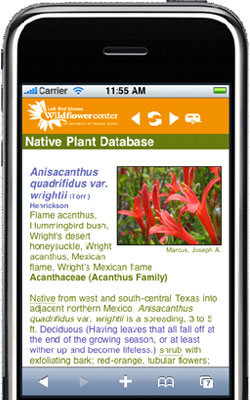
Did you know you can access the Native Plant Information Network with your web-enabled smartphone?
Ask Mr. Smarty Plants
Ask Mr. Smarty Plants is a free service provided by the staff and volunteers at the Lady Bird Johnson Wildflower Center.

rate this answer

Friday - July 20, 2007
From: Plano, TX
Region: Southwest
Topic: Seasonal Tasks
Title: Toxicity of horticultural oils
Answered by: Joe Marcus
QUESTION:
Is T&S dormant oil spray a toxic product? Our church (Prairie Creek Baptist in Plano, Texas) is transitioning to organic/native landscape. This is the product used by the current lawn service. Also, we would appreciate any other information to help us make this transition.ANSWER:
Since we know of no brandname, T&S, we are assuming you mean trees and shrubs. This would make sense because trees and shrubs are the landscape elements that you would spray with dormant oil. The term dormant oil speaks more to the season in which it is applied -- during trees' and shrubs' dormant season -- than to a particular kind of oil. In the past, dormant oils were all petroleum-based, rather heavy oils that had to be sprayed in warmish weather during the winter. Scale, aphids, mites and other overwintering insects are the target pests for winter-application of an oil spray. Petroleum-based dormant oils can damage green (non-dormant) tissue. So winter annuals such as pansies, snapdragons and ornamental crucifers are often severely damaged by overspray or spray drift.
The toxicity of any dormant oil, or any other horticultural oil for that matter, can vary from product to product. So it is very important to fully understand the toxicity of the specific product that is being applied. Pesticide labels and Material Safety Data Sheets (MSDS) are your primary sources of information for pesticide use, safety and toxicity information. Your lawn service company must have MSDS sheets on file for each material they use. They will provide copies of those sheets to you at your request. If you have concerns about the safety of the material that is being applied to your church's landscape, you should meet with a representative of your lawn care company to discuss those concerns and look for solutions to any problems you identify.
More Seasonal Tasks Questions
Planning garden tasks in advance from Austin
January 03, 2012 - My yard was a disaster last year-grass and trees browning, early leaf fall on flowering plants, and water bills sky high, even with the limited watering days. What can I do this year to prevent this s...
view the full question and answer
Care for penstemons in South Jordan, UT
June 21, 2009 - I have Firecracker Penstemons and they bloomed beautifully this year. How do I trim them and when? Will they continue to bloom throughout the summer?
view the full question and answer
Time to cut back Turk's Cap in Austin
January 27, 2011 - I did not find my question answered in the database. My question is: When is the best time to cut back Red Turks Cap? I live in Central Austin.
view the full question and answer
Too late to begin planting in May in Austin?
April 30, 2008 - Is it too late to begin planting in May? I live in Austin Texas and have finally completed my plans for a native Texas landscaping (plants and grass) of my front yard. I'd like to get the landscapi...
view the full question and answer
Removal of Carolina Jasmine in San Antonio
March 02, 2009 - We are attempting to permanently remove large old-growth Carolina Yellow Jasmine,
Gelsemium sempervirens bushes from our property. The bushes are cut down. Any suggestions for stump/root removal (mec...
view the full question and answer
| Support the Wildflower Center by Donating Online or Becoming a Member today. |