Native Plants

Q. Who is Mr. Smarty Plants?
A: There are those who suspect Wildflower Center volunteers are the culpable and capable culprits. Yet, others think staff members play some, albeit small, role. You can torture us with your plant questions, but we will never reveal the Green Guru's secret identity.
Did you know you can access the Native Plant Information Network with your web-enabled smartphone?
Ask Mr. Smarty Plants
Ask Mr. Smarty Plants is a free service provided by the staff and volunteers at the Lady Bird Johnson Wildflower Center.

rate this answer

Sunday - October 04, 2015
From: Trophy Club, TX
Region: Southwest
Topic: Grasses or Grass-like, Shrubs, Trees
Title: Restoring riverfront from Blanco Flood
Answered by: Nan Hampton
QUESTION:
We have cleared our riverfront from the Blanco Flood and I am now looking for help in replanting native trees/grass on our property. Our home was in the Flood of Hayes county Memorial Weekend. I am looking for advise/help in trying to restore the riverfront. Any suggestions would be greatly appreciated.ANSWER:
On our Special Collections page we have a special list of plants, Central Texas Riparian Restoration Species, recommending species that are appropriate for the restoration of your riverfront.
Grasses are very important components of the restoration. Here are several from the list that are excellent choices:
Andropogon glomeratus (Bushy bluestem) grows in full sun.
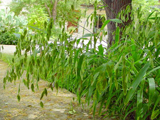
Chasmanthium latifolium (Inland sea oats) grows well in shade and partly shaded areas.
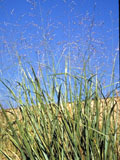
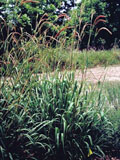
Panicum virgatum (Switchgrass) grows in sun and part shade.
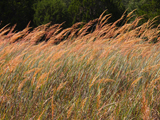
Sorghastrum nutans (Indiangrass) grows in sun, part shade and shade.
Tripsacum dactyloides (Eastern gamagrass) grows in part shade.
Here are suggestions for trees from the list:
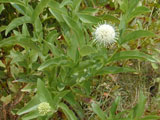
Cephalanthus occidentalis (Common buttonbush) is more a shrub than a tree and grows 6 to 12 feet.
Platanus occidentalis (American sycamore)
Populus deltoides (Eastern cottonwood) is fast growing.
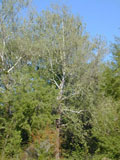
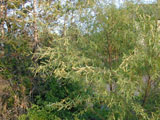
Salix nigra (Black willow) is fast growing.
Taxodium distichum (Bald cypress)
Texas State University has a webpage with the title Disaster Recovery Resources addressing the Memorial Weekend flood. Though they were done early in June some of the videos have information that is still useful. You can find the workshops by searching on YouTube for "Blanco Riparian Workshops". Here is the link to the workshop with the title "What to Plant after the Flood" by Bill Niemann of Native American Seed.
The Wildflower 2015 Fall Native Plant Sale occurs Saturday, Oct. 10 and Sunday, Oct. 11 with Wildflower "Members Only" day on Friday, Oct. 9. Most (if not all) of the plants listed above appear on the Plant Sale Plant List.
From the Image Gallery



More Trees Questions
Controlling a shrub/tree with lots of thorns and flowers similar to beebrush, but lots of thorns
July 08, 2014 - I live in Horseshoe Bay, Llano County with 1.5 acres of natural habitat. There is a plant that I have always called Cat's Claw but in researching Cat's Claw, I may have misidentified it. It has a fl...
view the full question and answer
Damaged oaks from Hurricane Ike in League City, TX
August 25, 2009 - After hurricane IKE, one of our oak trees (in front yard) was partially uprooted from the ground. We did place it back, and tie it down with supports. Further, we inserted fertilizer spikes, and give ...
view the full question and answer
Trees for home in Kansas
April 01, 2012 - I am needing help planting trees in my yard. It's a new construction home and I would like a tree that won't get into the septic system easily. Also, I have to plant 3 other trees as well due to the...
view the full question and answer
Problems with sophora secundiflora
April 19, 2008 - My mountain laurel is looking bad. It has lost of its leaves, especially on the lower part of the tree (it's about 7 feet tall) and many of the remaining ones don't look good - they are curled up an...
view the full question and answer
Is black olive (Bucida buchera) toxic to people or dogs?
June 02, 2009 - We have what we think is a black olive tree growing in our front yard, which I keep trimmed to about 4 feet high. A bird dropped the seedling in my garden, so I'm not quite sure it's a black olive,...
view the full question and answer
| Support the Wildflower Center by Donating Online or Becoming a Member today. |