Native Plants

Q. Who is Mr. Smarty Plants?
A: There are those who suspect Wildflower Center volunteers are the culpable and capable culprits. Yet, others think staff members play some, albeit small, role. You can torture us with your plant questions, but we will never reveal the Green Guru's secret identity.
Did you know you can access the Native Plant Information Network with your web-enabled smartphone?

Ask Mr. Smarty Plants
Ask Mr. Smarty Plants is a free service provided by the staff and volunteers at the Lady Bird Johnson Wildflower Center.

rate this answer

Saturday - May 09, 2015
From: Rochester, NY
Region: Northeast
Topic: Diseases and Disorders, Trees
Title: Shade Loving Plants for Under a Black Walnut Tree in Rochester, NY.
Answered by: Anne Van Nest
QUESTION:
Please advise on plants that will grow in the shade under a black walnut tree in Rochester, NY.ANSWER:
Fiddlehead Creek Farm and Native Plant Nursery have an extensive list of New York native plants that are tolant to Juglone that is produced by Black Walnut Trees and other Juglandaceae family members. They have a subgroup of their list that is tolerant of deep shade.
About black walnuts, the Fiddlehad Creek Farm website says ... Plants sensitive to juglone show signs of wilting, yellow leaves, stunted or slow growth, and eventually death. Many highly sensitive plants cannot tolerate even a small concentration of juglone and die within a few months. Unless one is aware of the toxicity problem, it is easy to blame these symptoms on other disease or nutritional problems. Unfortunately, there is no cure once plants are affected.
Planting near a black walnut tree (Juglans nigra) requires special precautions in the home landscape. Black walnuts produce a chemical called juglone, which occurs naturally in all parts of the tree, especially in the buds, nut hulls, and roots. The leaves and stems contain smaller quantities of juglone, which is leached into the soil after they fall. The highest concentration of juglone occurs in the soil directly under the tree’s canopy, but highly sensitive plants may exhibit toxicity symptoms beyond the canopy drip line. Because decaying roots can release juglone, toxicity may occur for several years after a tree has been removed.
And the Native Plant Database on our website has the following information about Black Walnut:
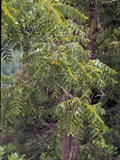
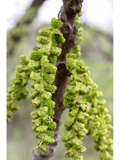
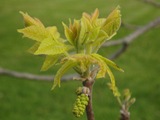
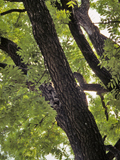
Black walnut is a large, rugged, deciduous tree, 50-75 ft. in height and width, sometimes reaching 150 ft. tall. Dark, furrowed bark on the trunk. Wide-spreading branches form an upright, umbrella-like crown in the woods or a round-topped crown in the open. The well-formed trunk is usually devoid of branches a considerable distance from the ground. Leaves up to 2 feet long with 5 to 11 pairs of leaflets along a central axis and a single leaflet at the tip; midrib of the lateral leaflets off-center with the wider part of the blade toward the leaf tip. Leaflets emerge very late in spring and are yellow-green. Fall color is clear yellow, unless the tree has been troubled with insects or leaf blight. Flowers inconspicuous, in elongate, green clusters. Fruit 1 1/2 to 2 1/4 inches in diameter, consisting of a hard-shelled, furrowed nut enclosed in a green husk, darker when ripe.
One of the scarcest and most coveted native hardwoods, Black Walnut is used especially for furniture, gunstocks, and veneer. Individual trees fetch attractive prices and a few prized trees have even been stolen. Since colonial days and before, Black Walnut has provided edible nuts and a blackish dye made from the husks. Tomatoes and apples do not survive near mature trees. The delicious nuts must be gathered early, before squirrels and other wildlife can consume them. Of all the native nut trees of North America, the Black Walnut is the most valuable save only the Pecan (Carya illinoinensis), and in the traditions of pioneer life and rustic childhood it is even more famous.
From the Image Gallery
More Diseases and Disorders Questions
Something eating holes in Texas Betony from Austin
June 06, 2012 - What pest is eating holes in the leaves of my Texas Betonys? They look healthy but almost all leaves have various sizes of round holes in them. What is the best cure for this? Thanks
view the full question and answer
Further question on sprouts from holly tree in Surprise AZ
November 16, 2010 - Thank you Barbara Medford for your response to my question about the sprouting holly tree in Surprise AZ. I took for granted that the tree I was talking about was a holly tree. I looked at pictures of...
view the full question and answer
What kind of beetles are attacking cedar trees on Cape Cod, MA.
May 17, 2010 - I live on Cape Cod, MA and my cedar trees are being attacked by some kind of beetle & killing them. I would appreciate knowing what this could be and how to treat this. Thank you
view the full question and answer
Keeping cows from eating the garden
September 02, 2008 - I have a flowerbed area outside of our new split-rail fence
available for planting, but cattle roam outside the
fence also! Do you have any suggestions for plants that
cows tend not to eat (unle...
view the full question and answer
Yellowing of Thuja occidentalis leaves in early Fall in Maryland
September 12, 2006 - Mr. Smarty Plants, I am from Maryland. Please help. I have planted 23 Thuja occidentalis Smaragd in my front yard a few months ago. Height of about 3 feet. Most of the trees have turned golden brown....
view the full question and answer
| Support the Wildflower Center by Donating Online or Becoming a Member today. |