Native Plants

Q. Who is Mr. Smarty Plants?
A: There are those who suspect Wildflower Center volunteers are the culpable and capable culprits. Yet, others think staff members play some, albeit small, role. You can torture us with your plant questions, but we will never reveal the Green Guru's secret identity.

Did you know you can access the Native Plant Information Network with your web-enabled smartphone?

Ask Mr. Smarty Plants
Ask Mr. Smarty Plants is a free service provided by the staff and volunteers at the Lady Bird Johnson Wildflower Center.

rate this answer

Sunday - November 16, 2014
From: Austin, TX
Region: Southwest
Topic: Planting, Shade Tolerant, Grasses or Grass-like
Title: Shade grasses for central Texas
Answered by: Guy Thompson
QUESTION:
We are new to the area and bought a home this summer that has lots of shade in the very small backyard. The problem is that there was new sod laid in the backyard which now is 50% dead. We do not know if there was not enough water or died because of shade. We have a larger dog so having grass for the dog to use is very important. We did hire an arborist about 6 weeks ago to trim trees. The backyard is to the west and there are numerous large slanting live oaks. What is the best shade grass to plant? The sunlight is only filtered through the trees. Is having any grass grow possible? How do we evaluate sunlight? What type of grass would you recommend? There is still some thin grass remaining on one section that they planted but we can not figure out what kind it is? Thank you for your advice.ANSWER:
Unfortunataely, there are no good native turf grasses that do well in shade. You may have had St. Augustine sod (that is a non-native which does fairly well in light shade, but we don't recommend it because of the high amount of water it requires).
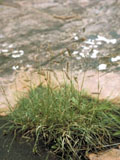
One grass that I grow in shade as a ground cover is Paspalum setaceum (Thin paspalum). It grows only a few inches high and the rather unattractive foot-tall seed heads can be controlled by mowing. If you and your dog can accept taller species, consider the following suggestions, taken from a previous Mr. Smarty Plants answer:
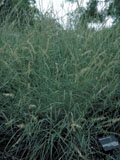
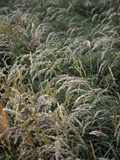
Bouteloua curtipendula (sideoats grama), the State Grass of Texas, 2-3 feet
Bouteloua hirsuta (hairy grama), 10-18 inches
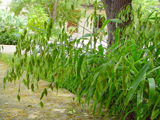
Chasmanthium latifolium (Inland sea oats), 2-4 feet, a particularly attractive plant
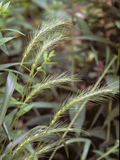
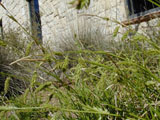
Elymus canadensis (Canada wildrye), 2-4 feet
Poa arachnifera (Texas bluegrass), 2-3 feet
Schizachyrium scoparium (little bluestem), 2-4 feet
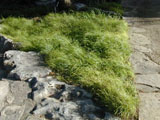
You might also consider using sedges. They make very good groundcovers and they tend to be rather short. You can read about their use for lawns in Sedge Lawns for Every Landscape by John Greenlee.
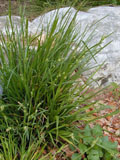
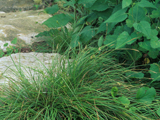
Carex blanda (eastern woodland sedge), 1-3 feet
Carex cherokeensis (Cherokee sedge), 12-18 inches
Carex planostachys (cedar sedge), less than 12 inches
Carex texensis (Texas sedge), 10-12 inches
Finally, here are groundcovers that aren't grasses or grass-like, are less than 18 inches high and will grow in the shade or part shade.
Seeds for many of these plants may be obtained at your local plant nurseries. Native American Seed is a particularly good source.
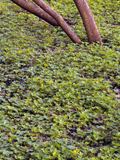
Calyptocarpus vialis (straggler daisy)
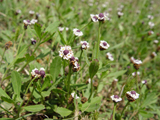
Phyla nodiflora (turkey tangle fogfruit)
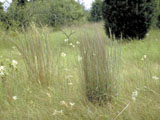
From the Image Gallery
More Planting Questions
Prairie wattle for woodland area in Austin
November 29, 2009 - Can prairie wattle be grown in a woodland area? It would get part shade, with full sun for at least half a day. The soil is a bit rocky; location is Austin.
view the full question and answer
How Close to Tree Trunks Should Bricks be Placed?
January 26, 2016 - Do you have guidelines as to how close bricks can be placed to trees, particularly cypress, cedars and live oaks? Contractors habitually plant up to the trunk and I've had trees die from their roots...
view the full question and answer
Specifications for a property in Corning CA
March 29, 2012 - Drought resistant, deer resistant, low growing (ground cover), and shade tolerant request:
I am looking for a variety of species that not only fit the above preferences, but also a few other things. ...
view the full question and answer
Move Roses or Ornamental Grasses in Crown Point, Indiana
September 15, 2010 - I have two ornamental grasses that grew real wide this year. They are blocking three big knock out roses that are four foot tall and four foot wide. My question is which one would be easier to dig up ...
view the full question and answer
Native plants for clay soil in Lathrop MO
March 21, 2011 - My family just moved to the north Kansas City, MO area and would like to know what native species, both perennial and tree, will do best in the clay soil. It has already proven problematic as we have ...
view the full question and answer
| Support the Wildflower Center by Donating Online or Becoming a Member today. |