Native Plants
Q. Who is Mr. Smarty Plants?
A: There are those who suspect Wildflower Center volunteers are the culpable and capable culprits. Yet, others think staff members play some, albeit small, role. You can torture us with your plant questions, but we will never reveal the Green Guru's secret identity.
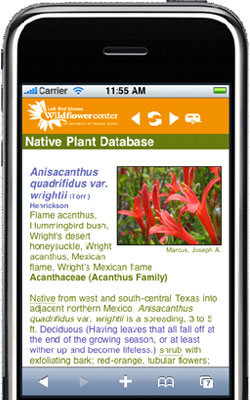
Did you know you can access the Native Plant Information Network with your web-enabled smartphone?
Ask Mr. Smarty Plants
Ask Mr. Smarty Plants is a free service provided by the staff and volunteers at the Lady Bird Johnson Wildflower Center.

rate this answer

Friday - July 25, 2014
From: Nederland, TX
Region: Southwest
Topic: General Botany
Title: The Designation of Annual and Perennial Plants
Answered by: Joe Marcus
QUESTION:
Sometimes when researching a plant I will find it listed as both annual and perennial. I understand that some plants will be perennial in a warm climate and die in a colder zone, but it is still a perennial that is grown out of it's preferred environment.ANSWER:
Plants that are perennials in warm climates but are not hardy in colder climates are there considered "tender perennials", but are sometimes termed "annuals" in those areas even though they are not technically annuals. Likewise, some cool-climate annual plants will survive more than one year in warm areas. Finally, some plants may complete their life cycle in one growing season or they may require more than one growing season to do so. Those species can be considered both annual and perennial because they may behave either way. As it turns out, plants are incredibly complicated organisms.
More General Botany Questions
Burn the wetlands
June 02, 2010 - Can the wetlands of Louisiana that have been soaked in oil be burned? I am a native plant gardener in the midwest. Burning is a natural process in the prairie.
Southerners are not used to this and ma...
view the full question and answer
Brownish-gold worm-looking things on loblolly pines
May 08, 2015 - We have a large loblolly pine that each spring drops thousands of brownish-gold "worm" looking things (about 1/2 to 1" long). Do they have a name and what is their purpose?
view the full question and answer
Clover in grass in Marysville WA
March 05, 2009 - I noticed clover growing in my grass and know that this is a sign of poor nitrogen in my soil.
I would like to know of some native plants / shrubs that I could put near my house in Washington that ...
view the full question and answer
Allelopathy in Sassafras albidum
January 11, 2012 - Sassafras albidum description says
"Sassafras is allelopathic and can discourage the growth of certain other plants within its root zone."
My question is: WHICH plants are susce...
view the full question and answer
Alleotrophic effects of caffeine found in Ilex species
January 24, 2007 - I'm doing research for my biology class on the alleotrophic effects of caffeine. I'm planning to use Ilex vomitoria as the caffeine-producing plant. As the control I want to use another non-c...
view the full question and answer
| Support the Wildflower Center by Donating Online or Becoming a Member today. |