Native Plants

Plant Database
Search for native plants by scientific name, common name or family. If you are not sure what you are looking for, try the Combination Search or our Recommended Species lists.
Marcus, Joseph A.
Ungnadia speciosa
Ungnadia speciosa Endl.
Mexican Buckeye, Monilla
Sapindaceae (Soapberry Family)
Synonym(s):
USDA Symbol: unsp
USDA Native Status: L48 (N)
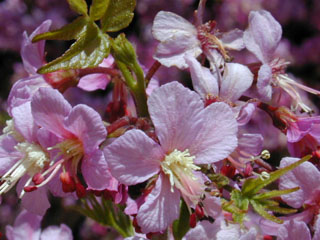
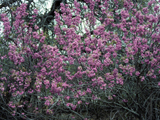
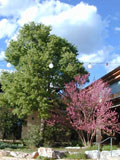
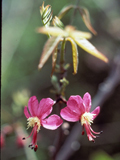
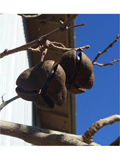
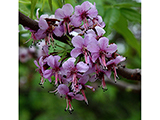
Mexican-buckeye, an 8-12 ft., deciduous tree, can reach 30 ft. in height. It is often multi-trunked with with light gray to brown bark, smooth on young branches, becoming fissured with age. Leaves up to 12 inches long, with a central axis supporting 2 to 6 paired leaflets and a terminal one; leaflets up to 5 inches long, ovate to narrower with an elongate tip, rounded base, and serrate margins. Pinnate foliage turns golden yellow in fall. Clusters of bright-pink, fragrant flowers appear before or with the leaves from the axils of the previous season. Fruit distinctive, a light reddish brown when ripe, 3 lobed capsule containing 1 to 3 dark brown to black, shiny seeds 1/2 inch in diameter, the walls of the capsule often persisting through the winter, seeds poisonous.
From a distance the plants in full flower resemble redbuds or peaches. The sweetish but poisonous seeds are sometimes used by children as marbles. Livestock seldom browse the toxic foliage, but bees produce fragrant honey from the flowers. Although not a true buckeye, it is so called because of the similar large capsules and seeds. This distinct plant, alone in its genus, commemorates Baron Ferdinand von Ungnad, Austrian ambassador at Constantinople, who introduced the Horsechestnut into western Europe in 1576.
Plant Characteristics
Duration: PerennialHabit: Tree
Leaf Retention: Deciduous
Leaf Arrangement: Alternate
Leaf Complexity: Pinnate
Leaf Shape: Ovate
Leaf Margin: Serrate
Fruit Type: Capsule
Size Notes: Up to about 30 feet tall.
Bloom Information
Bloom Color: PinkBloom Time: Mar , Apr , May , Jun
Distribution
USA: NM , TXNative Distribution: TX & s. NM to n.e. Mex.
Native Habitat: Rocky canyons & ridges. Common in rocky areas in canyons and on slopes and ridges in South, Central, and West Texas, east to Dallas county.
Growing Conditions
Water Use: LowLight Requirement: Sun , Part Shade
Soil Moisture: Dry
Cold Tolerant: yes
Soil Description: Rocky soils. Rocky, Sandy, Sandy Loam, Medium Loam, Clay Loam, Clay, Caliche type Limestone-based
Conditions Comments: Mexican buckeye produces an opulent show when it blooms. The foliage turns a clear yellow in the fall. Foliage, flowers and dense branching makes this species an outstanding small specimen tree or tall background shrub. Rapid-growing, drought-resistant, resistant to cotton root rot. Prune to encourage a single trunk if desired. Growth characteristics of this tree vary greatly with site. It has mildly poisonous seedpods.
Benefit
Use Ornamental: Showy, Aromatic, Accent shrub, Fall conspicuous, Understory tree, Attractive, Blooms ornamentalUse Wildlife: Nectar-bees, Nectar-butterflies, Nectar-moths, Seeds-granivorous birds, Seeds-Small mammals.
Conspicuous Flowers: yes
Fragrant Flowers: yes
Interesting Foliage: yes
Attracts: Butterflies
Larval Host: Henry's Elfin butterfly
Nectar Source: yes
Deer Resistant: High
Propagation
Propagation Material: SeedsDescription: Best sown fresh. Untreated seed will germinate in three weeks. Germination is best in warm soil. Field plant or use deep containers to accomodate a long initial root.
Seed Collection: Gather seed in August through October when capsules turn dark reddish brown and begin to open. Seeds should be shiny black and hard. Remove seeds from pods and air dry a few days before storing in bags or ventilated containers at room temperature. For longer storage, place paper bags in the refrigerator. They do not store well for long periods of time.
Seed Treatment: Sow fresh seed
Commercially Avail: yes
Mr. Smarty Plants says
Hedge in central Texas
June 17, 2009
Help, my oleanders are dying. I am in need of hedge suggestions- ideal would be quick growing, maybe 8-12 feet at their tallest. I live in Central Texas.
view the full question and answer
Round growths on Mexican buckeye
April 28, 2008
I have two pink buckeyes next to each other in my yard. The branches on one are completely covered in brown, round growths about the size of a pill bug. The other tree has none. Can you tell me what t...
view the full question and answer
Native plants for butterfly garden in Waco, TX
February 03, 2008
Few weeks ago I sent you a letter but never got an answer back.
I would like to have your suggestions of native plants for a butterfly garden (30'x 30') here in Waco. The plants must be (1)drought ...
view the full question and answer
Variety of native tall plants for a screen in shady area near Ft. Worth
June 12, 2007
Hello, we live west of Ft Worth. We are looking for tall plants to form a visual screen along a chain link fence we share with a neighbor. We have post oaks there and it is very shady and the ground ...
view the full question and answer
Invasive, non-native Paulownia
May 03, 2006
Hi. We would like to plant a fast growing tree that will provide shade for our house. What do you think of the Paulownia tree (Empress Tree) as a possibility for the Austin area? If this is not a g...
view the full question and answer
From the National Organizations Directory
According to the species list provided by Affiliate Organizations, this plant is on display at the following locations:Fredericksburg Nature Center - Fredericksburg, TX
Lady Bird Johnson Wildflower Center - Austin, TX
Texas Discovery Gardens - Dallas, TX
Sibley Nature Center - Midland, TX
Brackenridge Field Laboratory - Austin, TX
NPSOT - Native Plant Society of Texas - Fredericksburg, TX
Nueces River Authority - Uvalde, TX
Texas Parks and Wildlife Department - Austin, TX
NPSOT - Fredericksburg Chapter - Fredericksburg, TX
Texas Master Naturalists - Lost Pines Chapter - Bastrop, TX
NPSOT - Austin Chapter - Austin, TX
Jacob's Well Natural Area - Wimberley, TX
NPSOT - Williamson County Chapter - Georgetown, TX
Bibliography
Bibref 355 - Landscaping with Native Plants of Texas and the Southwest (1991) Miller, G. O.Bibref 354 - Native & Naturalized Woody Plants of Austin & the Hill Country (1981) Lynch, D.
Bibref 318 - Native Texas Plants: Landscaping Region by Region (2002) Wasowski, S. & A. Wasowski
Bibref 248 - Texas Wildflowers: A Field Guide (1984) Loughmiller, C. & L. Loughmiller
Bibref 291 - Texas Wildscapes: Gardening for Wildlife (1999) Damude, N. & K.C. Bender
Bibref 297 - Trees of Central Texas (1984) Vines, Robert A.
Bibref 286 - Wildflowers of the Texas Hill Country (1989) Enquist, M.
Search More Titles in Bibliography
Additional resources
USDA: Find Ungnadia speciosa in USDA PlantsFNA: Find Ungnadia speciosa in the Flora of North America (if available)
Google: Search Google for Ungnadia speciosa
Metadata
Record Modified: 2016-02-09Research By: TWC Staff, GAP