Native Plants

Plant Database
Search for native plants by scientific name, common name or family. If you are not sure what you are looking for, try the Combination Search or our Recommended Species lists.
Marcus, Joseph A.
Rhus lanceolata
Rhus lanceolata (A. Gray) Britton
Prairie Flameleaf Sumac, Flameleaf Sumac, Prairie Sumac, Lance-leaf Sumac, Lance-leaved Sumac, Texas Sumac, Tree Sumac, Limestone Sumac, Prairie Shining Sumac
Anacardiaceae (Sumac Family)
Synonym(s): Rhus copallina var. lanceolata, Rhus copallinum var. lanceolata
USDA Symbol: rhla3
USDA Native Status: L48 (N)
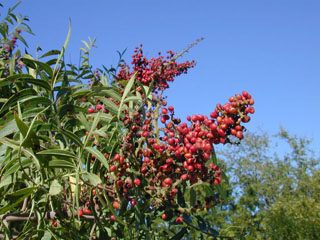
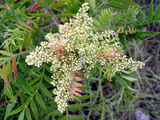
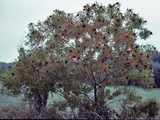
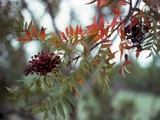
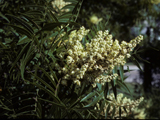
Prairie Flameleaf Sumac is a thicket-forming, small, deciduous tree to 30 ft. in height, but usually no taller than 20 ft. Pyramidal panicles of red, fall fruit follow white, summer blossoms. Pinnately-compound foliage becomes vivid red or orange in fall.
Native from southern Oklahoma through north, central, and west Texas to New Mexico and south to Puebla in central Mexico, the limestone-loving Prairie Flameleaf Sumac is relatively fast growing, generally pest- and disease-free, and heat-, cold-, and drought-tolerant. Flameleaf is a perfect description of this tree's outstanding, orange and red, autumn foliage, but its pale trunk and branches, green summer leaves, and pyramidal clusters of red fall fruit are also noteworthy. Though it may sucker from the base to form a colony, it is not as likely to aggressively colonize as the more easterly Shining Sumac (Rhus copallinum). Like the very different-looking Evergreen Sumac (Rhus virens), Prairie Flameleaf Sumac produces berries that, when soaked in water, make a tart, tasty, high-Vitamin C tea.

Plant Characteristics
Duration: PerennialHabit: Tree
Leaf Retention: Deciduous
Leaf Arrangement: Alternate
Leaf Complexity: Pinnate
Leaf Shape: Lanceolate
Leaf Venation: Pinnate
Leaf Pubescence: Glabrous , Pilose
Leaf Margin: Entire
Breeding System: Flowers Unisexual , Monoecious
Inflorescence: Panicle
Fruit Type: Drupe
Size Notes: Up to about 30 feet tall, usually much shorter.
Leaf: Shiny green above, pale below.
Autumn Foliage: yes
Flower: Panicles 4-6 inches long.
Fruit: Dark red 1/8 inch long.
Bloom Information
Bloom Color: White , Yellow , GreenBloom Time: Jul , Aug
Bloom Notes: color normally yellowish green or white
Distribution
USA: NM , OK , TXNative Distribution: Southern Oklahoma south through north-central, central, and west Texas, west to New Mexico, and south to Puebla
Native Habitat: Rocky, limestone hillsides and grasslands
Growing Conditions
Water Use: Low , MediumLight Requirement: Sun
Soil Moisture: Dry
Soil pH: Alkaline (pH>7.2)
Drought Tolerance: High
Cold Tolerant: yes
Heat Tolerant: yes
Soil Description: Rocky, calcareous, well-drained limestone soils, including clays, loams, and sands. Usually in calcareous rocky soils and clays.
Conditions Comments: Will be less likely to sucker and colonize if left undisturbed. Overly rich soil can cause fusarium wilt when the plant is young.
Benefit
Use Ornamental: Provides accent texture and vivid fall color as well as hardiness and easy maintenance. It is an excellent, relatively fast growing landscaping choice because of its ornamental fruits and fall foliage.Use Wildlife: Birds, especially bobwhites, grouse, and pheasants, consume quantities of the fruit in winter, and deer browse the foliage.
Use Food: Fruit soaked in water used to make a lemony drink similar to a diluted lemonade, sometimes called sumac-ade.
Use Other: The leaves contain tannin and have been used in tanning leather.
Conspicuous Flowers: yes
Interesting Foliage: yes
Attracts: Birds , Butterflies
Larval Host: Red-banded Hairstreak, Banded Hairstreak
Deer Resistant: Moderate
Value to Beneficial Insects
Special Value to Native BeesProvides Nesting Materials/Structure for Native Bees
This information was provided by the Pollinator Program at The Xerces Society for Invertebrate Conservation.
Butterflies and Moths of North America (BAMONA)
|
Banded Hairstreak (Satyrium calanus) 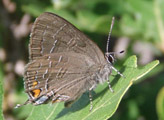 Larval Host |
Red-banded Hairstreak (Calycopis cecrops) 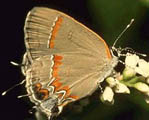 Larval Host |
Propagation
Propagation Material: Clump Division , Seeds , Semi-hardwood CuttingsDescription: Scarified seed or semi-hardwood cuttings taken in late summer. Several species of Rhus, this one among them, are commercially available as propagated stock, which is both ecologically more desirable and usually more successfully established than plants dug from the wild. The best time for planting most shrubs and trees is during the dormant period of fall and winter. Even during the winter, however, the root ball needs moisture, so plan some winter watering if soaking rains fail to come regularly. You can use a spade to cut outer shoots from a spreading cluster in the wild. This allows the plant to remain in its natural setting while providing transplantable shoots that already have a developed root system. Simply cut straight down between the outside “sucker” shoots and the other plant and then cut around the new shoots to remove them from the soil. Keep the roots wrapped in damp newspaper and out of the sun. Replant the same day, if possible. Take semi-hardwood cuttings from spring through fall.
Seed Collection: Collect September to October from plump, red fruit. Remove pulp from seed.
Seed Treatment: 30-55 minutes of acid scarification needed, treat with boiling water, or use rock tumbler to scarify seed. Soaking the seed in water then removing and planting plump seeds is also an option.
Commercially Avail: yes
Maintenance: Because it may colonize, do not plant near an area you don't want it to spread to, like a box hedge border. As with any shrub or tree, native or introduced, the first year requires regular deep watering for successful root establishment. Once established, sumacs do not require fertilizing or watering beyond average rainfall. Shrub-like specimens may be pruned to form a nice tree.
Mr. Smarty Plants says
Native alternative for Japanese Red Maple in Oklahoma
October 12, 2009
Mr. Smarty Plants, I am looking for a native alternative to a Japanese Red Maple. I would like a small tree that I can put in my front garden that will not pose a security risk my being overgrown and ...
view the full question and answer
Plants for wildlife and trees for shade.
September 29, 2007
We live in Kempner Texas, our land has mostly cedar trees. We would like to make a wildlife habitat on the back side of our property. Can you recommend plants that will grow in shade to partial sun,...
view the full question and answer
From the National Organizations Directory
According to the species list provided by Affiliate Organizations, this plant is on display at the following locations:Fredericksburg Nature Center - Fredericksburg, TX
Lady Bird Johnson Wildflower Center - Austin, TX
Texas Discovery Gardens - Dallas, TX
Brackenridge Field Laboratory - Austin, TX
Patsy Glenn Refuge, c/o Wimberley Birding Society - Wimberley, TX
Texas Parks and Wildlife Department - Austin, TX
NPSOT - Austin Chapter - Austin, TX
Jacob's Well Natural Area - Wimberley, TX
NPSOT - Williamson County Chapter - Georgetown, TX
Wildflower Center Seed Bank
LBJWC-63 Collected 2006-11-13 in Travis County by Lady Bird Johnson Wildflower CenterBibliography
Bibref 1186 - Field Guide to Moths of Eastern North America (2005) Covell, C.V., Jr.Bibref 298 - Field Guide to Texas Trees (1999) Simpson, B.J.
Bibref 1185 - Field Guide to Western Butterflies (Peterson Field Guides) (1999) Opler, P.A. and A.B. Wright
Bibref 946 - Gardening with Prairie Plants: How to Create Beautiful Native Landscapes (2002) Wasowski, Sally
Bibref 355 - Landscaping with Native Plants of Texas and the Southwest (1991) Miller, G. O.
Bibref 354 - Native & Naturalized Woody Plants of Austin & the Hill Country (1981) Lynch, D.
Bibref 841 - Native Alternatives to Invasive Plants (2006) Burrell, C. C.
Bibref 318 - Native Texas Plants: Landscaping Region by Region (2002) Wasowski, S. & A. Wasowski
Bibref 291 - Texas Wildscapes: Gardening for Wildlife (1999) Damude, N. & K.C. Bender
Bibref 297 - Trees of Central Texas (1984) Vines, Robert A.
Search More Titles in Bibliography
From the Archive
Wildflower Newsletter 1985 VOL. 2, NO.3 - Greenhouse Assists Research, Wild color on the Hills, Director's Report, Clearin...Additional resources
USDA: Find Rhus lanceolata in USDA PlantsFNA: Find Rhus lanceolata in the Flora of North America (if available)
Google: Search Google for Rhus lanceolata
Metadata
Record Modified: 2015-12-16Research By: TWC Staff, GDG