Native Plants

Plant Database
Search for native plants by scientific name, common name or family. If you are not sure what you are looking for, try the Combination Search or our Recommended Species lists.
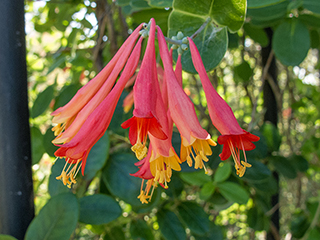
Brundage, Stephanie
Lonicera sempervirens
Lonicera sempervirens L.
Coral Honeysuckle, Trumpet Honeysuckle, Woodbine
Caprifoliaceae (Honeysuckle Family)
Synonym(s): Lonicera sempervirens var. hirsutula, Lonicera sempervirens var. minor, Lonicera sempervirens var. sempervirens, Phenianthus sempervirens
USDA Symbol: lose
USDA Native Status: L48 (N), CAN (I)
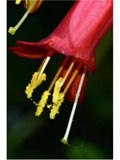
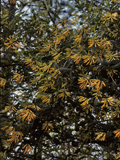
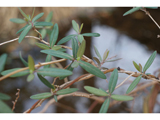
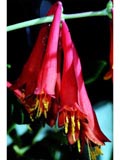
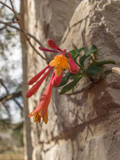
High-climbing, twining vine, 3-20 ft. long, with smooth, glossy, paired, semi-evergreen leaves and 2-4 flowered clusters of red, tubular blooms followed by bright-red berries. Leaves ovate to oblong with smooth, rolled down margins and a blunt or short pointed tip those immediately below the flowers fused at the base. This vine has showy, trumpet-shaped flowers, red outside, yellow inside, in several whorled clusters at the ends of the stems. Papery, exfoliating bark is orange-brown in color. Fruit a red berry.
This beautiful, slender, climbing vine is frequently visited by hummingbirds. Not too aggressive. Good climber or ground cover. The species name refers to its evergreen habit, especially in the South. Upper leaves are united. Five additional species also have upper leaves united. They differ from L. sempervirens in having wide spreading flower lobes.
The genus, Lonicera, is named for Adam Lonicer (1528 - 1586), a German botanist noted for his 1557 revised version of Eucharius Rösslin’s herbal. He became professor of Mathematics in 1553 and Doctor of Medicine in 1554, becoming the town physician in Frankfurt-am-Main. His true interest though was herbs and the study of botany.
Plant Characteristics
Duration: PerennialHabit: Vine
Root Type: Tap
Leaf Retention: Evergreen
Leaf Arrangement: Opposite
Leaf Complexity: Simple
Fruit Type: Berry
Size Notes: Stems up to about 20 feet long.
Leaf: Green
Flower: Flowers 2 inches long.
Fruit: Red to black. 0.25 in.
Bloom Information
Bloom Color: Red , YellowBloom Time: Mar , Apr , May , Jun
Bloom Notes: Blooms usually red but some cultivars/varieties yellow. Normally blooms mid-spring and intermittently thereafter.
Distribution
USA: AL , AR , CT , DC , DE , FL , GA , IA , IL , IN , KS , KY , LA , MA , MD , ME , MI , MO , MS , NC , NH , NJ , NY , OH , OK , PA , RI , SC , TN , TX , VA , VT , WVNative Distribution: S. ME to FL & e. TX; scattered inland to IL, Zones 6 to 9
Native Habitat: East Texas woodlands. Well-drained sand, clay.
Growing Conditions
Water Use: MediumLight Requirement: Sun , Part Shade
Soil Moisture: Moist
CaCO3 Tolerance: Medium
Cold Tolerant: yes
Soil Description: Various soils, but rich preferred. Sandy, Sandy Loam, Medium Loam, Clay Loam, Clay, Caliche type. Both lime and acidic OK.
Conditions Comments: Coral honeysuckle requires light, good air circulation, and adequate drainage to prevent powdery mildew. Some structural assistance may be necessary to help it begin climbing. Flowers best when given more sun. Tolerates poor drainage for short periods.
Benefit
Use Ornamental: Good twining vine with prominent blooms for full sun. Great for arbors.Use Wildlife: Flowers attract hummingbirds, bees, and butterflies. Fruits attract quail, Purple Finch, Goldfinch, Hermit Thrush, American Robin.
Use Medicinal: Dried and smoked for asthma, leaves ground by chewing and applied to bee stings. (Weiner) Leaves make a decoction for sore throats and coughs.
Conspicuous Flowers: yes
Attracts: Birds , Butterflies , Hummingbirds
Larval Host: Spring Azure, Snowberry Clearwing Moth
Nectar Source: yes
Value to Beneficial Insects
Special Value to Bumble BeesThis information was provided by the Pollinator Program at The Xerces Society for Invertebrate Conservation.
Butterflies and Moths of North America (BAMONA)
|
Spring Azure (Celastrina "ladon" ) 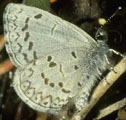 Larval Host |
Snowberry clearwing (Hemaris diffinis)  Larval Host |
Propagation
Propagation Material: SeedsDescription: The easiest way to propagate is by softwood or semi-hardwood cuttings taken from summer to fall. Layering is another means of propagation. Seed must be stratified.
Seed Collection: Collect seeds in late summer to early fall when berries turn ripe color. Clean immediately to avoid fermentation and overheating. Store in sealed containers at 34-38 degrees.
Seed Treatment: Stratification for two to three months at 40 degrees.
Commercially Avail: yes
Maintenance: Prune after flowering to shape and control. May have aphids in spring; hose off or allow ladybugs and lacewings to eat. Snip new growth and damaged buds.
Mr. Smarty Plants says
Toxicity and invasiveness of Scarlet Wisteria
May 04, 2007
I recently purchased seeds for Scarlet Wisteria (Chinese rattlebox tree). I spoke to a neighbor about this and she warned me not to plant them as they were poisonous to hummingbirds. Can you clarify...
view the full question and answer
National Wetland Indicator Status
| Region: | AGCP | AK | AW | CB | EMP | GP | HI | MW | NCNE | WMVE |
| Status: | FACU | FACU | FAC | FACU | FACU |
From the National Organizations Directory
According to the species list provided by Affiliate Organizations, this plant is on display at the following locations:Lady Bird Johnson Wildflower Center - Austin, TX
Texas Discovery Gardens - Dallas, TX
Delaware Nature Society - Hockessin, DE
Brackenridge Field Laboratory - Austin, TX
Patsy Glenn Refuge, c/o Wimberley Birding Society - Wimberley, TX
NPSOT - Native Plant Society of Texas - Fredericksburg, TX
Texas Parks and Wildlife Department - Austin, TX
NPSOT - Fredericksburg Chapter - Fredericksburg, TX
Georgia Native Plant Society - Atlanta, GA
NPSOT - Austin Chapter - Austin, TX
NPSOT - Williamson County Chapter - Georgetown, TX
Mt. Cuba Center - Hockessin, DE
Bibliography
Bibref 1207 - Earth Medicine, Earth Food (1990) Michael A. WeinerBibref 1186 - Field Guide to Moths of Eastern North America (2005) Covell, C.V., Jr.
Bibref 1185 - Field Guide to Western Butterflies (Peterson Field Guides) (1999) Opler, P.A. and A.B. Wright
Bibref 1620 - Gardening with Native Plants of the South (Reprint Edition) (2009) Wasowski, S. with A. Wasowski
Bibref 355 - Landscaping with Native Plants of Texas and the Southwest (1991) Miller, G. O.
Bibref 354 - Native & Naturalized Woody Plants of Austin & the Hill Country (1981) Lynch, D.
Bibref 841 - Native Alternatives to Invasive Plants (2006) Burrell, C. C.
Bibref 318 - Native Texas Plants: Landscaping Region by Region (2002) Wasowski, S. & A. Wasowski
Bibref 248 - Texas Wildflowers: A Field Guide (1984) Loughmiller, C. & L. Loughmiller
Bibref 291 - Texas Wildscapes: Gardening for Wildlife (1999) Damude, N. & K.C. Bender
Bibref 1294 - The Midwestern Native Garden: Native Alternatives to Nonnative Flowers and Plants An Illustrated Guide (2011) Adelman, Charlotte and Schwartz, Bernard L.
Search More Titles in Bibliography
Research Literature
Reslit 257 - Xylem Structure and Water Transport in a Twiner, a Scrambler, and a Shrub of Lonicera (Caprifoliaceae) (1992) S. T. Chiu and F. W. EwersReslit 1225 - Comparison of allozyme variability in a native and an introduced species of Lonicera (1995) K. A. Schierenbeck, J. L. Hamrick and R. N. Mack
Reslit 1253 - Greater morphological plasticity of exotic honeysuckle species may make them better invaders than native species (1999) J. A. Schweitzer and K. C. Larson
Reslit 2194 - Effects of herbivory on growth and biomass allocation in native and introduced species of Lonicera (1994) K. A. Schierenbeck, R. N. Mack and R. R. Sharitz
Reslit 2196 - Circumnutation behavior of an exotic honeysuckle vine and its native congener: Influence on clonal mobility (2000) K. C. Larson
Reslit 2282 - Seasonal and Diurnal Patterns of Photosynthetic Gas Exchange for Lonicera sempervirens and L. japonica (Caprifoliaceae) (1993) K. A. Schierenbeck and J. D. Marshall
Reslit 2315 - Effects of CO2 Enrichment on the Growth and Morphology of a Native and an Introduced Honeysuckle Vine (1991) T. W. Sasek and B. R. Strain
Reslit 2783 - Reclaimed water and Florida natives II (1992) L. M. Robinson, J. R. Parnell
This information was provided by the Florida WIldflower Foundation.
Search More Titles in Research Literature
Additional resources
USDA: Find Lonicera sempervirens in USDA PlantsFNA: Find Lonicera sempervirens in the Flora of North America (if available)
Google: Search Google for Lonicera sempervirens
Metadata
Record Modified: 2019-01-24Research By: TWC Staff