Native Plants

Plant Database
Search for native plants by scientific name, common name or family. If you are not sure what you are looking for, try the Combination Search or our Recommended Species lists.
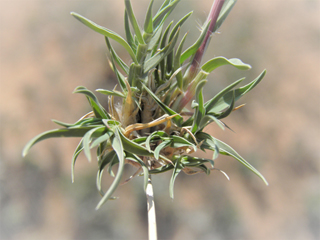
Anderson, Wynn
Hilaria belangeri
Hilaria belangeri (Steud.) Nash
Curly Mesquite Grass, Curly Mesquite
Poaceae (Grass Family)
Synonym(s):
USDA Symbol: hibe
USDA Native Status: L48 (N)
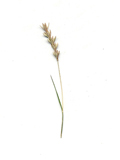
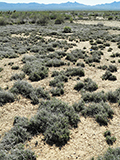
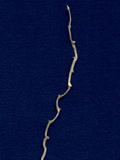
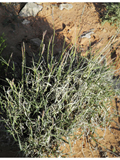
There are very few drought-tolerant turf grasses with lawn potential native to North America. The best known ones are Buffalograss (Bouteloua dactyloides), Blue Grama (Bouteloua gracilis), and Curly Mesquite Grass. Curly Mesquite Grass likely falls between the other two in drought tolerance, less drought tolerant than Blue Grama, more drought tolerant than Buffalograss. It is not marketed as a lawn grass as much as the other two, as it has a rougher-looking texture, but it can be used to lay a solid turf in rural settings within its range. In the wild, it can sometimes be found growing with Buffalograss in well-drained clay loam, where it colonizes densely by stolons. Its name comes from the way the leaves curl up when it goes dormant and because it is often found in mesquite (Prosopis species) savannahs. Its natural range is from central Texas west to Arizona and south to Nuevo Leon.

Plant Characteristics
Duration: PerennialHabit: Grass/Grass-like
Root Type: Fibrous
Leaf Arrangement: Alternate
Leaf Complexity: Simple
Leaf Shape: Linear
Leaf Venation: Parallel
Leaf Pubescence: Pilose
Inflorescence: Spike
Fruit Type: Caryopsis
Size Notes: Up to 1 foot tall.
Bloom Information
Bloom Time: Aug , Sep , OctBloom Notes: This grass occasionally blooms from March to November but normally doesn't start blooming until summer. The flowers (florets) of grasses are usually minute and therefore inconspicuous.
Distribution
USA: AZ , NM , TXNative Distribution: Central Texas west to Arizona, south to Nuevo Leon
Native Habitat: Dryish shortgrass prairies and savannas, caliche soils and hardpan clay sites.
Growing Conditions
Water Use: LowLight Requirement: Sun
Soil Moisture: Dry
Drought Tolerance: High
Soil Description: Well-drained sand, loam, clay, or caliche. Prefers clay loam.
Conditions Comments: More drought-tolerant than Buffalograss, but does go dormant in extreme droughts and in winter.
Find Seed or Plants
Order seed of this species from Native American Seed and help support the Wildflower Center.
Find seed sources for this species at the Native Seed Network.
Mr. Smarty Plants says
Native grasses for East Texas that require no mowing or watering
June 16, 2010
What native grass can I grow in deep East Texas that would require no supplemental watering and no mowing?
view the full question and answer
Native grasses for medians in Colorado Springs
June 11, 2010
Our city has stopped watering our historic landscaped medians due to severe budget shortfalls. The medians were historically tree boulevards but have had curb and gutter and blue grass added over th...
view the full question and answer
Will drought-stricken non-native St. Augustine come back in Cedar Park TX
January 30, 2010
I recently bought a new house but the grass in the yard looked completely dead (bought house in Nov) even though the neighbor's grass was still green. The previous owner stopped watering the grass (e...
view the full question and answer
Eliminating crabgrass in Middletown MO
September 28, 2009
Dear Mr. Smarty Plants,
I am having trouble with my lawn, specifically with the crabgrass in it. It now covers over 1/3 of it. I started using corn gluten meal this year, with limited tangible succ...
view the full question and answer
From the National Organizations Directory
According to the species list provided by Affiliate Organizations, this plant is on display at the following locations:Sibley Nature Center - Midland, TX
Tohono Chul Park, Inc. - Tucson, AZ
Patsy Glenn Refuge, c/o Wimberley Birding Society - Wimberley, TX
Texas Parks and Wildlife Department - Austin, TX
Native Seed Network - Corvallis, OR
Bibliography
Bibref 318 - Native Texas Plants: Landscaping Region by Region (2002) Wasowski, S. & A. WasowskiSearch More Titles in Bibliography
Web Reference
Webref 38 - Flora of North America (2019) Missouri Botanical Garden, St. Louis, MO & Harvard University Herbaria, Cambridge, MA.Additional resources
USDA: Find Hilaria belangeri in USDA PlantsFNA: Find Hilaria belangeri in the Flora of North America (if available)
Google: Search Google for Hilaria belangeri
Metadata
Record Modified: 2022-09-28Research By: GDG