Native Plants

Plant Database
Search for native plants by scientific name, common name or family. If you are not sure what you are looking for, try the Combination Search or our Recommended Species lists.
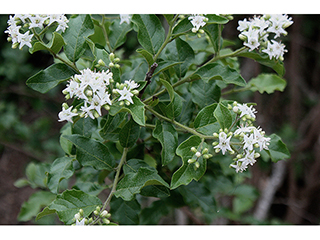
Smith, R.W.
Ehretia anacua
Ehretia anacua (Terán & Berl.) I.M. Johnst.
Anacua, Sugarberry Anacua, Anaqua, Anacahuita, Knockaway, Knackaway, Sandpaper Tree, Manzanita, Manzanillo, Tlalahuacate
Boraginaceae (Borage Family)
Synonym(s): Ehretia elliptica
USDA Symbol: ehan
USDA Native Status: L48 (N)
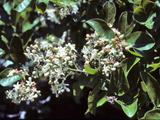
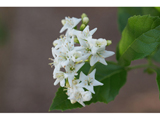
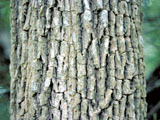
The sub-tropical knockaway or anacua is a 20-50 ft., evergreen or partly deciduous northward tree, often with suckers or multiple trunks. Leaves evergreen, some falling seasonally, up to 4 1/2 inches long, mostly smaller, ovate or narrower, upper surface rough, margins smooth, tip pointed. Flowers in clusters at the ends of the branchlets, white, fragrant. Fruit fleshy, spherical, up to 5/16 inch in diameter, orange to dark yellow, edible. Older trees have reddish, flaking bark and gnarled, stocky appearance.
A popular ornamental in Texas, this species is hardy in dry areas and north to central Texas, where the plants may die back in cold winters. Wildlife consume the fruit, and the wood has served for fenceposts and tool handles. The name Anacua is from "Anacahuite," a Mexican name for this and related species. That word is from two others of the Nahuatl language of the Aztecs meaning "paper" (amatl) and "tree" (cuahuitl), perhaps referring to the scaly peeling bark. The English name "Knockaway" is a corruption from the same source.


Plant Characteristics
Duration: PerennialHabit: Tree
Leaf Retention: Evergreen
Fruit Type: Berry
Size Notes: Up to about 50 feet tall. Trunk up to about 2 feet in diameter.
Leaf: Dark Green, rough like sandpaper.
Fruit: Edible, yellow to red two-seeded berries.
Bloom Information
Bloom Color: WhiteBloom Time: Apr
Distribution
USA: TXNative Distribution: C. & s. TX, south to Chiapas in southern Mexico
Native Habitat: Thickets, Open woodlands, Chaparral & brush country, Fence rows
Growing Conditions
Water Use: LowLight Requirement: Sun , Part Shade
Soil Moisture: Dry
Cold Tolerant: yes
Soil Description: Well-drained, alkaline soils. Sandy, Sandy Loam, Medium Loam, Clay Loam, Clay.
Conditions Comments: An attractive, subtropical tree, if planted as far north as Dallas it will freeze back in cold winters, and rarely develop flowers. It blooms from spring through summer with white, fragrant flowers that cover the tree in dense clusters. Bright edible orange fruits then ripen from April to June. Needs lots of water to get established, but then becomes quite drought-tolerant. Not a true evergreen – it replaces its leaves in early spring. Drought and disease tolerant. Multiple stems later fuse together to form an interesting fluted trunk with rough bark.
Benefit
Use Ornamental: Attractive, Aromatic, Showy, Blooms ornamental. Deep shade; spring blooms look like the tree is covered with snow; unusual mature trunks look like several corded trunks have been bound together.Use Wildlife: Blossoms attract honeybees. Fruits attract numerous birds and mammals. Nectar-bees, Nectar-insects, Fruit-birds, Fruit-mammals
Use Food: Yellowish orange fruit are sweet and good for jams.
Use Other: Quite popular as an indoor bonsai. Ehretia anacua, a recent addition to bonsai, is more resistant to heat and draught.
Conspicuous Flowers: yes
Fragrant Flowers: yes
Interesting Foliage: yes
Attracts: Birds
Larval Host: The exclusive host for larvae and adults of the Anacua Tortoise Beetle (Coptocycla texana).
Nectar Source: yes
Deer Resistant: High
Propagation
Description: Germinates readily from fresh seed, however germination rates are more uniform if the seed has been stratified. Will root from juvenile wood, suckers or softwood cuttings.Seed Collection: Gather seeds in late summer when fruit has turned orange or reddish. Pulp may be removed or dried on seeds. Store dried seeds in sealed, refrigerated containers.
Seed Treatment: Stratify in moist sand for 30 days at 41 degrees.
Commercially Avail: yes
Mr. Smarty Plants says
Tree for sound block near Houston
April 24, 2010
I live in Pearland, just south of Houston and am looking for a tree that I can plant along my fenceline between my neighbor and me that will block noise. We have a pool and entertain a lot, but they a...
view the full question and answer
Edible plants native to Austin, TX
August 05, 2009
Hello,
I am a chef from Buenos Aires Argentina visiting Austin, Texas and would like to learn about native, edible plants in the region.
Please let me know if there are any native, edible plants...
view the full question and answer
From the National Organizations Directory
According to the species list provided by Affiliate Organizations, this plant is on display at the following locations:Lady Bird Johnson Wildflower Center - Austin, TX
Texas Discovery Gardens - Dallas, TX
Brackenridge Field Laboratory - Austin, TX
Patsy Glenn Refuge, c/o Wimberley Birding Society - Wimberley, TX
Texas Parks and Wildlife Department - Austin, TX
NPSOT - Austin Chapter - Austin, TX
National Butterfly Center - Mission, TX
NPSOT - Williamson County Chapter - Georgetown, TX
Wildflower Center Seed Bank
LBJWC-PS-2 Collected 2006-06-06 in Guadalupe County by Lady Bird Johnson Wildflower CenterBibliography
Bibref 307 - Edible and Useful Plants of Texas and the Southwest: Including recipes, harmful plants, natural dyes, and textile fibers: A Practical Guide (1999) Tull, D.Bibref 298 - Field Guide to Texas Trees (1999) Simpson, B.J.
Bibref 1260 - Invertebrates of Central Texas Wetlands (2005) Taber, Stephen Welton and Scott B. Fleenor
Bibref 355 - Landscaping with Native Plants of Texas and the Southwest (1991) Miller, G. O.
Bibref 354 - Native & Naturalized Woody Plants of Austin & the Hill Country (1981) Lynch, D.
Bibref 318 - Native Texas Plants: Landscaping Region by Region (2002) Wasowski, S. & A. Wasowski
Bibref 291 - Texas Wildscapes: Gardening for Wildlife (1999) Damude, N. & K.C. Bender
Bibref 297 - Trees of Central Texas (1984) Vines, Robert A.
Bibref 36 - Useful wild plants of Texas, the Southeastern and Southwestern United States, the Southern Plains, and Northern Mexico (Volume 1: Abronia-Arundo) (1995) S. Cheatham; M. C. Johnston; L. Marshall
Search More Titles in Bibliography
Web Reference
Webref 23 - Southwest Environmental Information Network (2009) SEINet - Arizona ChapterAdditional resources
USDA: Find Ehretia anacua in USDA PlantsFNA: Find Ehretia anacua in the Flora of North America (if available)
Google: Search Google for Ehretia anacua
Metadata
Record Modified: 2023-05-29Research By: TWC Staff, TMH