Native Plants

Plant Database
Search for native plants by scientific name, common name or family. If you are not sure what you are looking for, try the Combination Search or our Recommended Species lists.
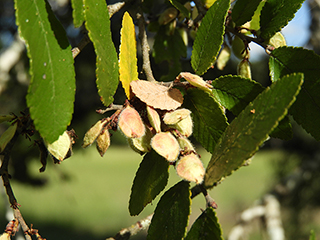
Richardson, Charmaine
Ulmus crassifolia
Ulmus crassifolia Nutt.
Cedar Elm, Fall Elm, Basket Elm, Scrub Elm, Lime Elm, Texas Elm, Southern Rock Elm, Olmo
Ulmaceae (Elm Family)
Synonym(s):
USDA Symbol: ULCR
USDA Native Status: L48 (N)
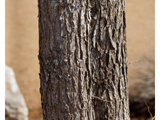
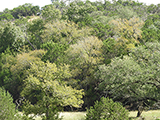
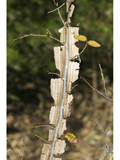
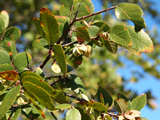
Cedar elm is a large, oval-rounded tree growing 50-70 ft. high and 40-60 ft. wide. Bark is scaly and the drooping branches have corky ridges. Dark-green leaves are small and rough-textured. Leaves much smaller than those of the American Elm, Fall foliage is yellow except in the southern part of the range where it is evergreen. Tree with rounded crown of drooping branches and the smallest leaves of any native elm.
The common native elm in east Texas where it is planted for shade. Called Cedar Elm because of the rough, cedar scale-like texture of the leaves and because it is often found in the western part of its range with Ashe Juniper (Juniperus ashei), which is locally called "cedar." The Latin species name means "thick leaf."
Plant Characteristics
Duration: PerennialHabit: Tree
Leaf Retention: Deciduous
Leaf Arrangement: Alternate
Leaf Complexity: Simple
Leaf Shape: Elliptic , Ovate
Leaf Venation: Pinnate
Leaf Margin: Crenate , Double-serrate
Leaf Apex: Obtuse
Leaf Base: Cuneate , Oblique , Rounded
Fruit Type: Samara
Size Notes: 30-60 feet tall.
Leaf: Green
Bloom Information
Bloom Color: GreenBloom Time: Jul , Aug , Sep , Oct
Distribution
USA: AR , FL , LA , MO , MS , OK , TN , TXNative Distribution: TN & AR, s. to MS & TX
Native Habitat: Woodlands; ravines; open slopes
Growing Conditions
Water Use: MediumLight Requirement: Part Shade
Soil Moisture: Moist
CaCO3 Tolerance: Low
Cold Tolerant: yes
Soil Description: Moist to dry, alkaline soils. Sandy, Sandy Loam, Medium Loam Clay Loam, Clay, Caliche type, Limestone-based
Conditions Comments: Cedar elm is a nicely-proportioned, hardy, drought tolerant shade tree for a broad range of soil types. It brings vivid yellow color to the landscape in autumn. No need to rake the small leaves—they compost nicely. Young trees have corky "wings" on their branches. The Mourning Cloak and Question Mark butterflies use it for larval food. Withstands drought and heavy, infertile soils. Susceptible to Dutch elm disease. Reasonably fast-growing. Known to cause severe allergy reactions.
Benefit
Use Ornamental: Shade tree, Fast growing, Long-living, Fall conspicuousUse Wildlife: Seeds-granivorous birds, Cover, Substrate-insectivorous birds, Nesting site, Browse, Seeds-Small mammals.
Interesting Foliage: yes
Attracts: Butterflies
Larval Host: Mourning Cloak, Question Mark
Deer Resistant: No
Butterflies and Moths of North America (BAMONA)
|
Question Mark (Polygonia interrogationis) 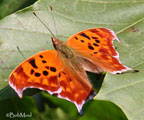 Larval Host |
Mourning Cloak (Nymphalis antiopa) 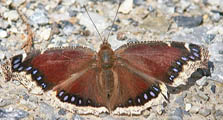 Larval Host |
Propagation
Propagation Material: SeedsDescription: Elms germinated quickly from fresh, untreated seeds. Sow spring-ripening species immediately after collection; fall-ripening after winter storage and stratification.
Seed Collection: Collect seeds by raking from the ground soon after they fall or by stripping them from the branches. Air-dry a few days before storing. Store in sealed, refrigerated containers.
Seed Treatment: Fall-ripened seeds may be stratified for 30-60 days at 36-40 degrees.
Commercially Avail: yes
Find Seed or Plants
View propagation protocol from Native Plants Network.
Mr. Smarty Plants says
Plants for wildlife and trees for shade.
September 29, 2007
We live in Kempner Texas, our land has mostly cedar trees. We would like to make a wildlife habitat on the back side of our property. Can you recommend plants that will grow in shade to partial sun,...
view the full question and answer
Native trees for cemetery plot in Karnes County, TX
April 08, 2007
I'm looking for a tree for a cemetery plot in Karnes County at Pana Maria. There will be someone to regularly water it. I understand live oak and pecan are native to the area. I assume these would...
view the full question and answer
Invasive, non-native Paulownia
May 03, 2006
Hi. We would like to plant a fast growing tree that will provide shade for our house. What do you think of the Paulownia tree (Empress Tree) as a possibility for the Austin area? If this is not a g...
view the full question and answer
Possible identification of Post Oak in New Braunfels, TX
January 27, 2006
I live 6 miles north of New Braunfels in the Hill Country and own 5 acres of land. The property consists of many escarpment live oaks, texas persimon, and ashe juniper. I believe I also have some Te...
view the full question and answer
National Wetland Indicator Status
| Region: | AGCP | AK | AW | CB | EMP | GP | HI | MW | NCNE | WMVE |
| Status: | FAC | FAC | FAC | FAC |
From the National Organizations Directory
According to the species list provided by Affiliate Organizations, this plant is on display at the following locations:Lady Bird Johnson Wildflower Center - Austin, TX
Pineywoods Native Plant Center - Nacogdoches, TX
Texas Discovery Gardens - Dallas, TX
Brackenridge Field Laboratory - Austin, TX
Patsy Glenn Refuge, c/o Wimberley Birding Society - Wimberley, TX
NPSOT - Native Plant Society of Texas - Fredericksburg, TX
Nueces River Authority - Uvalde, TX
Stengl Biological Research Station - Smithville, TX
Texas Parks and Wildlife Department - Austin, TX
NPSOT - Fredericksburg Chapter - Fredericksburg, TX
Texas Master Naturalists - Lost Pines Chapter - Bastrop, TX
NPSOT - Austin Chapter - Austin, TX
Jacob's Well Natural Area - Wimberley, TX
NPSOT - Williamson County Chapter - Georgetown, TX
Wildflower Center Seed Bank
LBJWC-42 Collected 2006-10-19 in Travis County by Lady Bird Johnson Wildflower CenterBibliography
Bibref 766 - Dale Groom's Texas Gardening Guide (2002) Groom, D.Bibref 298 - Field Guide to Texas Trees (1999) Simpson, B.J.
Bibref 355 - Landscaping with Native Plants of Texas and the Southwest (1991) Miller, G. O.
Bibref 354 - Native & Naturalized Woody Plants of Austin & the Hill Country (1981) Lynch, D.
Bibref 841 - Native Alternatives to Invasive Plants (2006) Burrell, C. C.
Bibref 318 - Native Texas Plants: Landscaping Region by Region (2002) Wasowski, S. & A. Wasowski
Bibref 291 - Texas Wildscapes: Gardening for Wildlife (1999) Damude, N. & K.C. Bender
Bibref 297 - Trees of Central Texas (1984) Vines, Robert A.
Search More Titles in Bibliography
From the Archive
Wildflower Newsletter 1993 VOL. 10, NO.6 - Saving Trees and Plants at New Center Site a Big Job, Director's Report, Wildflo...Additional resources
USDA: Find Ulmus crassifolia in USDA PlantsFNA: Find Ulmus crassifolia in the Flora of North America (if available)
Google: Search Google for Ulmus crassifolia
Metadata
Record Modified: 2022-06-17Research By: LAL, GAP