Native Plants

Plant Database
Search for native plants by scientific name, common name or family. If you are not sure what you are looking for, try the Combination Search or our Recommended Species lists.
Kircus, Marilyn
Taxodium distichum
Taxodium distichum (L.) Rich.
Bald Cypress, Baldcypress, Common Bald Cypress, Southern Bald Cypress, Deciduous Cypress, Southern Cypress, Swamp Cypress, Red Cypress, White Cypress, Yellow Cypress, Gulf Cypress, Tidewater Red Cypress
Cupressaceae (Cypress Family)
Synonym(s): Taxodium distichum var. nutans
USDA Symbol: TADI2
USDA Native Status: L48 (N)
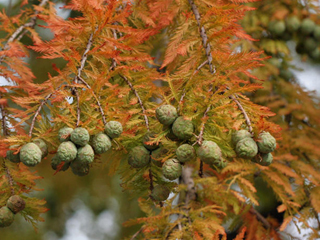
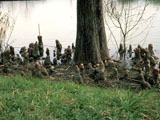
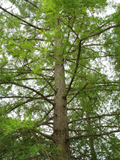
This lofty, deciduous conifer grows 50-75 ft. or taller. It is slender and conical in youth, becoming flat-topped in very old age. Sage-green leaves, which appear to be bipinnately compound (but are not) and resemble feathers, turn copper-colored before falling. A tapering trunk is slightly buttressed at the swollen base. "Knees" develop mostly in poorly drained situations. Exfoliating bark is red-brown to silver. Large, needle-leaf, aquatic, deciduous tree often with cone-shaped "knees" projecting from submerged roots, with trunks enlarged at base and spreading into ridges or buttresses, and with a crown of widely spreading branches, flattened at top.
Called the "wood eternal" because its heartwood is resistant to decay, Bald Cypress is used for heavy construction, including docks, warehouses, boats, bridges, as well as general millwork and interior trim. The trees are planted as ornamentals northward in colder climates and in drier soils. Easily seen in Big Cypress National Preserve near Naples, Florida, as well as in appropriate conditions throughout the rest of its natural range, which comprises much of southeastern North America from Delaware south to Florida, west along the coast to eastern Oklahoma and Central Texas, with populations also following the Mississippi River drainage as far north as Illinois and Indiana, and continuing further south through Mexico to Guatemala. Pond Cypress (T. ascendens Brongn.), a species with shorter, scale-like leaves, is found in shallow ponds and poorly drained areas from southeastern Virginia to southeastern Louisiana below 100 feet (30 m) elevation.

Plant Characteristics
Duration: PerennialHabit: Tree
Leaf Retention: Deciduous
Leaf Complexity: Simple
Fruit Type: Cone
Size Notes: 50-75 feet tall.
Leaf: Green
Autumn Foliage: yes
Fruit: Brown
Bloom Information
Bloom Color: PurpleBloom Time: Apr
Distribution
USA: AL , AR , FL , GA , IL , IN , KY , LA , MD , MO , MS , NC , NJ , NY , OH , OK , PA , SC , TN , TX , VANative Distribution: Eastern North America from DE (or possibly s. NY) to FL, w. along the coast and following inland waterways to s. IL, s.e. OK, & ctl. TX, s. through Mexico to Guatemala.
Native Habitat: Swamps; stream banks, Along streams and riparian areas in moist soils. Sand, loam, clay, limestone; poor drainage is fine.
Growing Conditions
Water Use: MediumLight Requirement: Sun , Part Shade
Soil Moisture: Moist
Soil pH: Acidic (pH<6.8)
CaCO3 Tolerance: None
Cold Tolerant: yes
Soil Description: Wet, acidic mucks, sands & loams. Sandy, Sandy Loam, Medium Loam, Clay Loam, Clay.
Conditions Comments: Bald cypress is a majestic tree with soft, ferny foliage that enhances many landscapes. Enjoy the terra cotta hue of the foliage around Thanksgiving. Adapted to riverine habitats, the roots are not susceptible to suffocation making bald cypress a common candidate for parking lots. Deciduous conifer adaptable to wet or semi dry conditions. Does well in full sun. Bald refers to the deciduous nature uncommon among other conifers.
Benefit
Use Ornamental: Fall conspicuous, Long-living, AttractiveUse Wildlife: Cover, Nesting site, Substrate-insectivorous birds, Seeds-granivorous birds, Seeds-Small mammals
Interesting Foliage: yes
Attracts: Birds
Deer Resistant: Moderate
Butterflies and Moths of North America (BAMONA)
|
Baldcypress sphinx (Isoparce cupressi) 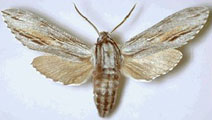 Larval Host |
Propagation
Propagation Material: SeedsDescription: Cones and seeds prone to staining.
Commercially Avail: yes
Find Seed or Plants
View propagation protocol from Native Plants Network.
Mr. Smarty Plants says
Plant database correct!
June 27, 2008
Wrong taxonomy for bald cypress tree family in your plant database?
view the full question and answer
Trees that are non-toxic for horses
May 02, 2008
I live in Ponder, Tx. We have some acreage and horses and wish to plant trees to afford some shade for the horses. Can you tell me what trees are toxic to horses.
view the full question and answer
Native plants for seasonal poor drainage
May 16, 2006
I have an area in my front yard that has a drainage ditch running through it. When it rains, that area stays very wet. What kind of plants available for sale will work in this situation?
view the full question and answer
National Wetland Indicator Status
| Region: | AGCP | AK | AW | CB | EMP | GP | HI | MW | NCNE | WMVE |
| Status: | OBL | OBL | OBL | OBL | OBL | OBL | OBL |
From the National Organizations Directory
According to the species list provided by Affiliate Organizations, this plant is on display at the following locations:Lady Bird Johnson Wildflower Center - Austin, TX
Pineywoods Native Plant Center - Nacogdoches, TX
Texas Discovery Gardens - Dallas, TX
Delaware Nature Society - Hockessin, DE
Brackenridge Field Laboratory - Austin, TX
NPSOT - Native Plant Society of Texas - Fredericksburg, TX
Crosby Arboretum - Picayune, MS
Nueces River Authority - Uvalde, TX
Texas Parks and Wildlife Department - Austin, TX
NPSOT - Fredericksburg Chapter - Fredericksburg, TX
Georgia Native Plant Society - Atlanta, GA
NPSOT - Austin Chapter - Austin, TX
Jacob's Well Natural Area - Wimberley, TX
NPSOT - Williamson County Chapter - Georgetown, TX
Mt. Cuba Center - Hockessin, DE
Wellspring Organic Farm and Education Center - West Bend, WI
Wildflower Center Seed Bank
LBJWC-636 Collected 2007-12-12 in Blanco County by Lady Bird Johnson Wildflower CenterBibliography
Bibref 1186 - Field Guide to Moths of Eastern North America (2005) Covell, C.V., Jr.Bibref 298 - Field Guide to Texas Trees (1999) Simpson, B.J.
Bibref 1185 - Field Guide to Western Butterflies (Peterson Field Guides) (1999) Opler, P.A. and A.B. Wright
Bibref 1620 - Gardening with Native Plants of the South (Reprint Edition) (2009) Wasowski, S. with A. Wasowski
Bibref 355 - Landscaping with Native Plants of Texas and the Southwest (1991) Miller, G. O.
Bibref 354 - Native & Naturalized Woody Plants of Austin & the Hill Country (1981) Lynch, D.
Bibref 841 - Native Alternatives to Invasive Plants (2006) Burrell, C. C.
Bibref 318 - Native Texas Plants: Landscaping Region by Region (2002) Wasowski, S. & A. Wasowski
Bibref 291 - Texas Wildscapes: Gardening for Wildlife (1999) Damude, N. & K.C. Bender
Bibref 297 - Trees of Central Texas (1984) Vines, Robert A.
Search More Titles in Bibliography
Web Reference
Webref 38 - Flora of North America (2019) Missouri Botanical Garden, St. Louis, MO & Harvard University Herbaria, Cambridge, MA.From the Archive
Wildflower Newsletter 1995 VOL. 12, NO.4 - The Natural Landscape Movement Comes of Age, Information and Clearinghouse, Exec...Additional resources
USDA: Find Taxodium distichum in USDA PlantsFNA: Find Taxodium distichum in the Flora of North America (if available)
Google: Search Google for Taxodium distichum
Metadata
Record Modified: 2023-03-23Research By: LAL