Native Plants

Plant Database
Search for native plants by scientific name, common name or family. If you are not sure what you are looking for, try the Combination Search or our Recommended Species lists.
Brundage, Stephanie
Malvaviscus arboreus var. drummondii
Malvaviscus arboreus Dill. ex Cav. var. drummondii (Torr. & A. Gray) Schery
Turk's Cap, Drummond's Turk's Cap, Drummond Turk's Cap, Wax Mallow, Drummond's Wax Mallow, Drummond Wax Mallow, Red Mallow, Texas Mallow, Mexican Apple, Sleeping Hibiscus, Bleeding Hearts, Manzanita
Malvaceae (Mallow Family)
Synonym(s): Malvaviscus drummondii
USDA Symbol: MAARD
USDA Native Status: L48 (N)
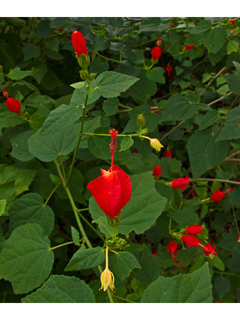
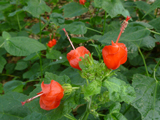
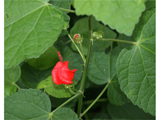
This spreading shrub, often as broad as high, grows 2-3 ft., sometimes reaching 10 ft. Bright-red, pendant, hibiscus-like flowers never fully open, their petals overlapping to form a loose tube with the staminal column protruding, said to resemble a Turkish turban, hence its most common name, Turk's Cap. Especially useful in shady situations.
The variety name of this plant is named for Thomas Drummond, (ca. 1790-1835), naturalist, born in Scotland, around 1790. In 1830 he made a trip to America to collect specimens from the western and southern United States. In March, 1833, he arrived at Velasco, Texas to begin his collecting work in that area. He spent twenty-one months working the area between Galveston Island and the Edwards Plateau, especially along the Brazos, Colorado, and Guadalupe rivers. His collections were the first made in Texas that were extensively distributed among the museums and scientific institutions of the world. He collected 750 species of plants and 150 specimens of birds. Drummond had hoped to make a complete botanical survey of Texas, but he died in Havana, Cuba, in 1835, while making a collecting tour of that island.

Plant Characteristics
Duration: PerennialHabit: Shrub
Leaf Retention: Deciduous
Leaf Arrangement: Alternate
Leaf Complexity: Simple
Leaf Venation: Palmate
Breeding System: Flowers Bisexual
Fruit Type: Berry , Schizocarp
Size Notes: Up to about 10 feet tall, often shorter.
Leaf: Light to medium green. Some cultivars have variegated leaves of white and green.
Flower: Flowers 2 to 3 inches.
Fruit: Schizocarpic berries, dark red, 1 inch.
Bloom Information
Bloom Color: White , RedBloom Time: May , Jun , Jul , Aug , Sep , Oct , Nov
Bloom Notes: Red flowers usually are produced in showy profusion during hot weather at the end of summer and early fall. White-flowered cultivars have been produced.
Distribution
USA: AL , AR , FL , GA , LA , MS , SC , TXNative Distribution: Central Texas east to Florida and Cuba, north to Arkansas and South Carolina, south through Mexico to the Yucatan and Chiapas. Other varieties of the species continue south through Central America to South America.
Native Habitat: Found along streams, on the edges of woods, and on wooded limestone slopes and ledges.
Growing Conditions
Water Use: MediumLight Requirement: Part Shade , Shade
Soil Moisture: Dry , Moist
Soil pH: Circumneutral (pH 6.8-7.2)
Cold Tolerant: yes
Soil Description: Sandy, loamy, clay, and limestone soils. Moist, well-drained, woodland soils best.
Conditions Comments: Drought tolerant. Prefers partially shady sites. Under cultivation, Turk’s Cap will adapt to and thrive in many different sites, including full sun and heavy soil, though unremitting sun will cause its leaves to become rougher, smaller, darker, and puckered.
Benefit
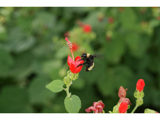
Use Ornamental: Turk’s Cap is a good ornamental for shady sites. Cultivars have been selected for white blooms and variegated foliage.Use Wildlife: Nectar-hummingbirds, Nectar-butterflies, Nectar-moths, Nectar-insects, Fruit-birds, Fruit-mammals
Use Food: The fruit is edible either raw or cooked, tasting rather like apple, hence its Spanish name, Manzanilla (Little Apple).
Conspicuous Flowers: yes
Interesting Foliage: yes
Attracts: Birds , Butterflies , Hummingbirds
Nectar Source: yes
Deer Resistant: Moderate
Propagation
Propagation Material: Root Division , Seeds , Softwood CuttingsDescription: Turk's Cap will germinate promptly from fresh, untreated seeds planted outside after danger of frost is past. Germination of Turk's Cap is inhibited by cold temperatures. Cover the seeds no deeper than 1/4 - 1/2 inches. Turk's Cap is also propagated easily from softwood cuttings. These cuttings should be 4 to 6 inches long with leaves from the bottom halves removed and treated with rooting hormone. Large clumps of Turk's Cap may easily be separated in early spring and transplanted to a new site. Be sure to water well.
Seed Collection: Collect the seeds as soon as the fruit turns ripe. Spread the fruit on screens to dry and separate. After a few days, the pulp will shrivel and may easily be rubbed off the seeds.
Seed Treatment: After thoroughly drying, dust the seeds with an insecticide and store in ventilated containers at room temperature. Seeds stored for long periods of time should be refrigerated in sealed containers.
Commercially Avail: yes
Maintenance: To keep at a desirable height and shape, prune back after a couple years. To keep it waist-high in the Southeast, cut it back to 5 inches after the last frost. Can be kept cut back to give the appearance of a ground cover, though it doesn't spread by either rhizomes or stolons but by layering. Will bloom even when cut short.
Find Seed or Plants
Order seed of this species from Native American Seed and help support the Wildflower Center.
Mr. Smarty Plants says
Need plants with red flowers to grow in shaded area in yard in Austin.
May 04, 2010
I have a shaded area where all the shrubs die. I would like to plant some flowers there instead of shrubs. What red flower plants can sustain a lot of shade.
view the full question and answer
Austin Shade Plants for Pots
March 28, 2010
I live in a condo in Austin Texas so I don't have any flower beds or yard space. I would like to put a few large pots of plants and flowers on my front patio but it's mostly shaded during the day. W...
view the full question and answer
Edible Native Plants for a Small Austin Garden
March 15, 2010
Hello Mr. Smarty Plants (or Mrs. or Miss, whomever is answering this go'round)!
First off, thank you so much for all the help you have given me in the past. Secondly, the company my husband works ...
view the full question and answer
Native plant to replace invasive non-native nandina in Houston
February 28, 2010
I'm just now finding out that Nandinas are an invasive species from our local chapter of the Native Plant Society of Texas. I have three of them in my front yard and want to replace them. Can you sug...
view the full question and answer
Edible plants native to Austin, TX
August 05, 2009
Hello,
I am a chef from Buenos Aires Argentina visiting Austin, Texas and would like to learn about native, edible plants in the region.
Please let me know if there are any native, edible plants...
view the full question and answer
From the National Organizations Directory
According to the species list provided by Affiliate Organizations, this plant is on display at the following locations:Lady Bird Johnson Wildflower Center - Austin, TX
NPSOT - Native Plant Society of Texas - Fredericksburg, TX
Stengl Biological Research Station - Smithville, TX
Texas Parks and Wildlife Department - Austin, TX
NPSOT - Fredericksburg Chapter - Fredericksburg, TX
Texas Master Naturalists - Lost Pines Chapter - Bastrop, TX
NPSOT - Austin Chapter - Austin, TX
National Butterfly Center - Mission, TX
NPSOT - Williamson County Chapter - Georgetown, TX
Wildflower Center Seed Bank
LBJWC-217 Collected 2008-10-06 in Travis County by Lady Bird Johnson Wildflower CenterLBJWC-600 Collected 2007-10-01 in Travis County by Lady Bird Johnson Wildflower Center
Bibliography
Bibref 1620 - Gardening with Native Plants of the South (Reprint Edition) (2009) Wasowski, S. with A. WasowskiBibref 355 - Landscaping with Native Plants of Texas and the Southwest (1991) Miller, G. O.
Bibref 318 - Native Texas Plants: Landscaping Region by Region (2002) Wasowski, S. & A. Wasowski
Bibref 281 - Shinners & Mahler's Illustrated Flora of North Central Texas (1999) Diggs, G. M.; B. L. Lipscomb; B. O'Kennon; W. F...
Bibref 248 - Texas Wildflowers: A Field Guide (1984) Loughmiller, C. & L. Loughmiller
Bibref 291 - Texas Wildscapes: Gardening for Wildlife (1999) Damude, N. & K.C. Bender
Bibref 286 - Wildflowers of the Texas Hill Country (1989) Enquist, M.
Search More Titles in Bibliography
Web Reference
Webref 38 - Flora of North America (2019) Missouri Botanical Garden, St. Louis, MO & Harvard University Herbaria, Cambridge, MA.Webref 23 - Southwest Environmental Information Network (2009) SEINet - Arizona Chapter
From the Archive
Wildflower Newsletter 1986 VOL. 3, NO.4 - Fall Highlights Busy Season at the Center, Wildflower Days Welcome the Holidays,...Additional resources
USDA: Find Malvaviscus arboreus var. drummondii in USDA PlantsFNA: Find Malvaviscus arboreus var. drummondii in the Flora of North America (if available)
Google: Search Google for Malvaviscus arboreus var. drummondii
Metadata
Record Modified: 2023-02-17Research By: RSB, TWC Staff