Native Plants

Plant Database
Search for native plants by scientific name, common name or family. If you are not sure what you are looking for, try the Combination Search or our Recommended Species lists.
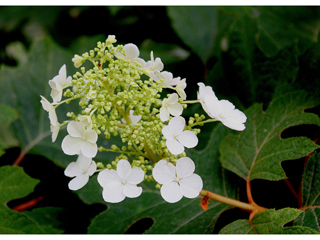
Smith, R.W.
Hydrangea quercifolia
Hydrangea quercifolia W. Bartram
Oakleaf Hydrangea, Oak-leaf Hydrangea
Hydrangeaceae (Hydrangea Family)
Synonym(s):
USDA Symbol: HYQU3
USDA Native Status: L48 (N)
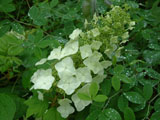
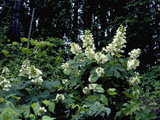
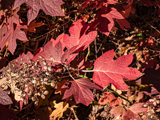
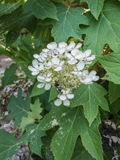
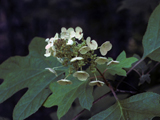
A mound-shaped shrub, 3-12 ft. tall. Multiple stems are sparingly branched with picturesque canes. Older stems are exfoliating to reveal a rich, brown inner bark. The showy inflorescence of greenish flowers, turns white then purplish and persists on the bush until mid-winter. The foliage, shaped something like that of red oak, becomes colorful in fall.
Plant Characteristics
Duration: PerennialHabit: Shrub
Leaf Retention: Deciduous
Fruit Type: Capsule
Size Notes: Up to about 12 feet tall.
Leaf: Green
Bloom Information
Bloom Color: White , Red , Green , PurpleBloom Time: Apr , May , Jun , Jul
Distribution
USA: AL , DC , FL , GA , LA , MS , NC , SC , TNNative Distribution: FL Panhandle & GA to LA
Native Habitat: Damp woods; river banks
Growing Conditions
Water Use: MediumLight Requirement: Shade
Soil Moisture: Moist
Soil pH: Circumneutral (pH 6.8-7.2)
CaCO3 Tolerance: Medium
Soil Description: Moist, fertile, well-drained soils.
Conditions Comments: Susceptible to sunscald, chlorosis in alkaline soils, and winter dieback. Many weak, brittle canes are easily broken in wind and ice. Forms colonies from a shallow root system. Canes can be cut to the ground every two or three years to keep the shrub smaller, but if the canes are allowed to grow, the naturally peeling bark is attractive. Pest free. Prune immediately after flowering.
Benefit
Use Wildlife: Low.Conspicuous Flowers: yes
Propagation
Description: Propagate by seed or cuttings. Softwood cuttings should be taken early. Asexual propagation is the usual means of propagation because of a wide variability in seedlings.Seed Treatment: Seeds require no sepcial treatment but need careful handling because they are so small.
Commercially Avail: yes
Find Seed or Plants
View propagation protocol from Native Plants Network.
Mr. Smarty Plants says
Native plant to replace invasive non-native nandina in Houston
February 28, 2010
I'm just now finding out that Nandinas are an invasive species from our local chapter of the Native Plant Society of Texas. I have three of them in my front yard and want to replace them. Can you sug...
view the full question and answer
From the National Organizations Directory
According to the species list provided by Affiliate Organizations, this plant is on display at the following locations:Texas Discovery Gardens - Dallas, TX
Delaware Nature Society - Hockessin, DE
Crosby Arboretum - Picayune, MS
Georgia Native Plant Society - Atlanta, GA
Mt. Cuba Center - Hockessin, DE
Bibliography
Bibref 1620 - Gardening with Native Plants of the South (Reprint Edition) (2009) Wasowski, S. with A. WasowskiBibref 841 - Native Alternatives to Invasive Plants (2006) Burrell, C. C.
Search More Titles in Bibliography
Web Reference
Webref 38 - Flora of North America (2019) Missouri Botanical Garden, St. Louis, MO & Harvard University Herbaria, Cambridge, MA.Research Literature
Reslit 233 - Genome size variation and species relationships in the genus Hydrangea (2001) M. Cerbah, E. Mortreau, S. Brown, S. Siljak-Yakovl...Reslit 657 - A phylogenetic analysis of Hydrangeaceae based on morphological data (1997) L. Hufford
Reslit 808 - Thidiazuron stimulates adventitious shoot production from Hydrangea quercifolia Bartr. leaf explants (2004) D. I. Ledbetter and J. E. Preece
Reslit 1140 - Self-incompatibility and time of stigma receptivity in two species of Hydrangea (2004) S. M. Reed
Reslit 1429 - Karyotype analysis and physical mapping of 45S rRNA genes in Hydrangea species by fluorescence in situ hybridization (2008) K. Van Laere, J. Van Huylenbroeck and E. Van Bocks...
Reslit 1652 - In vitro propagation of Hydrangea quercifolia Bartr. (1987) T. K. Sebastian and C. W. Heuser
Reslit 2507 - Landscape irrigation scheduling for Hydrangea quercifolia 'Alice' and Rhododendron austrinum (2009) A. L. Bailey and A. N. Wright
This information was provided by the Florida WIldflower Foundation.
Search More Titles in Research Literature
From the Archive
Wildflower Newsletter 1998 VOL. 15, NO.5 - Native Shrubs Providing Landscape Heritage and Habitat, Executive Director\'s Re...Additional resources
USDA: Find Hydrangea quercifolia in USDA PlantsFNA: Find Hydrangea quercifolia in the Flora of North America (if available)
Google: Search Google for Hydrangea quercifolia
Metadata
Record Modified: 2022-10-18Research By: TWC Staff