Native Plants

Plant Database
Search for native plants by scientific name, common name or family. If you are not sure what you are looking for, try the Combination Search or our Recommended Species lists.
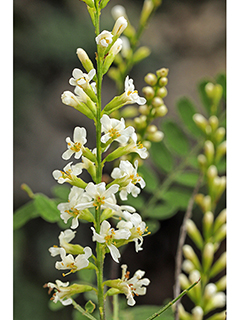
Cressler, Alan
Eysenhardtia texana
Eysenhardtia texana Scheele
Texas Kidneywood, Kidneywood, Bee Brush, Vara Dulce, Palo Dulce
Fabaceae (Pea Family)
Synonym(s): Eysenhardtia angustifolia
USDA Symbol: EYTE
USDA Native Status: L48 (N)
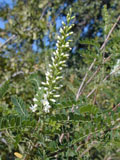
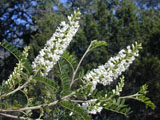
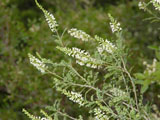
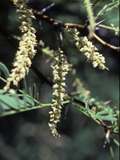
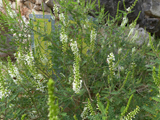
Texas kidneywood is an unarmed, much-branched shrub, 3-10 ft. tall, with an open, airy structure and gland-dotted, aromatic, resinous leaves and flowers. Its spikes of white flowers are fragrant, as are the deciduous, finely divided leaves. Leaves up to 3-1/2 inches long, consisting of a central axis and as many as 40 small leaflets, each from about 1/4 - 1/2 inch long, pungent when crushed. Flowers white, small, with a delicate fragrance, arranged in spikes up to 4-1/2 inches long at the ends of branchlets, appearing intermittently from May to October, especially after rains. Fruit a pod about 3/8 inch long, often with a threadlike tip. Seed pods are somewhat persistent.
Leaves and leaflets vary considerably in size, from plant to plant and sometimes on the same plant. Leaflets may vary from under 1/4 inch long on branches in full sun, to more than 1/2 inch long in shaded situations. (PERS.OBS)
This tree and its relative, the more westerly E. orthocarpa, were once used in remedies for kidney and bladder ailments, hence the name.
Plant Characteristics
Duration: PerennialHabit: Shrub
Leaf Retention: Deciduous
Leaf Arrangement: Alternate
Fruit Type: Legume
Size Notes: Up to about 10 feet tall.
Bloom Information
Bloom Color: WhiteBloom Time: Apr , May , Jun , Jul , Aug , Sep , Oct
Distribution
USA: TXNative Distribution: Central and south TX, n. to Bell, San Saba, Crockett & Brewster Cos. & s. to central Mex.
Native Habitat: Frequent in brushy vegetation in Rio Grande Plains, Central and West Texas. Well-drained sand, loam, clay, caliche, limestone. Dry, brushy hills & canyons
Growing Conditions
Water Use: LowLight Requirement: Sun
Soil Moisture: Dry
Cold Tolerant: yes
Heat Tolerant: yes
Soil Description: Dry, rocky, calcareous soils. Sandy, Sandy Loam, Medium Loam, Clay Loam, Clay, Limestone-based, Caliche type
Conditions Comments: Kidneywood foliage has a pungent, citrusy smell. Bees flock to the ambrosial flowers, which bloom at intervals through the warm months. The Dogface butterfly also eats kidneywood as larval food. Can create a small tree with proper pruning. May temporarily lose leaves during a dry spell. Drought-tolerant.
Benefit
Use Ornamental: Aromatic, Accent tree or shrub, Blooms ornamental, Fast growing, ShowyUse Wildlife: Flowers attract bees and butterflies
Use Food: It is very palatable and is readily grazed by white-tailed deer and goats.
Use Other: The wood has been used for dyes and is fluorescent in water.
Conspicuous Flowers: yes
Fragrant Flowers: yes
Fragrant Foliage: yes
Attracts: Butterflies
Larval Host: Dogface butterfly
Nectar Source: yes
Propagation
Propagation Material: SeedsDescription: Fresh seed; softwood or semi-hardwood cuttings in early fall
Seed Treatment: Seed in dry years may not be viable, so collect seed in wet years.
Commercially Avail: yes
Mr. Smarty Plants says
Native plants for butterfly garden in Waco, TX
February 03, 2008
Few weeks ago I sent you a letter but never got an answer back.
I would like to have your suggestions of native plants for a butterfly garden (30'x 30') here in Waco. The plants must be (1)drought ...
view the full question and answer
From the National Organizations Directory
According to the species list provided by Affiliate Organizations, this plant is on display at the following locations:Lady Bird Johnson Wildflower Center - Austin, TX
Texas Discovery Gardens - Dallas, TX
Sibley Nature Center - Midland, TX
Brackenridge Field Laboratory - Austin, TX
Patsy Glenn Refuge, c/o Wimberley Birding Society - Wimberley, TX
NPSOT - Native Plant Society of Texas - Fredericksburg, TX
Nueces River Authority - Uvalde, TX
Texas Parks and Wildlife Department - Austin, TX
NPSOT - Fredericksburg Chapter - Fredericksburg, TX
Texas Master Naturalists - Lost Pines Chapter - Bastrop, TX
NPSOT - Austin Chapter - Austin, TX
National Butterfly Center - Mission, TX
Jacob's Well Natural Area - Wimberley, TX
NPSOT - Williamson County Chapter - Georgetown, TX
Wildflower Center Seed Bank
LBJWC-49 Collected 2006-12-06 in Travis County by Lady Bird Johnson Wildflower CenterBibliography
Bibref 355 - Landscaping with Native Plants of Texas and the Southwest (1991) Miller, G. O.Bibref 354 - Native & Naturalized Woody Plants of Austin & the Hill Country (1981) Lynch, D.
Bibref 841 - Native Alternatives to Invasive Plants (2006) Burrell, C. C.
Bibref 318 - Native Texas Plants: Landscaping Region by Region (2002) Wasowski, S. & A. Wasowski
Bibref 291 - Texas Wildscapes: Gardening for Wildlife (1999) Damude, N. & K.C. Bender
Bibref 297 - Trees of Central Texas (1984) Vines, Robert A.
Bibref 286 - Wildflowers of the Texas Hill Country (1989) Enquist, M.
Search More Titles in Bibliography
Web Reference
Webref 1 - Texas Native Shrubs (2002) Texas A&M University Agriculture Program and Leslie Finical, Dallas ArboretumAdditional resources
USDA: Find Eysenhardtia texana in USDA PlantsFNA: Find Eysenhardtia texana in the Flora of North America (if available)
Google: Search Google for Eysenhardtia texana
Metadata
Record Modified: 2022-10-18Research By: TWC Staff, TMH