Native Plants

Plant Database
Search for native plants by scientific name, common name or family. If you are not sure what you are looking for, try the Combination Search or our Recommended Species lists.
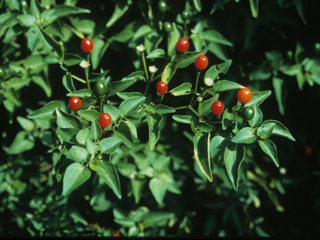
Wasowski, Sally and Andy
Capsicum annuum
Capsicum annuum L.
Chile Tepin, Chile Pequin, Chiltepin, Chile Petin, Bird Pepper, Turkey Pepper , Cayenne Pepper
Solanaceae (Potato Family)
Synonym(s):
USDA Symbol: CAAN4
USDA Native Status: L48 (NI), HI (I), PR (I), VI (I)
This species includes botanical varieties that are North American natives. However, it also includes botanical varieties that are not native to North America, e.g. Capsicum annuum var. annuum, Cayenne Pepper. Non-native taxa are not treated in this database.
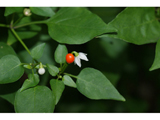
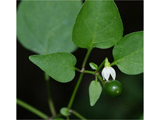
Plant Characteristics
Duration: Annual , PerennialHabit: Herb
Leaf Retention: Deciduous
Leaf Arrangement: Alternate
Breeding System: Flowers Bisexual
Fruit Type: Berry
Size Notes: Up to about 2 feet tall.
Fruit: Green, turns red when ripe.
Bloom Information
Bloom Color: WhiteBloom Time: May , Jun , Jul , Aug , Sep , Oct
Distribution
USA: AL , AZ , CT , FL , GA , HI , LA , MD , NC , NY , PA , SC , TX , UT , VANative Habitat: On ledges along rivers, in thickets and groves and along arroyos on the Edwards Plateau and in South Texas. Well drained sand, loam, clay, caliche, limestone.
Growing Conditions
Water Use: LowLight Requirement: Sun , Part Shade , Shade
Soil Moisture: Moist
Cold Tolerant: yes
Heat Tolerant: yes
Soil Description: clay, heavy clay, sandy loam
Conditions Comments: The Chile pequin is a much sought after perennial native hot pepper that is well behaved in the garden. It is an easy to grow favorite that the birds will also appreciate. Chile pequins will grow with sun or shade and respond to good care with more growth and fruits. The fruits are edilble and on the hot side as a seasoning. Beautiful when used in mass plantings.
Benefit
Use Food: Small and very hot pepper.Conspicuous Flowers: yes
Attracts: Birds
Nectar Source: yes
Deer Resistant: High
Propagation
Propagation Material: SeedsDescription: Take cuttings throughout summer or start seeds in late winter in a greenhouse setting.
Seed Treatment: Completely dry ripened fruits in a cool dry area and then break out the fresh seed and store in a dry, refrigerated setting until ready to plant
Commercially Avail: yes
Maintenance: Can be pruned to shape or to control height. Mild winter will not freeze them to the ground but it can be helpful to prune the back anyway to refresh if the plant is several years old.
Mr. Smarty Plants says
Austin Shade Plants for Pots
March 28, 2010
I live in a condo in Austin Texas so I don't have any flower beds or yard space. I would like to put a few large pots of plants and flowers on my front patio but it's mostly shaded during the day. W...
view the full question and answer
Edible Native Plants for a Small Austin Garden
March 15, 2010
Hello Mr. Smarty Plants (or Mrs. or Miss, whomever is answering this go'round)!
First off, thank you so much for all the help you have given me in the past. Secondly, the company my husband works ...
view the full question and answer
Edible plants native to Austin, TX
August 05, 2009
Hello,
I am a chef from Buenos Aires Argentina visiting Austin, Texas and would like to learn about native, edible plants in the region.
Please let me know if there are any native, edible plants...
view the full question and answer
Deer resistant, sun tolerant plants for landscaping
April 19, 2007
I live in Driftwood and am looking for flowering, deer-resistant plants for the northern side of my house; however the house turn just enough to the west that the flowerbed receives about 3 hours of a...
view the full question and answer
From the National Organizations Directory
According to the species list provided by Affiliate Organizations, this plant is on display at the following locations:Fredericksburg Nature Center - Fredericksburg, TX
Texas Discovery Gardens - Dallas, TX
Tohono Chul Park, Inc. - Tucson, AZ
Brackenridge Field Laboratory - Austin, TX
NPSOT - Native Plant Society of Texas - Fredericksburg, TX
Texas Parks and Wildlife Department - Austin, TX
NPSOT - Fredericksburg Chapter - Fredericksburg, TX
Texas Master Naturalists - Lost Pines Chapter - Bastrop, TX
NPSOT - Austin Chapter - Austin, TX
NPSOT - Williamson County Chapter - Georgetown, TX
Bibliography
Bibref 318 - Native Texas Plants: Landscaping Region by Region (2002) Wasowski, S. & A. WasowskiSearch More Titles in Bibliography
Web Reference
Webref 23 - Southwest Environmental Information Network (2009) SEINet - Arizona ChapterAdditional resources
USDA: Find Capsicum annuum in USDA PlantsFNA: Find Capsicum annuum in the Flora of North America (if available)
Google: Search Google for Capsicum annuum
Metadata
Record Modified: 2023-05-23Research By: TWC Staff