Native Plants

Plant Database
Search for native plants by scientific name, common name or family. If you are not sure what you are looking for, try the Combination Search or our Recommended Species lists.
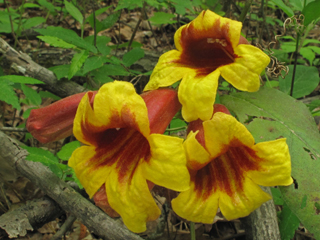
Cressler, Alan
Bignonia capreolata
Bignonia capreolata L.
Crossvine
Bignoniaceae (Trumpet-Creeper Family)
Synonym(s): Anisostichus capreolata, Anisostichus crucigera
USDA Symbol: BICA
USDA Native Status: L48 (N)
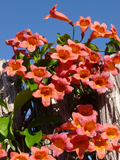
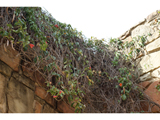
A climbing, woody vine reaching 50 ft. long with showy, orange-red, trumpet-shaped flowers 2 inches long and 1 1/2 inches across which hang in clusters of two to five. They are sometimes seen high in a tree, as the vine climbs by means of tendrils. Holdfasts (adhesive pads) at the end of its tendrils allow crossvine to cling to stone, bricks and fences without support. Leaves are opposite and bifoliolate -- actually trifoliate, but one leaflet being modified into a branched tendril. Leaflets are 4-6 inches long by 1-1/2 inches wide. Persistent, glossy, semi-evergreen leaves change from dark green in summer to reddish-purple in winter.

Plant Characteristics
Duration: PerennialHabit: Vine
Leaf Retention: Evergreen
Leaf Arrangement: Opposite
Leaf Complexity: Pinnate
Leaf Texture: Waxy
Fruit Type: Capsule
Size Notes: Can climb to 36-50 feet.
Leaf: Leaves compound, bifoliolate. Dark green, with purplish venation and stems in winter.
Flower: Flowers 2 inches long.
Fruit: Brown, flat pod-like capsules, 4 to 8 inches long.
Bloom Information
Bloom Color: Red , YellowBloom Time: Mar , Apr , May
Bloom Notes: Bloom can be brick red with yellow throats, yellow with brick red throats, some other combination of those two colors, or completely brick red.
Distribution
USA: AL , AR , FL , GA , IL , IN , KY , LA , MD , MO , MS , NC , OH , OK , SC , TN , TX , VA , WVNative Distribution: FL to e. TX, n. to MD, WV, & the Ohio R. valley, Zones 6 to 9
Native Habitat: Forested floodplains and uplands, hammocks, fencerows, limestone escarpments
Growing Conditions
Water Use: Low , MediumLight Requirement: Sun , Part Shade
Soil Moisture: Dry , Moist
Soil pH: Circumneutral (pH 6.8-7.2)
CaCO3 Tolerance: Medium
Cold Tolerant: yes
Soil Description: Moist, well-drained, acidic or calcareous soils. Sandy, Sandy Loam, Medium Loam, Clay Loam, Clay.
Conditions Comments: Some shade is tolerated, but the best flowering is achieved in full sun. Tolerates brief flooding.
Benefit
Use Ornamental: An evergreen vine with glossy leaves and showy, two-tone, trumpet flowers.Use Wildlife: Hummingbirds are attracted to flowers. An early nectar source for butterflies and hummingbirds. Deer browse it in winter.
Conspicuous Flowers: yes
Interesting Foliage: yes
Attracts: Hummingbirds
Nectar Source: yes
Deer Resistant: No
Propagation
Propagation Material: Root Cuttings , Seeds , Softwood CuttingsSeed Collection: Collect the large, woody capsules from late summer through fall when they are light brown and beginning to dry. Seeds remain viable one year in sealed, refrigerated containers.
Seed Treatment: Seed requires no pretreatment.
Commercially Avail: yes
Maintenance: Training to avoid crowding of stems will aid in the formation of flower shoots. Branches can be cut back in the spring to encourage flowering.
Find Seed or Plants
View propagation protocol from Native Plants Network.
Mr. Smarty Plants says
Perennial vine for full sun, Denton, TX
March 19, 2010
I would like to grow a perennial vine that would tolerate full sun during the day. A flowering or non-flowering is fine. I do NOT want anything that is poisonous, i.e. Carolina jasmine, since this w...
view the full question and answer
Vines for shade in North-Central Georgia
August 07, 2009
I am looking for something to hide a 6' wood fence that will grow in almost full shade. I have an area approx 2 feet wide to plant in. Since the fence and planting areas are stepped -- about 8 feet f...
view the full question and answer
Plants for green roof in Mexico
August 06, 2008
Hello! I am checking local plants to plant on a Green Roof, and am researching on which are mostly to survive better. Is it possible to plant the following on a green roof?? (Root depth needed, basica...
view the full question and answer
Toxicity and invasiveness of Scarlet Wisteria
May 04, 2007
I recently purchased seeds for Scarlet Wisteria (Chinese rattlebox tree). I spoke to a neighbor about this and she warned me not to plant them as they were poisonous to hummingbirds. Can you clarify...
view the full question and answer
Locating yellow crossvine
April 20, 2006
I am attempting to find a yellow crossvine. I am not having much luck. I thought I saw some growing in the Taylor area, but I cannot locate it now. In my memory, the flowers had brown dots on them.
view the full question and answer
National Wetland Indicator Status
| Region: | AGCP | AK | AW | CB | EMP | GP | HI | MW | NCNE | WMVE |
| Status: | FAC | FAC | FAC | FACW |
From the National Organizations Directory
According to the species list provided by Affiliate Organizations, this plant is on display at the following locations:Lady Bird Johnson Wildflower Center - Austin, TX
Texas Discovery Gardens - Dallas, TX
Texas Parks and Wildlife Department - Austin, TX
NPSOT - Fredericksburg Chapter - Fredericksburg, TX
Georgia Native Plant Society - Atlanta, GA
NPSOT - Austin Chapter - Austin, TX
NPSOT - Williamson County Chapter - Georgetown, TX
Mt. Cuba Center - Hockessin, DE
Bibliography
Bibref 1620 - Gardening with Native Plants of the South (Reprint Edition) (2009) Wasowski, S. with A. WasowskiBibref 355 - Landscaping with Native Plants of Texas and the Southwest (1991) Miller, G. O.
Bibref 841 - Native Alternatives to Invasive Plants (2006) Burrell, C. C.
Bibref 318 - Native Texas Plants: Landscaping Region by Region (2002) Wasowski, S. & A. Wasowski
Bibref 248 - Texas Wildflowers: A Field Guide (1984) Loughmiller, C. & L. Loughmiller
Bibref 291 - Texas Wildscapes: Gardening for Wildlife (1999) Damude, N. & K.C. Bender
Search More Titles in Bibliography
Research Literature
Reslit 325 - Propagation protocol for production of container Bignonia capreolata plants (Container seedling); USDA NRCS - Norman A. Berg National Plant Materials Center, Beltsville, Maryland (2001) K. M. Davis and J. L. KujawskiThis information was provided by the Florida WIldflower Foundation.
Search More Titles in Research Literature
Additional resources
USDA: Find Bignonia capreolata in USDA PlantsFNA: Find Bignonia capreolata in the Flora of North America (if available)
Google: Search Google for Bignonia capreolata
Metadata
Record Modified: 2020-04-10Research By: TWC Staff, RLU