Native Plants

Plant Database
Search for native plants by scientific name, common name or family. If you are not sure what you are looking for, try the Combination Search or our Recommended Species lists.
Brundage, Stephanie
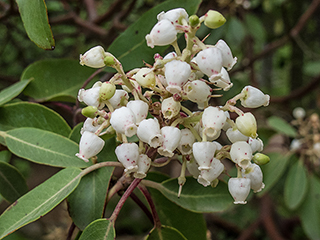
Arbutus xalapensis
Arbutus xalapensis Kunth
Texas Madrone, Madrone, Texas Arbutus, Manzanita, Xoxocote, Amazaquitl
Ericaceae (Heath Family)
Synonym(s): Arbutus texana, Arbutus xalapensis var. texana
USDA Symbol: ARXA80
USDA Native Status: L48 (N)
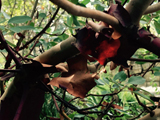
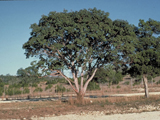
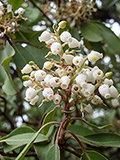
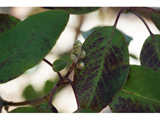
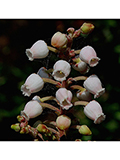
Usually multi-trunked, Texas madrone is a 20-30 ft., evergreen tree. Its colorful, exfoliating outer bark reveals polished, red, inner bark. Stout, crooked, spreading branches form a distinct crown. Dark-green, leaves are red-tinged on edges and undersides. Petioles up to 1 1/4 inches long, blades to 3 1/2 inches long, ovate to elliptic, of a leathery texture, margins usually smooth. Flowers white, small, urn shaped, in wooly clusters, appearing in early spring. Fruit red or orange berries, spherical, up to 1/3 inch in diameter, in elongate clusters, edible.
It is reported that the fruit of this uncommon species is edible and that the fruit of related European species has narcotic properties. The wood has been used locally for tool handles. The species name, xalapensis, refers to the city of Jalapa/Xalapa in the east Mexican state of Veracruz.
Plant Characteristics
Duration: PerennialHabit: Tree
Root Type: Tap
Leaf Retention: Evergreen
Leaf Arrangement: Alternate
Leaf Complexity: Simple
Leaf Shape: Elliptic , Ovate
Leaf Venation: Pinnate
Leaf Margin: Entire
Leaf Apex: Obtuse
Leaf Base: Rounded
Leaf Texture: Leathery
Inflorescence: Panicle
Fruit Type: Berry
Size Notes: Up to about 30 feet tall.
Leaf: Shiny dark green above, lower surface paler
Fruit: Orange-red. 1/4 - 1/3 in., borne in clusters 2-3 in. long.
Bloom Information
Bloom Color: WhiteBloom Time: Feb , Mar , Apr
Distribution
USA: NM , TXNative Distribution: Central Texas (Edwards Plateau) to Trans-Pecos Texas and SE. New Mexico (Guadalupe Mountains), through Mexico to Nicaragua; at 2000-6000' (610-1829 m).
Native Habitat: Grows in rocky limestone soil; igneous soil in canyons; and is sometimes found on the open plains of the Edwards Plateau and in the mountains of the Trans-Pecos.
Growing Conditions
Water Use: MediumLight Requirement: Sun , Part Shade
Soil Moisture: Dry
Cold Tolerant: yes
Soil Description: Moist, rocky soils. Limestone-based, Caliche type, Sandy, Sandy Loam, Medium Loam, Clay Loam Clay
Conditions Comments: One of the most interesting and beautiful native trees of Texas, but temperamental to propagate or grow. Propagation requirements are complex, and it is very difficult to transplant successfully from the wild. In the landscape, it grows best in well-drained areas.
Benefit
Use Ornamental: Attractive, Fruits ornamental, Blooms ornamentalUse Wildlife: Birds eat sweet berries. Nectar-insects, Fruit-birds, Fruit-mammals, Fruit-deer. Browsed by cattle and heavily by deer and goats.
Use Medicinal: The bark and leaves are astringent and are occasionally used in Mexico.
Use Other: The wood is used for tools, handles, rollers, fuel, and charcoal for gunpowder. It is reddish brown, sapwood lighter, close-grained, hard, heavy, specific gravity about 0.75.
Conspicuous Flowers: yes
Interesting Foliage: yes
Attracts: Birds
Deer Resistant: No
Mr. Smarty Plants says
Propagation of Texas madrone (Arbutus xalapensis)
October 08, 2008
I have seeds from a madrone tree and would like to know if you have had success propagating a madrone and if so, could you give me some tips, because I hear it can be tricky.
view the full question and answer
From the National Organizations Directory
According to the species list provided by Affiliate Organizations, this plant is on display at the following locations:Lady Bird Johnson Wildflower Center - Austin, TX
Tohono Chul Park, Inc. - Tucson, AZ
Patsy Glenn Refuge, c/o Wimberley Birding Society - Wimberley, TX
Texas Parks and Wildlife Department - Austin, TX
NPSOT - Austin Chapter - Austin, TX
Herbarium Specimen(s)
NPSOT 0721 Collected Mar 29, 1994 in Comal County by Mary Beth WhiteNPSOT 0722 Collected Jul 18, 1992 in Bandera County by Harry Cliffe
Bibliography
Bibref 298 - Field Guide to Texas Trees (1999) Simpson, B.J.Bibref 355 - Landscaping with Native Plants of Texas and the Southwest (1991) Miller, G. O.
Bibref 354 - Native & Naturalized Woody Plants of Austin & the Hill Country (1981) Lynch, D.
Bibref 318 - Native Texas Plants: Landscaping Region by Region (2002) Wasowski, S. & A. Wasowski
Bibref 248 - Texas Wildflowers: A Field Guide (1984) Loughmiller, C. & L. Loughmiller
Bibref 291 - Texas Wildscapes: Gardening for Wildlife (1999) Damude, N. & K.C. Bender
Bibref 297 - Trees of Central Texas (1984) Vines, Robert A.
Bibref 286 - Wildflowers of the Texas Hill Country (1989) Enquist, M.
Search More Titles in Bibliography
Additional resources
USDA: Find Arbutus xalapensis in USDA PlantsFNA: Find Arbutus xalapensis in the Flora of North America (if available)
Google: Search Google for Arbutus xalapensis
Metadata
Record Modified: 2022-07-08Research By: NPC